Long live aircraft carriers: more crisis and diplomacy, less war
This article was translated automatically and may contain differences from the original. For reference, read the original.
- por Juan Pablo Toro
- Actualidad estratégica
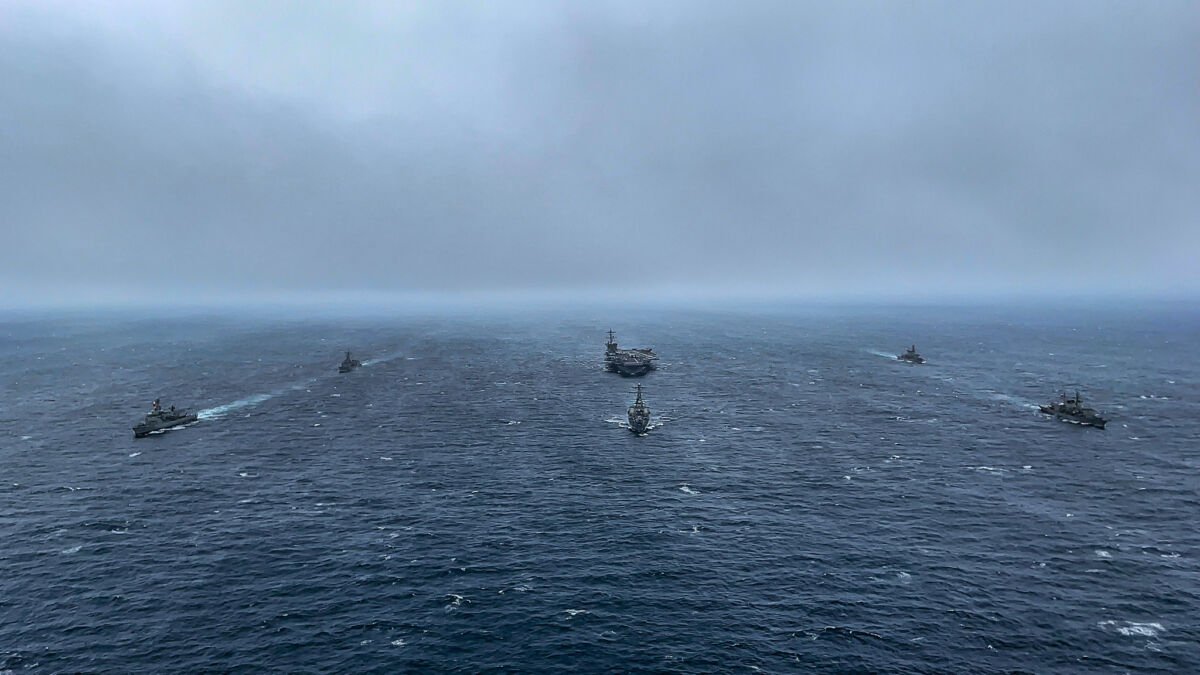
In these days when the USS George Washington is conducting exercises with the Chilean Navy on its way to Japan, it is pertinent to question the future of the great nuclear-powered aircraft carrier, considered the most powerful surface warship in naval history, as it concentrates a vast array of capabilities in a single vessel: firepower represented by strike fighters, long-range radars, and numerous sensors that coexist within a true floating city of up to 5,000 people.
When this type of ship finds optimal operating conditions, that concentration of power makes it an efficient and flexible means, both to deter adversaries and to punish enemies. This was evident in the recent conflict between Israel and Hamas in Gaza, where to prevent a greater regional spillover, two aircraft carriers with their respective battle groups were deployed in the area. This measure served to directly contain Iran and launch attacks by F-18 strike fighters against Houthi rebels, who from the coasts of Yemen harass maritime traffic in the Red Sea.
At least six key tasks can be identified for this vessel: to act as the eyes of the fleet thanks to its embarked maritime reconnaissance aircraft; to disrupt enemy lines with swift and precise strikes from the strike fighters; to serve as a capital ship in decisive battles; to be a nuclear attack vector with its aircraft; to play a key role in the geopolitical game; and, finally, to provide mobile landing strips.[1].
With over 100 years of existence, the use of aircraft carriers became common after World War II, a conflict in which they stood out in the Battle of Taranto (1940) and the attack on Pearl Harbor (1941). Although it was primarily in the Pacific theater where they were crucial in overcoming the ‘tyranny of distance,’ extending the limited flight autonomy of attack aircraft and the absence of airfields.
Following the retirement of the great battleships with the sinking of the Yamato off the coast of Okinawa, every country that wished to be considered a naval power equipped itself with these units, aware of both their enormous construction/maintenance costs and their vulnerabilities.
If in the Falklands War (1982) their use was decisive for the British, in other subsequent conflicts they have primarily served to attack ground targets with little opposition, as seen in former Yugoslavia, Afghanistan, Iraq, and Syria.
However, improvements in torpedoes and the advent of hypersonic missiles have cast doubt on their survival prospects in open sea warfare. Not surprisingly, the Chinese supersonic ballistic missiles DF-21 and DF-26, with ranges between 1,000 and 5,000 kilometers, have been dubbed ‘carrier killers,’“carrier killers”—further fueling concerns.
If such a ship were sunk, all its impressive capabilities would be lost simultaneously. Thousands of lives and equipment valued at over $13 billion (the individual cost of the ship without the embarked fighters and helicopters) would sink to the bottom of the sea. The political-military cost would be enormous for any country, and the mere idea of its eventual replacement would be immediately called into question.
In the recent book “Questioning the Carrier: Opportunities in Fleet Design for the U.S. Navy”, active-duty officer Jeff Vandenengel advocated for moving beyond the idea of a fleet designed around aircraft carriers and adopting the concept of ‘distributed lethality,’ where any surface platform, regardless of size, could carry the same offensive weapon systems, whether cruisers, destroyers, frigates, or amphibious ships.If the U.S. maritime warfare doctrine starts with ‘strike first’ (
“strike first”) and aircraft carriers would no longer be able to do so, because as enemy weapon ranges increase, their aircraft operations are limited—argues the author—it is logical for the navy to embrace the ‘Missile Era,’ where the nuclear-powered submarine will play a leading role.There is no doubt that the proposal is as bold as it is controversial for a navy that has made the aircraft carrier synonymous with its power, especially since countries like China (3), Italy (2), India (2), the United Kingdom (2), France (1), Russia (1), and Spain (1) continue to invest in these large vessels as important indicators of national strength and ambition
[2]. In the Latin American region, only Argentina and Brazil have had these units in the past, but today there are neither resources to acquire them again nor interest in them[3].Aircraft carrier sharing. Creative Commons: FOX52
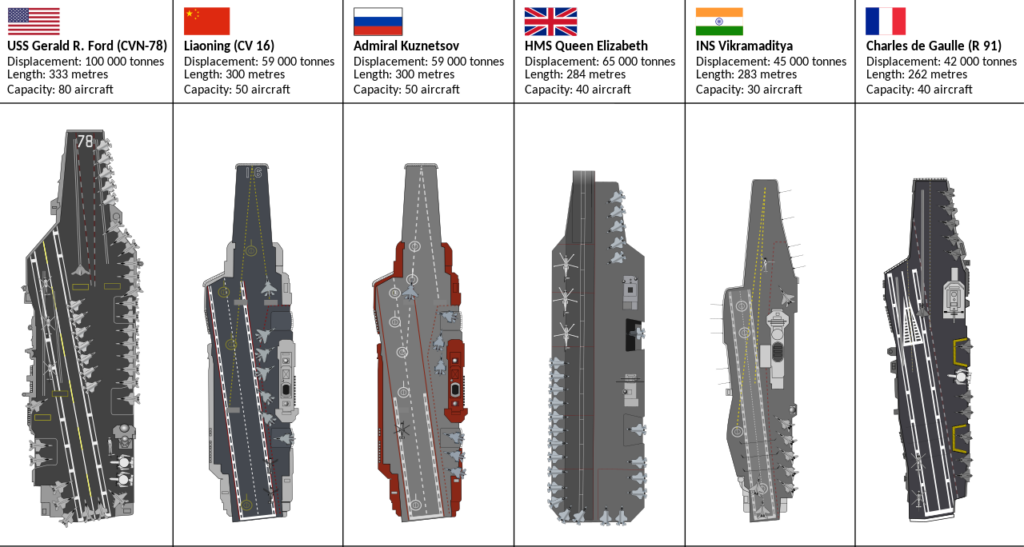
[4].Photo: Three Chilean frigates escort the USS George Washington.
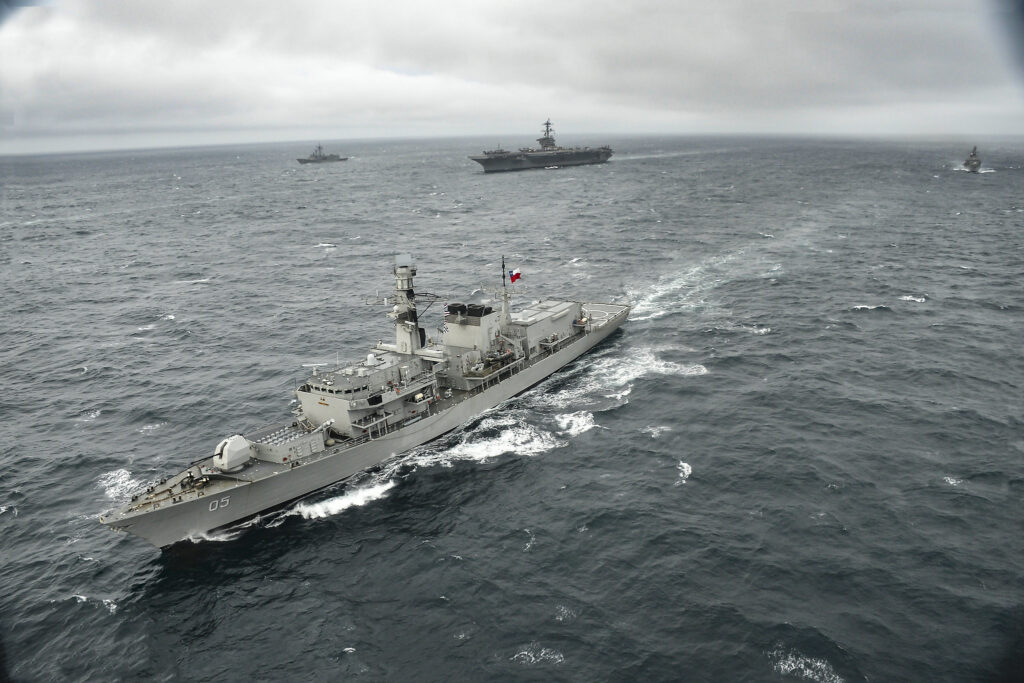
Moreover, it is worth considering that before striking these steel leviathans, it is necessary to penetrate multiple defensive layers found in space, in the air, on the surface, and, of course, beneath it, thanks to their respective battle group. Additionally, the U.S. Navy has been significantly improving its interception capabilities with the development of SM-6 missiles. Even Ukrainian forces claim that in the context of the current war, they have shot down Russian hypersonic missiles, which was previously considered impossible.
A RAND Corporation report warned that while these vessels are vulnerable, ground-based air bases are even more so: ‘Aircraft carriers can move, have defensive support from escorts; they can be quickly resupplied’
[5].Deck change of the Japanese helicopter carrier Kaga to receive F-35B. Photo: JP Toro
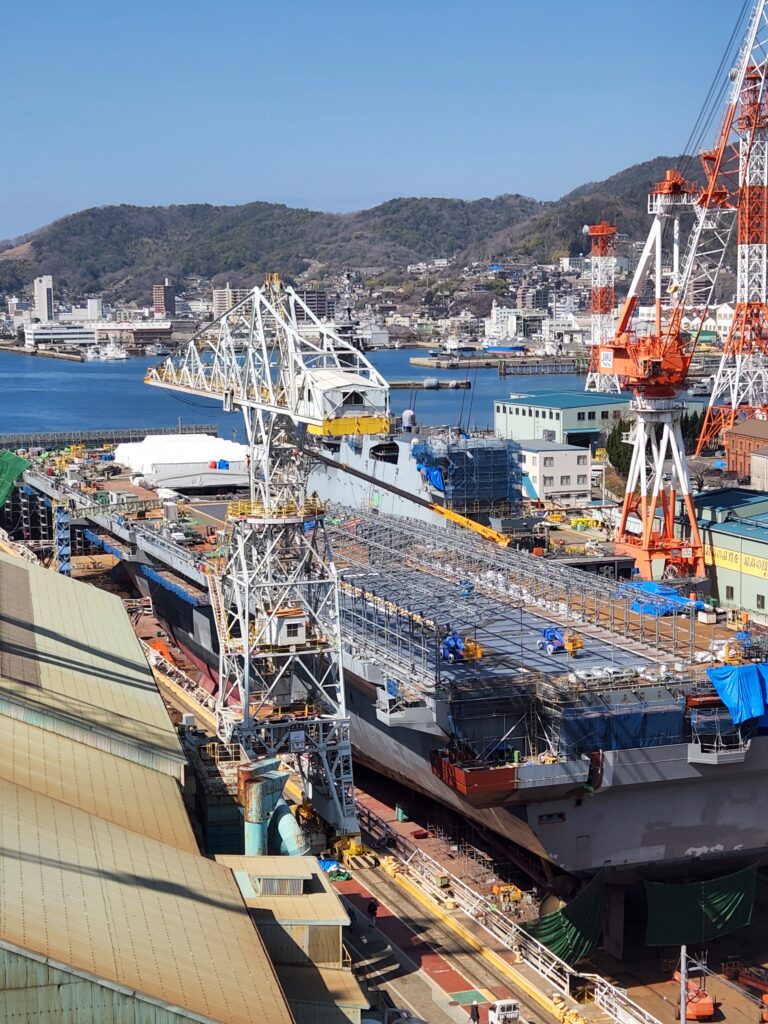
[6], thus redistributing the embarked firepower and multiplying battle groups from 11 to many more, although this would impose additional pressure to have more escort ships—perhaps presenting an opportunity for friendly navies of the United States, such as Chile’s. This is what Japan did by modifying the Izumo-class helicopter carriers at 27,000 tons and transforming them into aircraft carriers capable of operating F-35B vertical takeoff fighters. To some extent, Vandenengel also supports this idea.A step further, naval strategist James Holmes asserted that in the age of artificial intelligence and unmanned vehicles, each ship could become a kind of ‘aircraft carrier,’ with varying capabilities. However, he clarifies that drones will be more of a complement, not a replacement for embarked naval power. The important thing is always to better distribute the lethality of the fleet
[7].So far, it seems that aircraft carriers will continue to be a central component of U.S. fleets in the coming decades, as the operation of the Ford class is planned to extend beyond 2060, given their assigned lifespan of 50 years. However, the ultimate determination of their relevance or obsolescence will not be so much in the hands of admirals or political leaders, but rather in the technologies that provide the best alternatives to effectively fulfill combat tasks and missions in peacetime. As demonstrated in Ukraine, many weapons previously deemed obsolete produce a significant effect when well employed and combined with the latest advancements. Nimitz and Ford-class aircraft carriers can accommodate everything from the old and reliable F-18s to the modern F-35C and MQ-25 Stingray aerial refueling drones, the latter being key to extending the range of aircraft and allowing these vessels to operate further from enemy missiles.
Chinese aircraft carrier Fujian. Photo: AFP
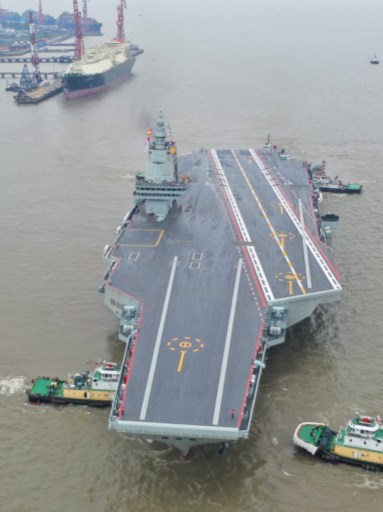
[8]. It would not be surprising if Beijing—aspiring to have six—ends up employing them similarly to the United States in an ‘expanded policing role’ in the Indo-Pacific seas, as they would not need them to eventually strike Taiwan, which is on average only 150 kilometers away.After all, perhaps the best way to close this decades-long debate and maintain interest in the imposing power of aircraft carriers is to recall a scene from the movie Top Gun: Maverick, when Captain Pete Mitchell (Tom Cruise) is reprimanded by Rear Admiral Chester Haim (Ed Harris), who announces the imminent replacement of embarked combat pilots with attack drones that ‘do not need to sleep or challenge orders’:
—Rear Admiral Haim: The end is inevitable, ‘Maverick.’ Your kind is extinct.
—“Maverick”: Maybe, sir, but not today.
June 11, 2024
[1]
Speller, I (2014). Understanding naval warfare . Routledge: New York. p. 154.[3]
Naval Portal (02/23/2024). “ A new aircraft carrier for the Brazilian Navy?”,Alexandre Galante. Available at: https://www.naval.com.br/blog/2024/02/23/um-novo-porta-avioes-para-a-marinha-do-brasil/ [4]
RAND (2017), Future Aircraft Carrier Options, by Bradley Martin ,Michael McMahon , p. xviii. Available at: https://www.rand.org/pubs/research_reports/RR2006.html[6]
South China Morning Post (06/03/2024). “China’s new aircraft carrier pushes India, Japan, South Korea to upgrade: ‘source of anxiety,” Junaid Kathju . Available at https://www.scmp.com/week-asia/politics/article/3264962/chinas-new-aircraft-carrier-pushes-india-japan-south-korea-boost-naval-capabilities-source-anxiety.