DT30 | Geopolitical Update of the Chilean Antarctic Territory
This article was translated automatically and may contain differences from the original. For reference, read the original.
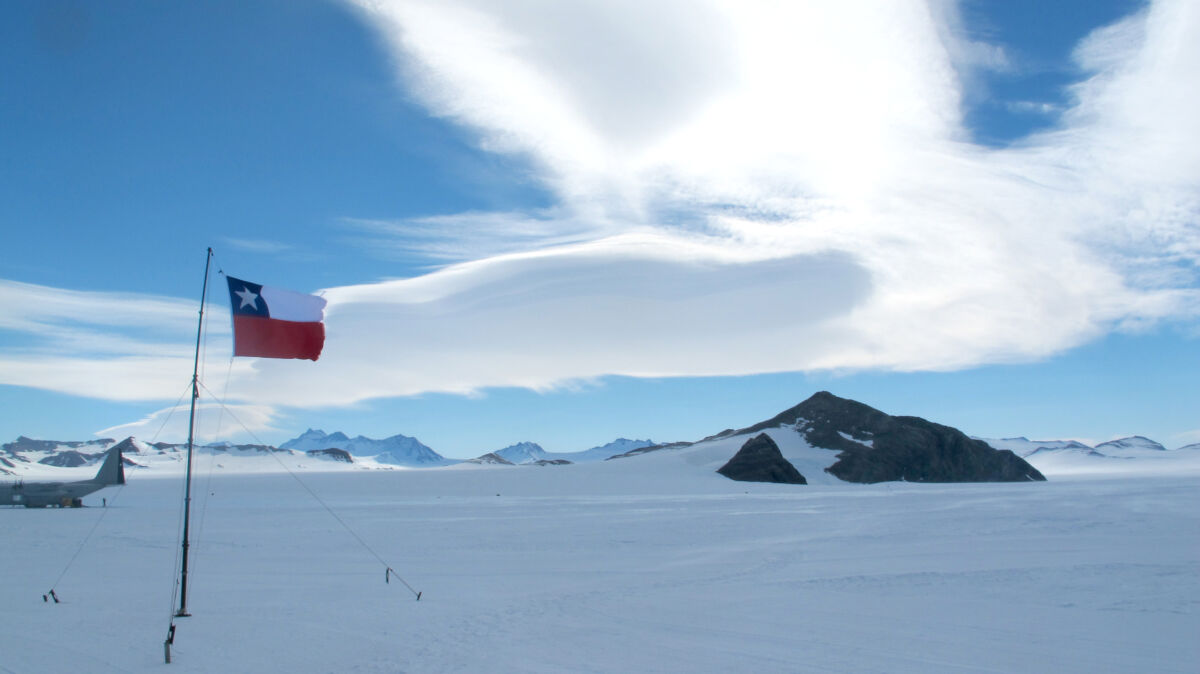
A team from AthenaLab, accompanied by diplomats and experts in Antarctic law, visited Antarctica as part of a research and fieldwork effort to address the challenges faced by a country that holds rights and an unparalleled position over a significant section of Antarctica.
The icy wind blows fiercely at the South Pole, where a chrome sphere atop a red and white pedestal reflects the flags of the 12 original signatory countries of the 1959 Antarctic Treaty. In this inhospitable place, long sought after by past explorers, all existing territorial claims over the continent converge, along with those that may arise in the future.
The competition among great powers that characterizes the current times promises to reach every corner of the planet. Various geographical spaces could, in one way or another, become the subject of conflicts—direct or indirect—or witness tensions in this reconfiguration of the international order.
The reality of a tri-continental Chile, based, in the words of General Ramón Cañas Montalva, on a privileged continental position on the western Andean slope of South America, which provides a clear and definitive projection over the Pacific Ocean; combined with the projection that its possessions in Rapa Nui and Isla Salas y Gómez grant it in Oceania, extending its interests to Asia and the Indian Ocean to the west; and an indisputable sovereignty over Antarctica, whether due to proximity, continuity, or geographical contiguity; are all arguments that compel the State of Chile to take note of past, present, and especially future events that affect its national interests wherever they may be.
In this regard, the situation of Antarctica is unique. The establishment of the Antarctic Treaty System (ATS) has provided stability, with a unique governance model that has so far been effective and functional to Chile’s interests. However, nothing guarantees that this will last forever; on the contrary, all indications suggest that geopolitical pressure and interest in the last continent to be discovered will only intensify over time.
All of this compels the State of Chile to engage directly in all matters related to Antarctica, particularly in the American quadrant. The steadfast defense of sovereign rights over the Chilean Antarctic territory, as well as the preservation of its habitat, represents a permanent and unavoidable challenge for those in power. Hence, significant and varied challenges arise, starting with the most evident, such as the need to inhabit Antarctica more decisively and profoundly, which remains a major challenge despite all the technology available for protection against low temperatures. The exaggerated characteristics of isolation, with changing and extreme weather conditions, in which vast distances must be traversed without assured communications, form the natural context of the white continent.
Despite all these inconveniences, Chile must make every effort required to positively exercise its sovereign rights within the recognized legal framework. This is not an option but a national obligation, undoubtedly becoming a long-term investment for the country.
In this way, and in the context of updating geopolitical studies of areas of national interest, a team from AthenaLab, accompanied by diplomats and experts in Antarctic law, visited Antarctica—including the South Pole—as part of a research and fieldwork effort to address the challenges faced by a country that holds rights and an unparalleled position over a significant section of Antarctica. This work includes a first part that describes aspects related to the exploration of Antarctica, its natural resources, the most relevant aspects of the Antarctic treaty system, and a review of national rights, policies, and other activities on the continent. Subsequently, an analysis of the geopolitical situation is conducted, addressing issues related to geopolitical competition, the overlap of Chilean sovereignty and claims from other states, as well as the need to prioritize Antarctic matters, including the generation of national awareness regarding them. Finally, in other sections, conclusions from the work are drawn, and propositions are formulated to improve Chile’s position in Antarctica.