YEAR-END SPECIAL | Challenging Times in 2024
This article was translated automatically and may contain differences from the original. For reference, read the original.


The year that is concluding serves to demonstrate that we are experiencing challenging times —as Mario Vargas Llosa would say— from which no one seems to be exempt. A significant challenge that AthenaLab has faced with dedication, discipline, and creativity.
The fall of the fifty-year dictatorship of the Assads in Syria has crowned a series of geopolitical changes that are redrawing the Middle East, while simultaneously, the governments of Germany, Canada, South Korea, and France are being weakened by dynamics inherent to democracies. As the war between Russia and Ukraine prepares to enter its third year, it is now the waters of East Asia that are beginning to boil. In Latin America, President Javier Milei seems to have managed to stabilize the Argentine economy in broad terms, while Nicolás Maduro celebrated elections solely to perpetuate himself in power in Venezuela.
In the case of Chile, the elections for governors and mayors altered the political landscape, reshaping the traditional correlation in the country, where the right and left now have more similar volumes and the extremes are once again relegated to the margins. Unfortunately, the public security crisis has not ceased and, as projected, is only worsening day by day. Equally serious, meager economic growth appears to have settled as part of the landscape due to the uncertainty generated by politics.
Although complex, this scenario served as inspiration, as AthenaLab had a fruitful 2024, as evidenced by its publications, conferences, youth training workshops, participation in working groups and advisory roles, research trips, and media appearances.
PUBLICATIONS

Six working papers were published in 2024; among them, the “Geopolitical Update of the Southern Ice Field” and the “Geopolitical Update of the Chilean Antarctic Territory” stand out, which are part of a series of investigations about the country. Additionally, “The Illegal Arms Economy” was addressed, and “General Considerations for Designing a Public Security Strategy Against Organized Crime” was delivered. “Russia’s Invasion of Ukraine: Two Years of War in Europe” and “Frigate Construction in Chile” were other topics that warranted thorough studies.
Special documents were also prepared on various current issues, including: “Challenges for the Defense Industry in the New International Order: Three Comparative Views”; “Taiwan: Between the ‘Silicon Shield’ and Enhanced Defense. A Case of Global Security”; “Chile Facing the Geopolitics of Critical Minerals: Lithium, Cobalt, and Rare Earths”; “Visions of the Indo-Pacific from France and Chile”; and “A Naval Force for the Country’s Challenges.”
As is traditional each year, we held the launch of a book. This time, it was “General Ramón Cañas Montalva: Pioneer of Geopolitics in Chile”, a text that compiles the vision of this forward-thinking Chilean military figure who, in the 1930s and 1940s, envisioned a tri-continental country projecting itself to the world.
We celebrated the anniversary of our “Survey of Perceptions on Foreign Policy and National Security (AthenaLab-IPSOS)”, which turned five years old, allowing us to have unique material over time regarding the threats, interests, and affinities observed by Chileans.
Of course, we collaborated with foreign publications; among them, a chapter in the book “Latin America in the New Global Geopolitics,” launched in Lima by the Center for Strategic Studies of the Peruvian Army, the William J. Perry Hemispheric Defense Studies Center, and the U.S. Army War College Institute for Strategic Studies.
All of the above was complemented by comments, analyses, interviews, and opinion columns on our own platforms and in national and international media. We thank the latter for their willingness to reach out to us.
ACADEMY

In January and July, we held two training workshops for young leaders in International Relations, Security, and Defense, thus adding 64 new students to the extensive AthenaLab network.
Additionally, AthenaLab researchers conducted conferences and taught classes for the Catholic University of Chile, the University of Chile, Adolfo Ibáñez University, the University of Development, Georgetown University, the Army War Academy, and the Naval War Academy, among others.
ACTIVITIES

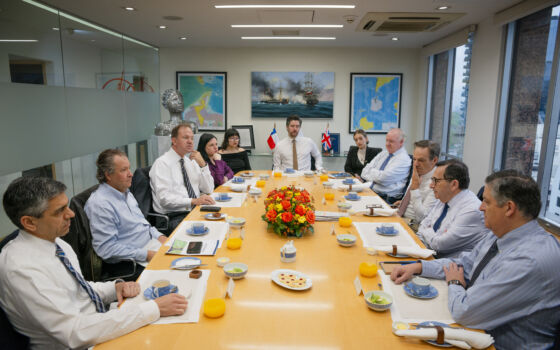
2024 concluded for AthenaLab with a prominent participation in the Exponaval, where we organized discussion panels, presented at conferences, moderated debates, and showcased our products at an exhibition stand. All of this culminated in a private gathering in Valparaíso with the Second Sea Lord of the Royal Navy, Vice Admiral Martin Connell, and the Deputy Commander of the U.S. Pacific Fleet, Rear Admiral Blake Converse.
Prior to that, we organized a seminar with the Embassy of Ukraine on the 1,000 days of the invasion and another with the Embassy of the United Kingdom for the launch of the document “Global Strategic Trends: Out to 2025,” from that country’s Ministry of Defense.
We also reflected on the first anniversary of the October 7, 2023 attack against Israel with our partners at the Royal United Services Institute (RUSI) and on the possibilities of strengthening cooperation between Chile and France in the South Pacific, taking advantage of the visit of ships from the Marine Nationale to Valparaíso.
AthenaLab presented at conferences organized by RUSI, on polar issues and illicit finance, in London, and by our partners at the Real Instituto Elcano, in Madrid. In the British capital, the inauguration of the “Lord Thomas Cochrane” room at the traditional headquarters of the Royal United Services Institute, at Whitehall #61, was a significant event, attended by Princess Anne of the United Kingdom. We were also invited to give a presentation on the national reality at the
Meeting of National Chambers of Commerce in the region , held in Lima.In March, we facilitated the visit of the renowned strategic thinker
Edward Luttwak, who came to Chile in the context of Fidae and other activities conducted by the Chilean Air Force. Of course, organized crime was a central concern, and we debated this with experts from Brazil and other countries in various forums.
ON THE GROUND
The South Pole, in Chilean Antarctica; the South Atlantic; Peru (port of Chancay); Israel; Taiwan; and Ukraine were some of the places we visited to explore the complexities they present and incorporate them into our analyses. Additionally, we participated in the traditional conferences of the First Sea Lord, Land Warfare RUSI, and the Schuman Security and Defense Forum of the European Union.

INSTITUTIONAL RELATIONS
AthenaLab actively participated in

forums, round tables, and councils organized by the Ministry of Foreign Affairs, Society of Promotion, Public Studies Center, Prosecutor’s Office, Chamber of Production and Commerce, European embassies, among others. Memorandums of understanding were also signed
with The Foreign Policy Council “Ukrainian Prism” and the National Defense University of Taiwan, thus extending our network of associated research centers. Periodically, we held meetings with ambassadors
from Australia, Canada, the Netherlands, Israel, the United Kingdom, Singapore, and Ukraine, as well as with delegations from Argentina, Brazil, the United States, Japan, Taiwan, and the European Union. 2025 The coming year will be marked internationally by the
return of Donald Trump

to the White House and by his positioning regarding China, the Middle East, and the Russo-Ukrainian war, as well as his approach to Latin America. It will also be the year of the general elections in Chile
, a process to which AthenaLab will continue to contribute ideas and proposals, as well as participate in the debate, so that we can once again have a common aspiration for a free, secure, and prosperous country. As usual, we will begin 2025 with ouryouth training workshop
in January, and we are already working with the Atlantic Council to hold an international seminar in Washington in June on the effects of threats to Chile’s national security. Happy Holidays Executive Director AthenaLab
December 2024.