ANALYSIS | In partnership with the U.S., gunboat diplomacy returns to Venezuela
This article was translated automatically and may contain differences from the original. For reference, read the original.
- by Juan Pablo Toro
- Noticias
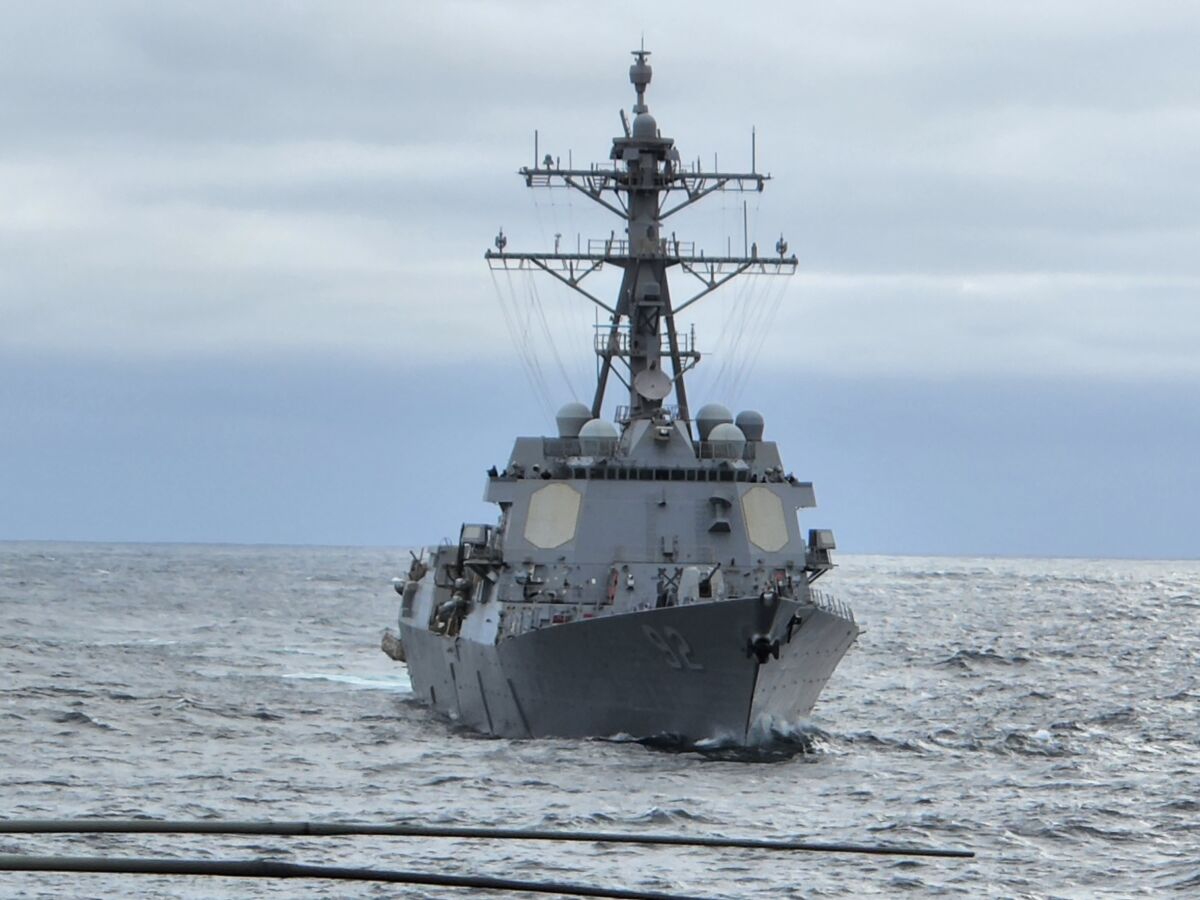
Both the illegal and legal economies of Venezuela navigate through saltwater; the naval deployment of the United States aims to impact the former.
If there was still any doubt about President Donald Trump’s determination to confront the major drug cartels with the full power of the United States—whom he classified as global terrorist organizations—the announcement of sending three destroyers off the coast of Venezuela was enough to sufficiently intimidate Nicolás Maduro, who in response ordered the mobilization of military personnel, militias, and other forces loyal to his regime.
It is truly incredible the effect that just 27,000 tons of steel can have on an entire country, especially when they carry the Aegis radar system and Tomahawk land-attack missiles, SM-2 air defense missiles, Harpoon anti-ship missiles, along with embarked assault groups. There does not even seem to be room for debate on whether the Arleigh Burke destroyers are the most suitable platform for detecting, pursuing, capturing, or destroying drug trafficking vessels. It would be assumed that U.S. Coast Guard patrol boats and even irregular littoral combat ships are better suited for missions related to law enforcement rather than winning wars at sea. Borrowing an idea from Marshall McLuhan, the medium also seems to be the message in this case. The type of military vessel reflects how the threat is perceived.
On the other hand, the use of the sea is fundamental for Maduro’s regime. The re-exportation of drugs produced in neighboring Colombia requires clear maritime routes, as does the oil transported by tankers to Asian clients. Thus, both the illegal and legal economies of Venezuela navigate through saltwater. Despite this, and unlike the Army and Air Force, the Bolivarian Navy is the least enhanced of the three branches when significant purchases of Russian and other foreign materials were made. Currently, the navy has equipped its oceanic patrol boats with Chinese CM-90 anti-ship missiles (vessels not designed to withstand punishment) and has incorporated six Iranian Peykaap III fast missile boats, the same ones used by that country’s Revolutionary Guard to harass cargo ships in the Persian Gulf. This demonstrates that the focus on coastal defense remains intact in this South American navy.
During his first term, Trump launched a similar anti-drug operation in 2020 that included the participation of Arleigh Burke destroyers, which positioned themselves 16 miles off the Venezuelan coast, considering that sovereign space extends to 12 nautical miles. The difference from that time would not only be the simultaneous deployment of three combat ships (the USS Gravely, the USS Jason Dunham, and the USS Sampson) and, apparently, also a submarine, but also that Maduro’s head is now worth double (the reward has risen to $50 million) and, most importantly, he is considered the leader of the so-called Cartel of the Suns (military personnel colluding with drug traffickers). Additionally, there is a significant derivative: two potential sponsors of Venezuela, namely Russia and Iran, are weakened in their ability to project power beyond their immediate regions. Moscow is bogged down in its war against Ukraine, having to abandon partners in the Caucasus (Armenia) and the Middle East (Syria). Meanwhile, Tehran is focused on reconstituting its military apparatus after Israeli attacks.
If we take the 2020 operation as a precedent, its result was greater drug seizures due to constant maritime interdictions, but the Bolivarian regime did not suffer anything resembling a direct attack. While some have tried to recall that dictator Manuel Antonio Noriega was overthrown in 1989 through an invasion due to his ties to drug trafficking, many of the U.S. troops that participated in “Operation Just Cause” were based in Panama, a country much smaller than Venezuela. Undoubtedly, the plans held by the commanders of the destroyers are a mystery, but their actions are likely aimed more at suffocating Venezuela’s illegal economy as a way to weaken its criminalized government and thereby its capacity to cause harm.
The so-called “gunboat diplomacy”gunboat diplomacy in English is not new at all and is nothing more than the pursuit of foreign policy objectives with the help of visible displays of naval power. A classic example occurred around Venezuela in 1902-1903, when ships from Germany, France, Italy, and the United Kingdom blockaded the South American country to demand payment of debts and compensation for damages suffered by their nationals amid civil wars. At that time, the intervention of the United States before the Europeans was key to seeking a negotiated solution to the impasse and avoiding an attack.
In this sense, “gunboat diplomacy” seems to be back in the Caribbean, one of the places where it had some of its greatest expressions. Unintentionally, Trump seems to have invoked Theodore Roosevelt (1901-1909), another president not known for his timidity in imposing his views. If Maduro exhibits such nervousness, it is because he has something to fear. Some U.S. intelligence sources estimate that up to 500 tons of cocaine leave Venezuela for the world. With the destroyers in position, that will be much more difficult, and it will also be recorded as evidence that such a volume of illegal cargo can only be moved by sea if someone has the direct intention to allow it.
Juan Pablo Toro, Executive Director AthenaLab
Montevideo, August 20, 2025