The Ten Key Points of the Annual Homicide Report in Chile 2024
This article was translated automatically and may contain differences from the original. For reference, read the original.

Recently, the studies division of the National Prosecutor’s Office of Chile presented the latest homicide report. The reports, published annually since 2021 and covering data series since 2016, complement the work of the Center for the Prevention of Homicides and Violent Crimes of the Ministry of Public Security, providing crucial information about offenders and thematic contexts. A thorough analysis of this data is essential not only for understanding the criminal phenomenon but also for designing public policies and conducting longitudinal follow-ups on the evolution of this serious crime. Below are ten key points drawn from the findings of the 2024 report, offering a comprehensive view of the homicide phenomenon in Chile.
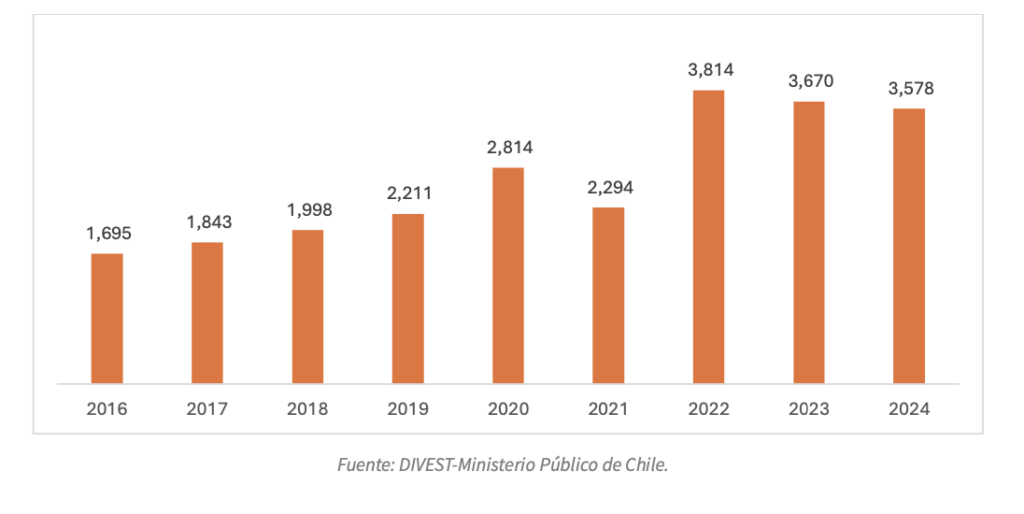
- Slight decrease in homicide cases (2024 vs. 2023). The year 2024 marked a continuation of the upward trend observed between 2021 and 2022, recording a decrease compared to 2023. Homicide cases and offenses decreased by 3%; victims decreased by 11.2% (totaling 4,330 victims, including completed and attempted homicides), and offenders decreased by 4.1%. This decrease compared to the previous year does not indicate a break in the trend, as there is an evident upward trend since 2016 when considering the complete series. In fact, comparing the first year of the series (2016) and the last (2024), there is a 111% increase in homicide cases.
Figure No. 1. Total cases, offenses, victims, and offenders for homicides, 2020-2024
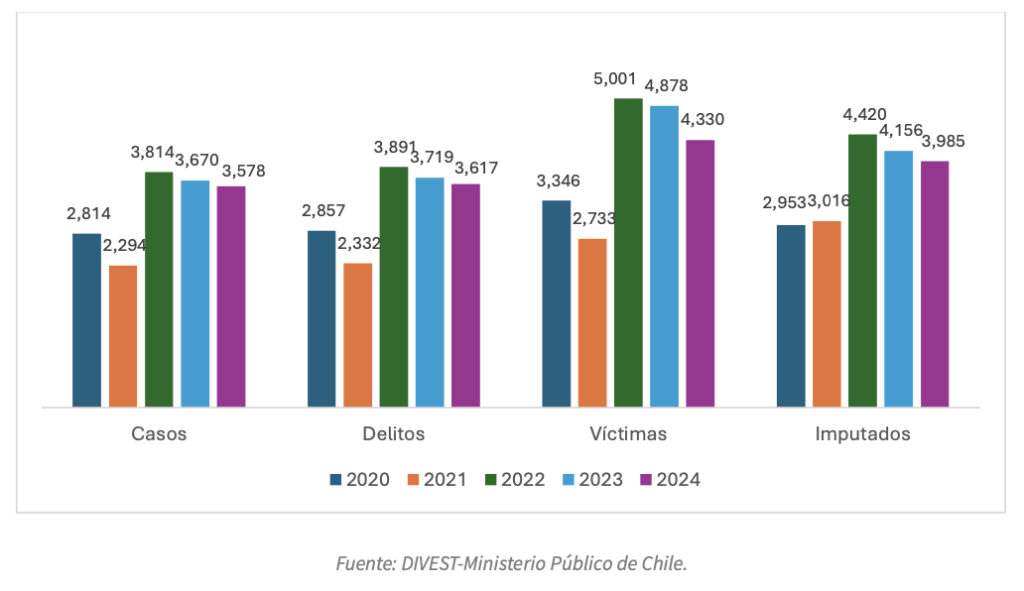
Figure No. 2. Number of homicide cases, 2016-2024
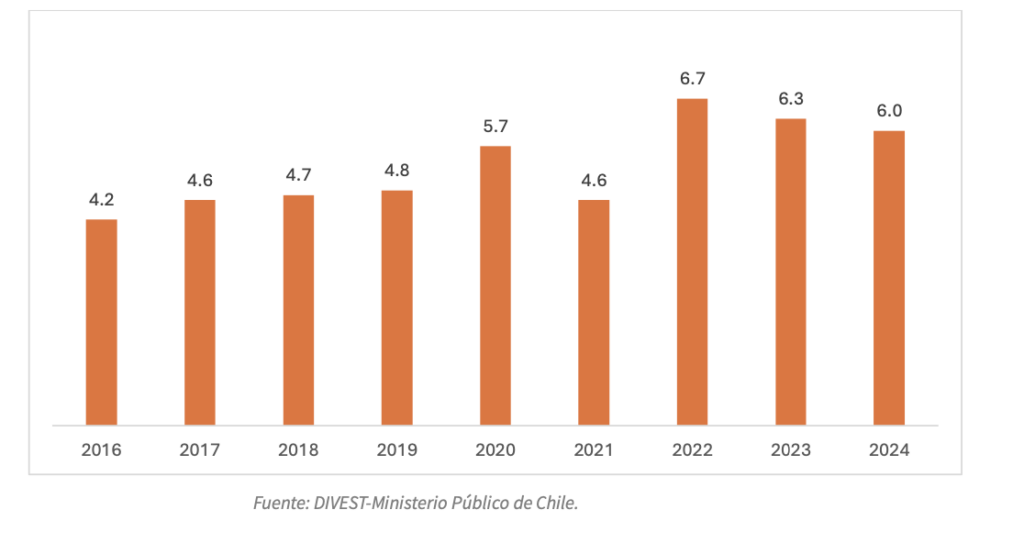
- Reduction in the national rate of completed homicides, although with significant regional variations. The rate of victims of completed homicides in 2024 reached 6.0 per 100,000 inhabitants, representing a 4% decrease compared to 2023, although at levels higher than those reached in the pre-pandemic period. Regionally, Arica and Parinacota (9.9), Metropolitan Center North (9.3), and Aysén (9.2) had the highest rates, while Metropolitan East (1.8), Magallanes (2.7), and Los Lagos (3.1) had the lowest. Notably, Aysén experienced a significant increase in its rate, due to an increase from 5 to 10 cases.
Figure No. 3. Distribution of homicide victims by Regional Prosecutor’s Office, 2023-2024
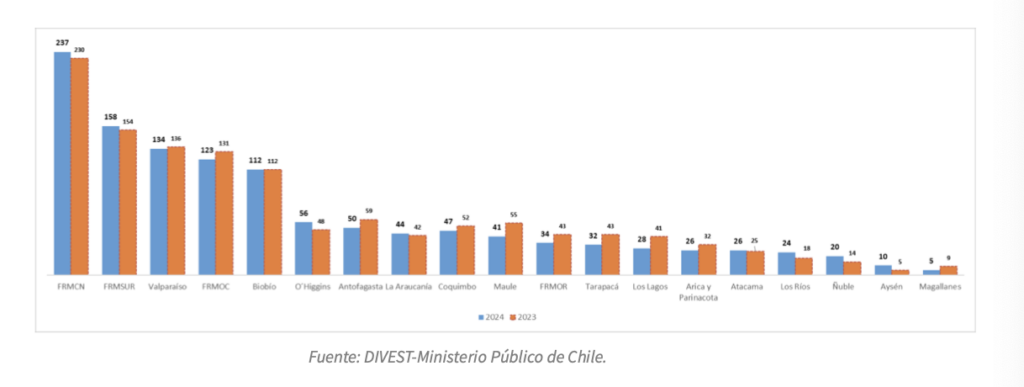
Figure No. 4. Rate of victims of completed homicides per 100,000 inhabitants, 2016-2024
- Improvement in the identification of offenders, reducing unknown cases. The report shows a significant advancement in the capacity of institutions to identify those responsible for homicides. The proportion of victims with unknown offenders decreased to 34% in 2024, a notable improvement from the peak of 42% recorded in 2022 and 40% in 2023. In summary, for the year 2024, 66% of victims of completed homicides had at least one known offender associated. This may be linked to the implementation of Organized Crime and Homicides teams (ECOH).
- Persistence and impact of organized crime in homicides. Despite a marginal decrease of 4% in the number of victims compared to 2023, homicides linked to organized crime continue to be a factor of particular relevance. In 2024, 16.5% of victims of completed homicides nationwide were associated with this context. The regional prosecutors’ offices of Metropolitan South and Metropolitan Center North exceeded the national average in this type of cases. Lampa (71%), La Pintana (29%), and Recoleta (29%) were the municipalities with the highest proportions of victims in this context. 30% of foreign victims are linked to organized crime, in contrast to 13.5% of Chilean victims, and firearms predominated in 92.5% of cases.
- Relative stability of femicide cases. In 2024, there was a slight increase in the number of femicide victims, reaching 44 cases, one more than in 2023. 84% of these correspond to femicides in the context of domestic violence, with the cohabitant relationship being the most frequent (50%). Regarding the location of the crime, most cases occur in the shared home with the aggressor (39%), followed by public spaces, which account for 32% of cases. Notably, there was a significant increase in femicides in public spaces, doubling the number of cases compared to 2023. In terms of the type of weapon used, the use of sharp weapons stands out, reaching 36%.
- Decrease in women charged with homicide. The year 2024 showed a significant reduction in the number of women charged with homicide, decreasing from 112 cases in 2023 to 79 in 2024, representing a decrease of 29.4%.
- Worrying increase in children and adolescents (NNA) as victims of homicide. In 2024, the highest number of NNA victims of completed homicides in the historical series (2016-2024) was recorded, with 76 victims, representing 6.3% of the national total of homicides. This upward trend, sustained since 2020, contrasts with the general decrease in homicides, highlighting a concerning reality for this population. The majority of NNA victims were between 14 and 17 years old (52.6%), were of Chilean nationality (92%), and firearms were the primary means used (57%).
- Increasing involvement of adolescents as offenders in homicide cases. The rate of adolescents charged with completed homicides reached a peak of 8.8 per 100,000 adolescents in 2024, surpassing the rate of 6.8 in 2023. It is important to note that 50% of the homicides were committed with firearms; 50% of the adolescents charged had at least one adult as an accomplice, and 84% of them were under some form of detention during the process.
- Drastic increase in homicides under state custody in penitentiary facilities. Homicides in penitentiary facilities recorded a rate of 80.2 victims per 100,000 people in the closed subsystem of Gendarmería in 2024, a figure more than 13 times higher than the national rate (6.0). This represents the third highest value for the period (2018-2024) and an increase of 9.3% compared to 2023. The victims are predominantly young (over 75%, aged 18 to 39 years), and sharp or pointed objects are the most common means of commission (82%). While the Metropolitan Region concentrates the highest number of cases (20), the Los Ríos Region presents the highest rate (294.5).
- Patterns of victims and offenders: predominantly male and increasing number of foreign offenders. Offenders for homicide continue to be predominantly men aged 18 to 39 years. Regarding nationality, foreigners reached a peak in 2024, with 234 individuals, representing an increase of 1,070% compared to 2016, primarily concentrated among Venezuelan and Colombian nationalities. Homicide victims are also predominantly men (88% in 2024), and individuals aged 18 to 39 years account for 60% of cases.
Conclusion
The report provides a valuable overview of the homicide phenomenon in Chile. While the overall data shows a generalized downward trend in homicide indicators and progress in the identification of offenders, significant challenges remain.
The increasing impact on children and adolescents (NNA) as victims and their greater involvement as offenders; the sustained rise in homicides in penitentiary facilities, and the persistence of homicides associated with organized crime demand differentiated, specialized, and coordinated responses. Monitoring this type of crime with data and analysis is essential to strengthen institutional capacities and design public policies that effectively influence the reduction of violence and the improvement of security.
Colaboradora de AthenaLab