The long-term strategy of the Spanish Navy in a complex and uncertain environment
This article was translated automatically and may contain differences from the original. For reference, read the original.
- by Almirante Antonio Piñeiro Sánchez
- Guest Contributions
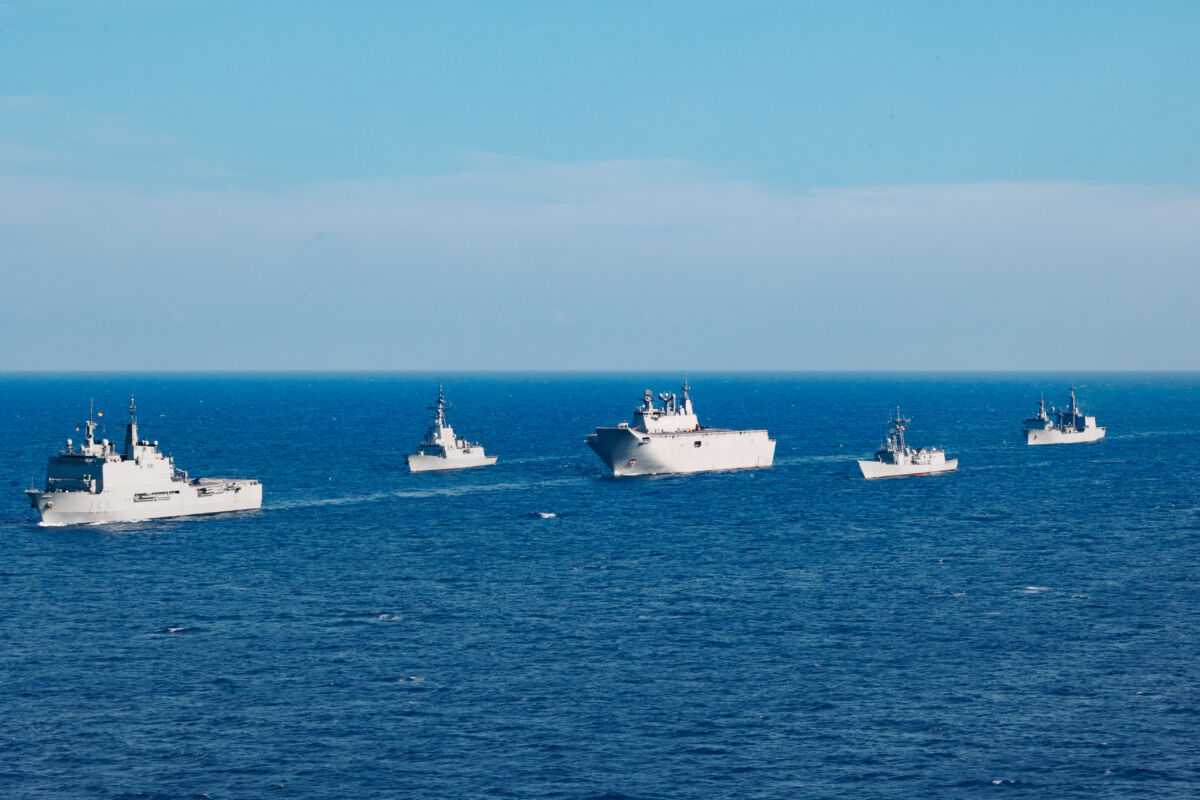
Through the document "Navy 2050," the aim is to align the activities of the Spanish Navy to face future challenges and ensure the country's security in an increasingly uncertain environment.
“He who does not know to which port he sails, no wind is favorable,”
Seneca
The international environment has undergone significant evolution over the past decades. It has shifted from a unipolar model to a more complex and fragmented reality, where a multipolar order is emerging.
In this new scenario, various global actors compete in an environment where alliances and power balances are in constant flux. This tense dynamic shapes a complex and uncertain global landscape, which has been exacerbated in Eastern Europe and the Middle East. An environment that demands more than ever the guarantee of security, the preservation of national interests, and the strengthening of international relevance.
The vision “NAVY 2050”is born from this idea and is the impetus the Navy needs to face the challenges ahead. It is a high-level document that serves as a guide to orient short-term actions and establish long-term objectives that align decisions with an unchanging foundation: Spain needs now, and will continue to need in the future, a decisive Navy prepared for combat.
To this end, the long-term vision of the Navy defines four fundamental pillars: a decisive and relevant Naval Force in combat; at the technological forefront; with a firm commitment to personnel; and supported by an efficient use of resources. These pillars must have three key supports: social and institutional support, resource availability, and a robust defense industry.
To this end, this force must be credible, balanced, modern, versatile, and possess high combat capability to deter a potential adversary from threatening our interests and thus avoid confrontation. The deterrent capability is enhanced by the Navy through three key aspects: the projection capability due to its strategic effects; the submarine weapon for its deterrent nature; and joint and combined interoperability to enhance capabilities.
With this fundamental idea, and based on the capability to project naval power onto land, frigates, submarines, amphibious-capable ships, fixed and rotary-wing aircraft, mine countermeasure units, and a robust Marine Corps are presented as essential vectors. Units that already operate in a highly digitized and automated environment, where the Naval Force must be at the forefront of technology, enhance emerging technologies, and have advanced systems for data analysis and decision-making support in a rapid, precise, and effective manner.
It is well known that technological revolutions have transformed combat strategies throughout history, and the current era is no exception. In this context, the use of drones, artificial intelligence, combat cloud, digital twins, modular systems, and data analysis platforms are presented as transformative elements that must be incorporated into the Navy.
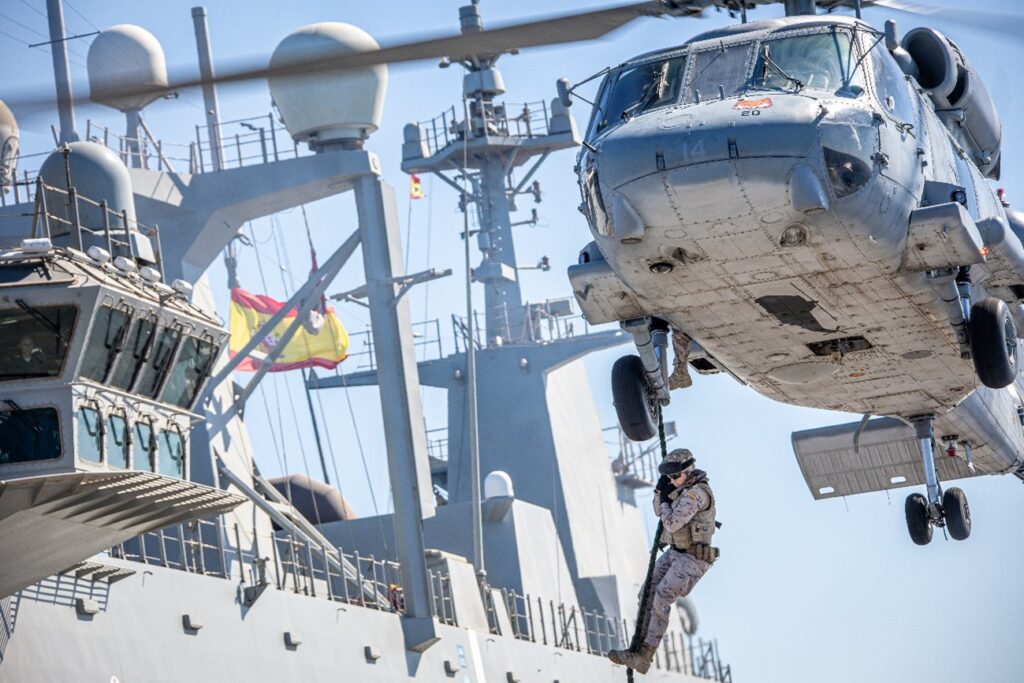
Fast Rope on the deck of the LHD “Juan Carlos I” (Spanish Navy)
The Navy must not only adapt to the demands of a constantly changing strategic environment but also streamline research, development, and technological innovation (R&D&I) processes. Technology is advancing at an unprecedented speed, making it imperative to promote scientific research and optimize the development and application processes of these new technologies. To achieve these objectives, it is necessary to foster close collaboration between the Navy, the defense industry, and academia. A dynamic of cooperation and mutual knowledge that fosters synergies and allows for the alignment of viable solutions tailored to the specific needs of the Navy.
Innovation not only involves the creation of new systems or technologies but also the ability to adapt existing ones. Solutions that must be extensible to the organization to streamline and optimize processes in resource management and sustainment to achieve greater performance of the operational cycles of the units, and increase their operational availability to ensure the operability of the Force and have more units ready for combat.
In this context of geopolitical uncertainty, global tensions, and competition for resources, the ability to make sovereign decisions without excessive dependence on external actors becomes particularly relevant. To this end, achieving a certain degree of strategic autonomy necessarily requires strengthening and promoting the national defense industry, one of the indispensable factors that significantly influences not only the development of military capabilities but also the life cycle of the units.
However, all of the above is not possible if the Navy does not have the personnel it needs. The keystone of this entire strategy is the human value of the institution and its commitment to it, a priority objective. The Navy therefore needs sufficient personnel, with excellent technical training, well-equipped, trained, highly committed to the institution, motivated, and with a combat mindset. All of this built on a solid foundation of values.
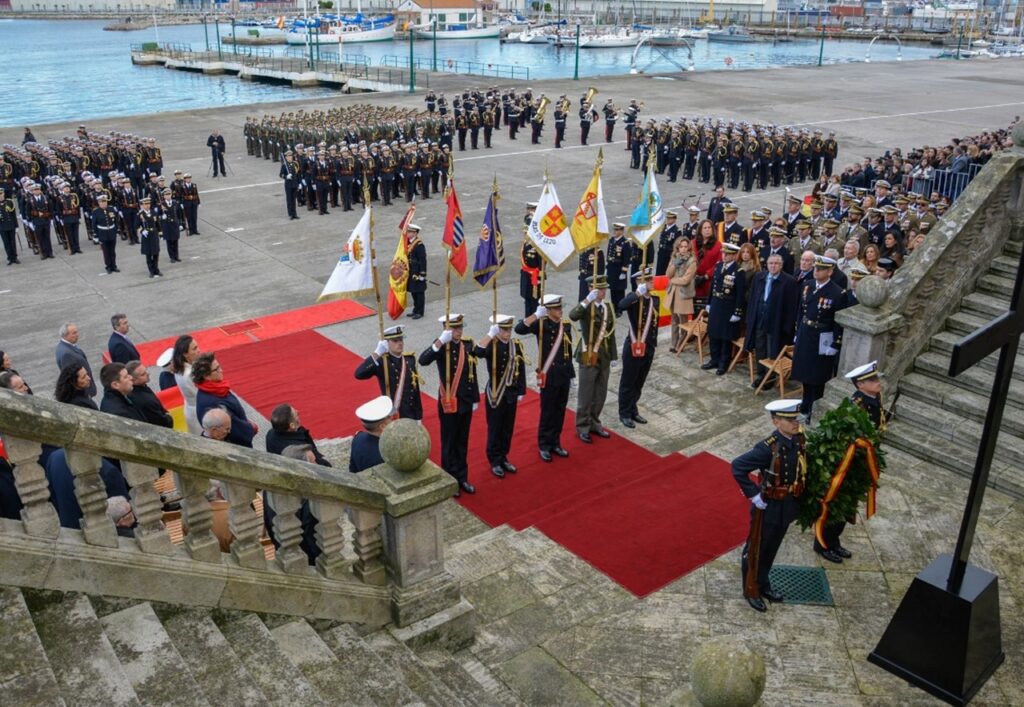
Tribute to the fallen at the Naval Military School (Spanish Navy)
Finally, it is essential to have adequate social and institutional support, which requires effective external communication and a robust defense culture plan. Bringing the Navy closer to the rest of society is imperative for citizens to understand and identify with the need for a Navy prepared to ensure the security and defense of their interests and well-being. Knowing the Navy is the first step to valuing the importance of its contribution to security and defense.
In short, the long-term vision is an indispensable guide to align activities in the short and long term towards the objective of remaining relevant in defending Spain’s interests at sea and from the sea. The document “Navy 2050” aims, therefore, to be the beginning of a strategic alignment process, an impetus to build the Navy that Spain needs to face the challenges ahead in a complex and uncertain environment.
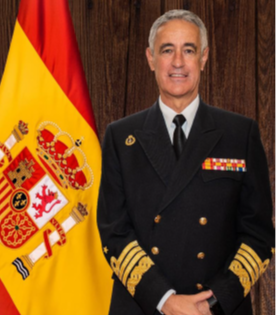
Antonio Piñeiro Sánchez
Admiral Chief of Naval Staff
September 2, 2025
Special for AthenaLab