The literature on the coming war: fiction as anticipation
This article was translated automatically and may contain differences from the original. For reference, read the original.
- by Juan Pablo Toro
- Strategic Affairs
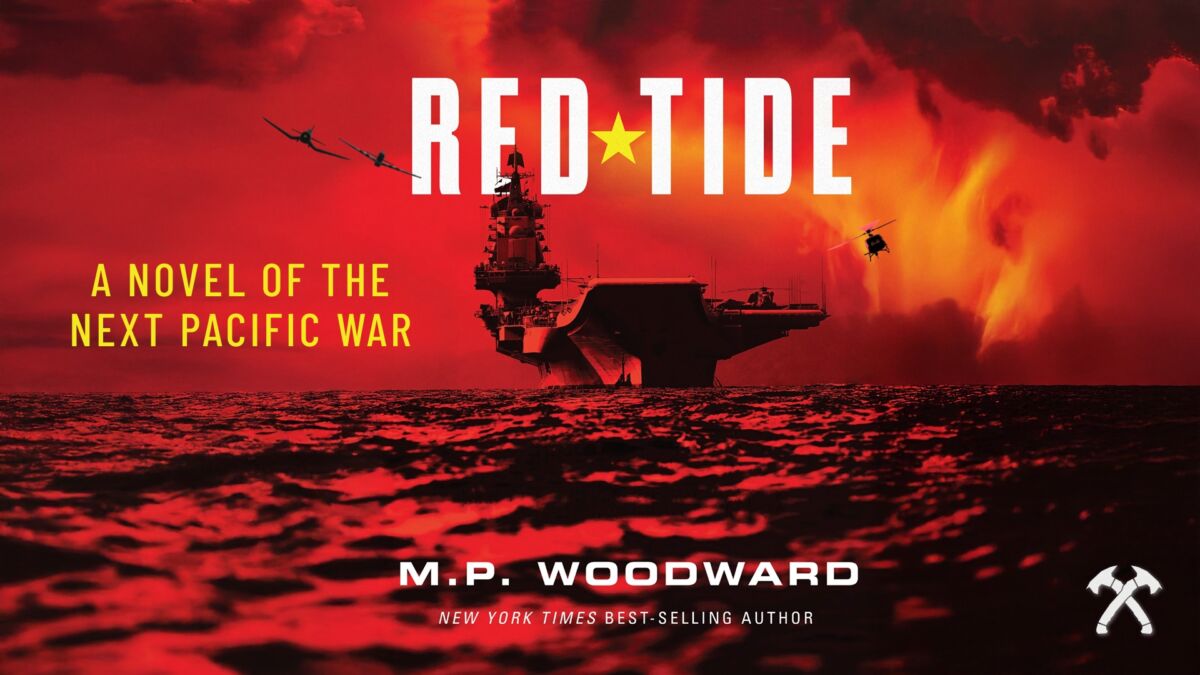
Novels such as "Red Tide" by M.P. Woodward, about a future war between the United States and China, serve to warn of the risks of being unprepared for new threats, following a tradition that dates back to works like "The Battle of Dorking" from 1871. Juan Pablo Toro
Recently launched last month, the novel Red Tide, by M.P. Woodward, is a gripping war thriller about an impending war in the Pacific involving the United States, China, and Taiwan, centered around an American family connected to the U.S. Navy.
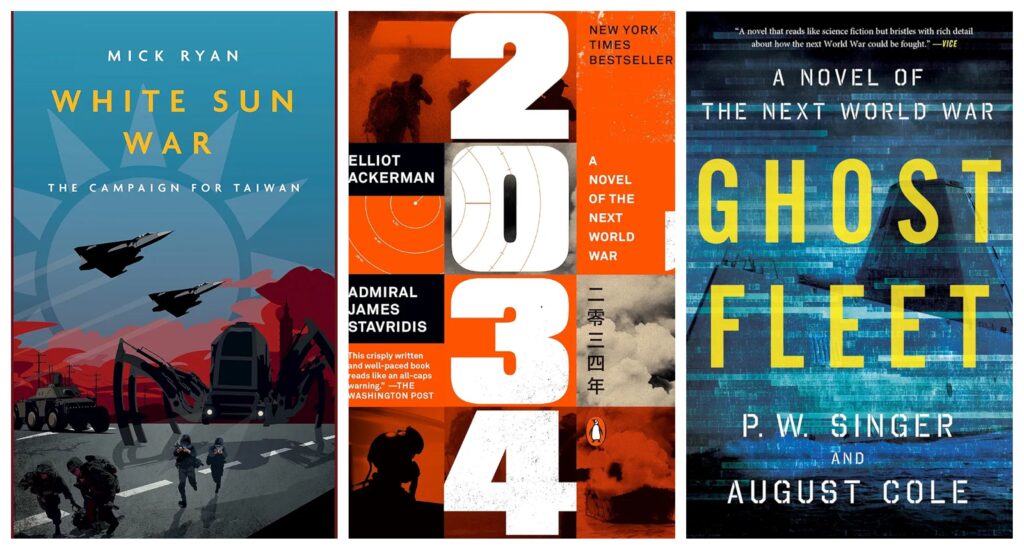
The same theme has been addressed, with varying emphases, in White Sun War: The Campaign for Taiwan (2023), by retired Australian General Mick Ryan; 2034 (2021), by Elliot Ackerman and retired U.S. Admiral James Stavridis; and Ghost Fleet (2015), by P.W. Singer and August Cole.In addition to featuring the same actors involved, sometimes with special appearances from Russia, Australia, and Japan, there are certain elements that recur in all these works. Time and again, the technological advantage gained by the Chinese military emerges, which, in principle, poses serious challenges to the obsolescent U.S. platforms and their predictable tactics.
The advancements achieved by the People’s Liberation Army in areas such as artificial intelligence, cyberspace, space, drones, and robotics seem to be a recurring concern. All of this occurs within the framework of immense industrial capacity directed by a techno-authoritarian state, a situation that today seems very distant for a United States burdened by various types of deficits and dysfunctional domestic politics.
As direct antecedents of these 21st-century novels, one often cites
The Hunt for Red October or Red Storm Rising , both by Tom Clancy— the latter co-authored with Larry Bond— which fictionalize crises or confrontations between the United States and the Soviet Union in the 1980s, a period of maximum tension between the two powers.However, if one goes much further back, one should arrive at
The Battle of Dorking: Reminiscences of a Volunteer , byGeorge Tomkyns Chesney , written in 1871, just after the Franco-Prussian War, which had as its main setting an invasion of Great Britain from a German-speaking country referred to as “The Other Power” or “The Enemy.” Although the United Kingdom was ultimately defeated, it was a success in that country because it alerted about the cost that can arise for a state being ill-prepared for new threats on the horizon, which are often not directly addressed, as it may be politically incorrect or diplomatically inconvenient to do so.In this regard, strategic thinker Lawrence Freedman—who does not write fiction—argues that the value of such works lies in their authors’ attempts to demonstrate what could happen if their warnings are ignored. Thus, the drama they infuse into their books seeks to help mobilize urgent actions. Because if something is more costly and painful than a war, it is losing one.
While purists of literature may debate the stylistic quality of the texts, which are generally direct and simple, the fact is that the authors mentioned at the beginning of this commentary are experts well-versed in their subjects, either through study or firsthand experience.
In Woodward’s case, he is a retired naval intelligence officer of the United States Navy. In his career, he was deployed in the Persian Gulf and the Far East, in addition to having worked with various security agencies and special forces in his country. Ryan and Stavridis, for their part, held high military positions, while Singer is known as a thinker who effectively connects the security dimensions of new technologies being introduced in the battlefield.
Given the increasing tensions between the United States and China,
Red Tide offers an entertaining perspective and a novel hypothesis about a conflict that seems to be approaching day by day. This is evident as China tightens its grip around Taiwan and the strategic advantage of having guaranteed access to semiconductors, of which the island is by far the leading producer. Aside from the fascinating plot and without the intention of providing
spoilers, Woodward and company make it clear that combat experience, determination, and innovation that occurs in environments of freedom are as substantial as the best technologies. In other words, there is much material for reflection in these novels if read with the attention they require.Juan Pablo Toro.