Key Elements of the National Security Strategy of the United States of America (NSS, 2025)
This article was translated automatically and may contain differences from the original. For reference, read the original.

This week, specifically on Thursday, December 4, the White House published the new National Security Strategy of the United States of America. This is a 33-page document that reaffirms its doctrine of “America First.” It defines its main priorities for guiding and acting on national security across all spheres and available instruments of power, becoming the foundational document for all subsidiary planning, which includes foreign policy, defense, economy, energy, among other sectoral issues. Undoubtedly, it constitutes a foundational act of great relevance for understanding the actions of one of the main global powers in the current international order.
In this regard, we will highlight— for better understanding— some key points, both from the process of formulating this strategy and from the main contents of the document.
First, it is worth mentioning that the publication of national security strategies is a widespread practice among major powers and modern democracies, as seen in China (2025), the United Kingdom (2025), France (2025), Spain (2021), among other countries. For example, within OECD countries, 71.05% have national security architectures, and in NATO, the percentage rises to 80%.
Secondly, it is important to mention that this practice of explicitly publishing national security strategies presupposes the existence of a level of governance and related structures from which the mentioned strategy is managed, towards an interagency process that considers all existing instruments of power. Consequently, the structure comes first, followed by the explicit formulation of a means to achieve national objectives, as is the case with any strategy, in a manner consistent with available resources.
When mentioning the public nature of these documents, we must note that we should not consider them solely for what they state, but rather for what is not explicitly mentioned in them. The true game of international power does not take place on the international board, on the table, but rather occurs beneath it, in a more reserved and secretive manner.
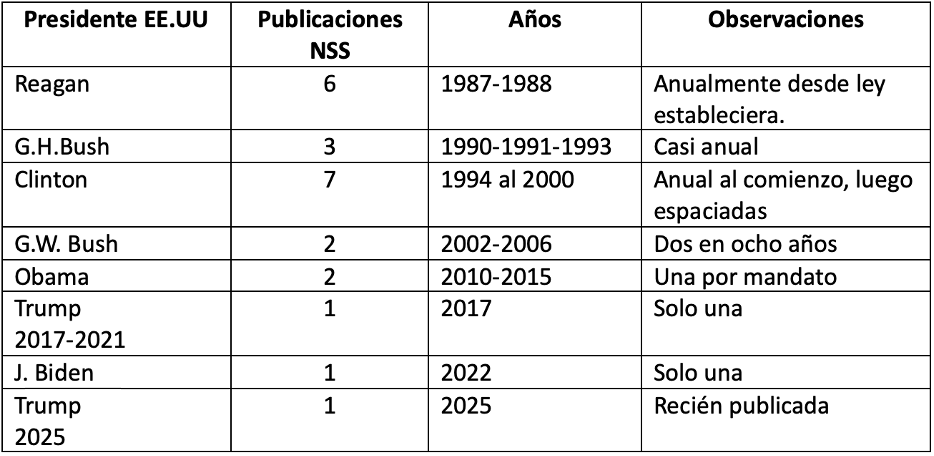
A third noteworthy element is that, in the current American model, the explicit formulation of the national security strategy—as it operates today—and its respective transmission to Congress is carried out by a special law. This document is a law, the Goldwater-Nichols Act. Consequently, the National Security Strategy (NSS) is a report required by Section 603 of the Goldwater-Nichols Department of Defense Reorganization Act of 1986 (Public Law 99-433), which established, in passing, the most significant reorganization of the Department of Defense in the United States, establishing the position of the “Joint Chief of Staff” as the principal advisor to the Commander-in-Chief, who in this case is the President of the Republic, as well as granting effective command to the commanders of established Operational Commands. The NSS has been transmitted annually since 1987, and the 2025 version is its latest iteration. In practice, it has been published recently every four years and typically before a year from the start of the presidential term.
Source: Own elaboration.
B. Development
Now, regarding the content of this latest publication, it is structured into four fundamental parts. The first three are presented with a question: the first serves as an introduction, posing the question “What is the U.S. strategy?”; the second part refers to “What should the U.S. aim for?”; and the third, “What means are available for the objectives that the U.S. intends to achieve?” Finally, the fourth and last part refers to the strategy itself and its impact on various regions globally.
In the first part of the NSS 2025, conceptual considerations are established, defining the strategy as a concrete plan detailing how to achieve the defined objectives, and it does so more than just listing good intentions. In this way, it links desired ends with available resources. This departs from traditional post-Cold War approaches that—according to the strategy—led to fostering uncontrolled globalization, with harmful free trade, in a context of high dependency among allies, each with their own agendas. It concludes by mentioning President Trump’s first term as the beginning of the correction to overcome the aforementioned issues. In this regard, it is relevant to highlight its clarity and capacity for self-criticism, legitimizing the selective withdrawal to be promoted, avoiding previous references to achieving a global positioning of character and dominance.
In the second part general and specific objectives are established and detailed. In the domestic realm, the following objectives stand out: sovereign survival through effective border control; resilient infrastructure; a U.S. defense with advanced nuclear technology, accompanied by a stronger and more vigorous industrial economy as the foundational element of all objectives, as well as the goal of adequate job restoration and greater national unity and cohesion through family ties. Regarding objectives by geographical areas, priority is given to a stable Western Hemisphere (the Americas), free from large migratory flows and criminal cartels. A free Indo-Pacific from Chinese domination; a secure but self-sufficient Europe; a Middle East without levels of conflict and eternal confrontations. Additionally, leadership to be developed in the technological fields of artificial intelligence, biotechnology, and quantum computing is highlighted. This part of the strategy is considered the most ambitious and coherent, establishing a direct relationship between security, development, and economic prosperity, which clearly differentiates it from previous, more idealistic editions. In this section, the reference to the “Trump Corollary to the Monroe Doctrine” clearly refers to the influence of external actors; particularly, China in Latin America.
In the third part the fundamental aspects for the success of the strategy are highlighted: an agile political system; a foundational innovative economy; the consolidation of the dollar as a global reserve; clear leadership in advanced technologies; a powerful military without rivals close to its capacity; a solid network of alliances, marked by advantageous geography, and a patriotic “soft power.” In summary, this section is characterized by being optimistic about what is intended, within a very realistic framework of its postulates.The fourth part contains the most operational section of the document, which is divided into: “Principles, priorities, and the various regions.” Regarding the principles, it maintains the concept of “America First,” within a framework of flexible realism, without interventionism that is not justified, emphasizing national sovereignty, power balances, and greater reciprocity among respective alliances. There is a clear intention to present President Trump’s management as key in conflict resolution, fundamentally through unconventional diplomatic means. In this section, there is an emphasis on the possibilities of deterrence as a tool, which should be compatible with the potential erosion of international norms.Regarding the priorities, the objective of ending mass migration is highlighted, the protection of freedoms, sharing security efforts, realignment through promoted peace agreements; security in its economic dimension, through more balanced trade, an emphasis on reindustrialization, and greater energy dominance. In terms of the various global geopolitical regions, the following main ideas are highlighted:
– Western Hemisphere (the Americas), reaffirming the “Monroe Doctrine” (Trump corollary) to exclude rivals and external influences, as well as greater cooperation in migration control. – Regarding Asia, there is a clear recognition of China as the main competing power, with which economic reciprocity should be pursued; maintaining the defense of Taiwan, thereby strengthening the QUAD alliance. This occurs in the context of an open Indo-Pacific led from a clear position of strength.– Concerning Central Europe, support for sovereignties is established; achieving an end to the war in Ukraine; generating greater control over migratory movements and strengthening weakened national identity. In passing, it prioritizes the stability of the European space over NATO expansion. – In the Middle East, the expansion of the Abraham Accords is presented as a tool for peace, security, and development. At this point, there is an underestimation of the implications of Iran as a regional actor and its capacity to alter regional stability. The document confirms the importance of maintaining energy supply from this region, open and secure, through the maintenance of its main maritime routes (Red Sea, Strait of Hormuz).– Regarding Africa, the potential to build relationships with select friendly and reliable states to create mutual benefits is highlighted. This involves aspects of business and investment, transitioning from a paradigm focused more on individual aid to one of investment and growth capable of leveraging Africa’s abundant natural resources and latent economic potential, while also mitigating existing conflicts.
C.
Final Considerations
Overall, it is evident that the recent national security strategy of the U.S. predominates a realistic view of international relations, with a clear conceptual predominance of power factors, as well as the relevance of deterrence in achieving objectives or effects on the behavior of other states. There is a clear predominance of tangible and absolute gains over other considerations such as universal ideals. Undoubtedly, its success will depend on proper execution in an increasingly volatile, uncertain, and disruptive world, where interaction with rival powers will determine levels of global peace and security.
Finally, it is necessary to reiterate that—in the context of a modern state—national security is the primary responsibility of any government; without security, there is no democracy or possible development. Likewise, its effect is key to establishing the foundations for adequate prosperity and a way of life free from risks, in the context of secure borders and a stable economy. Its actions involve the protection of each and every citizen, as well as the promotion of Chile’s national interest, enabling a safer, stronger, sovereign, and competitive country, with real advantages to face the risks, threats, and opportunities that arise in the short, medium, and long term.
Jefe de estudios