Argentina: an active-duty officer for the Ministry of Defense
This article was translated automatically and may contain differences from the original. For reference, read the original.
- by Andrea Guidugli
- Strategic Affairs
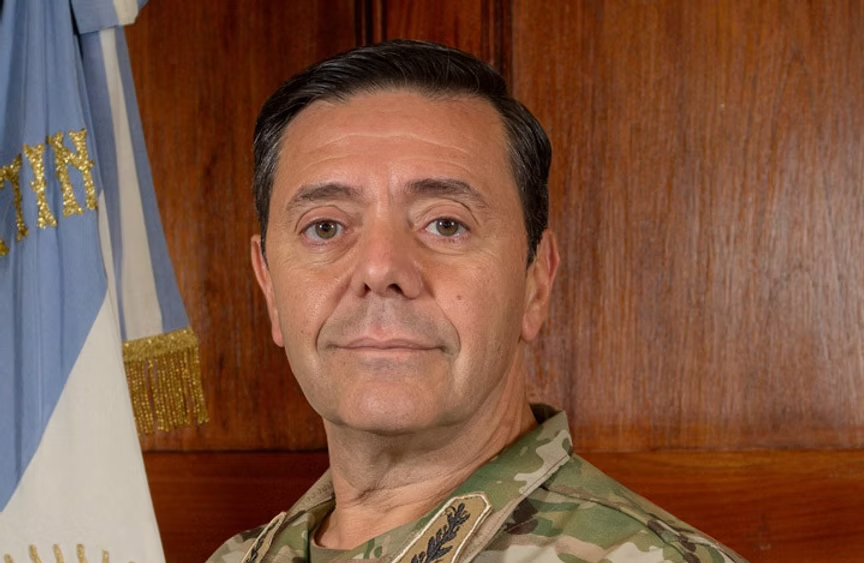
The Argentine media Pucará Defensa authorized AthenaLab to publish the following article, which analyzes the appointment of Lieutenant General Carlos Alberto Presti, Chief of the General Staff of the Army in active service, as the next Minister of Defense. The debate this possibility has opened in Argentina offers a relevant opportunity to reflect, also in the Chilean case, on the scope, implications, and impacts that such decisions can have on the civil conduct of defense and on civil-military relations.
In 1976, during a trip through the Los Libertadores pass towards Córdoba, I had my first direct contact with an Argentina deeply marked by military presence in everyday life. On the roads, long columns of Army trucks advanced with soldiers stationed behind the cabin, armed with rifles equipped to launch grenades. Upon arriving in Mendoza, a sudden checkpoint completely blocked a street: the military checked documents one by one, and the atmosphere conveyed a tension difficult to forget for a young person just beginning to understand the political reality of the Southern Cone.
Almost fifty years later, that memory serves to underscore a central distinction: the military conduct of the State that characterized that era has no relation to the contemporary debate about the possible appointment of an active-duty officer as Minister of Defense. Today, Argentina operates within a consolidated democratic framework, with professionalized Armed Forces and an institutional structure that clearly separates civilian governance from the technical management of the military instrument. The context, the actors, and the nature of the discussion are completely different.
A change that seemed impossible
The opening of the possibility for an active-duty officer to assume the Ministry of Defense marks an unexpected turn for Argentine politics. Since 1983, the country has maintained, without exceptions, a principle of strict civilian control over the area, initially as a necessary institutional reaction during the democratic transition and later as a consolidated tradition in itself.
The current proposal does not imply an alteration of the democratic framework nor a return to the past, but rather a pragmatic review in light of a more complex strategic scenario and Armed Forces that require technical leadership to recover basic capabilities.
The key point is that, for the first time, a broad range of actors recognizes that the Argentine defense system needs more than administration: it needs operational management, doctrinal knowledge, and international communication capacity, elements that an active-duty officer can provide immediately.

Evolution of the principle of civilian control
After the constitutional return, Argentina applied a rigid model: exclusively civilian ministers, frequent rotation of heads, and a Ministry that operated more as an administrative body than as a strategic leadership body.
This scheme played a fundamental historical role, but over time it showed limitations: a rupture between political leadership and the professionalized military framework; absence of sustained multi-year planning; doctrinal delays in joint operations; difficulties in negotiating modernization programs with foreign technical counterparts.
Meanwhile, countries like Brazil, Chile, Colombia, and Peru adopted more flexible models: civilian political leadership, but with the presence of military or former military personnel in strategic positions.
Argentina, on the other hand, maintained a homogeneous scheme even when the professionalization of the Armed Forces reached standards comparable to those in the region.
Why this discussion is happening now
a. Deep deterioration of capabilities
The situation of the Argentine military instrument is well known:
• The Air Force maintains severely reduced capabilities after two decades of accumulated obsolescence. The agreement for the F-16 represents a significant qualitative leap, but does not alter the scarcity of support platforms: limited strategic transport, a helicopter fleet with fluctuating availability, insufficient ISR capabilities, and a fragmented air defense system with radars of disparate generations. The lack of an advanced training aircraft with LIFT capabilities restricts the training curve for fighter pilots, while airport infrastructure and maintenance workshops require investments to sustain an operational pace consistent with the new incoming material. The renewal of the supersonic system is necessary, but not sufficient without a robust support architecture.
• The Army faces an equally critical modernization scenario. The fleet of armored vehicles — TAM, M113, and VCTP — often exceeds 40 years of service, with structural limitations in firepower, protection, and mobility. The TAM 2C program is progressing slowly and does not cover the entire fleet. The new Strykers provide tactical mobility, but their incorporation — in second-hand condition — does not substantively change the lack of a modern 8×8 vehicle or the need to renew field artillery and short-range air defense systems. The level of joint training is restricted by the availability of ammunition, fuel, and maintenance of training areas, affecting preparedness for combined and high-intensity operations.

• The Navy is facing an even more complex situation: a surface fleet that urgently requires replacements and chronic availability problems; a virtually nonexistent submarine fleet following the loss of the ARA San Juan and the operational retirement of the ARA Santa Cruz. Alternatives with France for potential Scorpène-type units are being analyzed, but no binding agreements have been reached to date. The naval aviation component maintains severely reduced capabilities due to obsolescence, logistical limitations, and low aircraft availability — including P-3 Orions, Sea King helicopters, and the inability to recover the Super Étendard system — which affects maritime patrol, anti-submarine warfare, and embarked support. The amphibious component also faces restrictions due to aging material and limited transport and support capacity.
This situation prevents any reform if the minister does not possess immediate technical knowledge of logistical cycles, operational priorities, and real limitations.
b. A more demanding regional environment
South America faces more complex hybrid threats: the expansion of organized crime; cyber threats to critical infrastructure; increased presence of extra-regional actors; expansion of naval capabilities in Brazil and Chile.
In this context, the conduct of defense requires quick, coherent, and technically sound decisions.
c. International reputation
Argentina needs to demonstrate that it can sustain consistent defense policies.
A minister with operational experience facilitates: communication with Western governments and suppliers; understanding of interoperability requirements; faster progress in FMS and cooperation programs.
The government’s decision and its rationale
The government has confirmed the appointment of Lieutenant General Carlos Alberto Presti, Chief of the General Staff of the Army, as the next Minister of Defense. This is the first time since 1983 that an active-duty officer assumes political leadership in the area, a fact that the Executive itself has described as “an exceptional decision for exceptional circumstances.”
The official argument centers on three axes:
a. Professionalization and efficiency
The Ministry requires — according to the government’s position — a “highly technical” leadership capable of accelerating modernization processes delayed for more than two decades and translating operational needs into concrete political decisions.
b. End of the ideological dichotomy
The Casa Rosada argues that the automatic exclusion of active officers from the ministerial position was a useful norm during the democratic transition, but today lacks foundation. It claims that the Armed Forces have reached a level of professionalization that allows for the consideration of operational profiles without compromising the civilian leadership of the State.
c. Speed in decision-making
Given the critical state of capabilities — particularly in the naval and land domains — the Executive argues that a minister who immediately understands logistical, doctrinal, and budgetary cycles is necessary, avoiding prolonged learning curves.
In its statement, the government emphasizes that the appointment does not alter the institutional subordination of the Armed Forces to civilian power nor does it imply changes in the democratic nature of the system. It is presented, instead, as an operational measure, aimed at providing the Ministry with leadership that has direct knowledge of the military instrument under the same constitutional framework in force.

Regional implications
Brazil: A technical-military leadership would send the signal that Argentina wishes to recover capabilities and balance the current asymmetry. It could revitalize joint projects and improve coordination in cyber defense, strategic transport, and operations in the Plata Basin.
Chile: Chile has maintained a stable defense policy for two decades. An Argentina with technical leadership would facilitate: more efficient dialogue between general staffs, southern and Antarctic cooperation, and more complex joint exercises.
United States: Washington values technical interlocutors who understand NATO standards and can sustain long-term projects. The arrival of a military minister could consolidate: increasing interoperability, smoother access to FMS programs, and expanded joint training. In parallel, the relationship with the United States includes the analysis of a joint logistics base in Ushuaia, aimed at Antarctic operations, search and rescue, and scientific support, without the character of a permanent military base. This project reaffirms Washington’s interest in expanding its presence in the South Atlantic and strengthening interoperability with Argentina. During the previous government, there were infrastructure proposals involving Chinese participation in Tierra del Fuego, interpreted by some sectors as dual-use initiatives, but without the deployment of forces or base agreements. The new approach seeks to organize that framework and ensure that southern logistical capabilities are developed within transparent schemes compatible with Western partners.
China: China has shown interest in expanding its presence in the Argentine defense sector. A minister with a strong operational orientation would review these links with strictly technical criteria, prioritizing logistical sustainability and interoperability, but information circulating in the sector claims that this government will not purchase anything from China at all.
Internal criticisms and institutional evaluation
The foreseeable objections focus on the symbolic risk of “militarization.”
However: the Constitution does not prevent a military officer from holding the position; political control remains intact; the democratic context is not comparable to that of past eras; the current Armed Forces possess high standards of professionalization and institutional subordination.
The challenge is primarily communicational: to explain that the measure seeks efficiency, not a change in political nature.

What would really change in defense policy
Planning: Resume a ten-year multi-year cycle with clear priorities and annual evaluation.
Modernization based on operational requirements: Avoid symbolic acquisitions and direct the budget towards: combat vehicles; short-range air defense; utility helicopters; maritime patrol; consolidation of southern and Antarctic capabilities.
Interoperability: Strengthen combined exercises with Brazil, Chile, the United States, and Europe; doctrinal standardization; expansion of joint training.
Transparency: Technical leadership reduces uncertainty in bidding processes, shortens timelines, and improves document consistency.
Sustainability of change
The appointment of a military officer will not, by itself, resolve structural problems. The key will be: budgetary stability; continuity beyond electoral cycles; strengthening shipyards, FAdeA, and arsenals; an agenda for innovation and cyber defense.
Ultimately, the eventual appointment of an active-duty officer as Minister of Defense would represent a historic novelty for Argentina, but not a return to the past. Rather, it would be a functional correction in a system that requires technical leadership to recover basic capabilities and reposition the country within the South American security architecture.
With consolidated democratic institutions, clear legislation, and professionalized Armed Forces, the discussion no longer revolves around historical fears, but around the need to build a modern, efficient defense instrument aligned with the challenges of the 21st century.