Xi Jinping's Ambitions in Sensitive Areas of Latin America: China's New White Paper
This article was translated automatically and may contain differences from the original. For reference, read the original.

The document outlines plans to expand Beijing's presence in strategic sectors such as technology, defense, and space, positioning the Asian country on a potential collision course with Washington.
On December 10, 2025, the People’s Republic of China (PRC) published its new White Paper on its relations with Latin America and the Caribbean. The latest version, following the white papers on China and Latin America from 2008 and 2016, maintained the established interval of 8-9 years between updates. It is a document that, while diplomatic in tone, overflows with self-confidence and details China’s commitment to continue expanding and deepening its relationship with Latin America and the Caribbean on all fronts. It highlights the expansion of PRC activities in the region, not only in trade and investment but also in science, technology, and people-to-people exchanges, political commitment at national, subnational, and multilateral levels, and an increasing involvement in strategic sectors such as military, police, space, digital technologies and artificial intelligence.
Ironically, the document was published just days after the new U.S. National Security Strategy, which focused largely on countering China’s influence and interference in security and other strategic sectors of the Western Hemisphere.. However, China’s white paper made no direct reference to the United States as part of the hemisphere, nor to the increasing U.S. resistance to China’s advances. It only included indirect references, such as a comment in the introduction about the “unilateral harassment” in the region, the “glorious tradition of independence” of Latin America and China’s willingness to coordinate with “third parties” in its relations. As expected,
the document is broader and more detailed than the 2016 White Paper , with a wider range of areas for cooperation, forums, and other vehicles, and technical issues, from free trade agreements to investment protection and double taxation, customs inspection, and quarantine, reflecting the growth and maturation of the relationship in the nine years since the last White Paper was drafted.In its key areas, the document follows the format adopted in the China-CELAC Cooperation Plan 2025-2027, organizing around five “programs” of cooperation:
“Solidarity,” “Development,” “Civilization,” “Peace,” and “Connectivity among Peoples” . At the same time, it reaffirms the role of Latin America in each of its five “initiatives” that organize its global commitment: theGlobal Governance Initiative (GGI), the Global Development Initiative (GDI), the Global Civilization Initiative (GCI), the Global Security Initiative (GSI), and “Belt and Road Cooperation” (the latter being a subtle downgrade from the usage of the term “Belt and Road Initiative” in other contexts). It is noteworthy that
China begins its discussion on engagement with Latin America with governance issues, rather than trade . Under its Global Governance Initiative, the People’s Republic of China proclaims itsintention to collaborate with Latin America to “reform” multilateral financial institutions . Among those mentioned are theInternational Monetary Fund (IMF) and the World Bank , theG20 and the APEC , and theBRICS , where it has led the creation of theNew Development Bank .Seeking to capitalize on discontent with new U.S. tariffs and other policies toward the region, the People’s Republic of China positions itself as a
defender of an “open and cooperative international environment” that opposes “harassment” and “decoupling,” presumably by the United States. In its analysis of
non-financial multilateral engagement , the document focuses almost exclusively on theCommunity of Latin American and Caribbean States ( CELAC), including the various China-CELAC sub-forums created within that framework.It does not even mention the institutions of the Inter-American System in which the United States is present , including theOrganization of American States (OAS), in which the People’s Republic of China has been an active observer since May 2004 .In the
trade realm , beyond the predictable references to mutually beneficial trade relations and the myriad of forums and entities that promote them, the document highlights China’sinterest in promoting transactions in local currencies, instead of the dollar, through “swaps” and other mechanisms to facilitate it. The document also mentions a series of financing mechanisms, including “panda bonds” to finance projects of the People’s Republic of China in Latin America. The new white paper from China specifically mentions
oil and gas (not just green energy), as well as infrastructure projects (including electrical and telecommunications infrastructure), the manufacturing industry in Latin America and agriculture as areas where the People’s Republic of China will continue to focus, naming multiple China-CELAC sub-forums that will facilitate that commitment. Also in the “Development” section of the document,
China highlights its intention to deepen cooperation with the region in various strategic areas that are likely to attract Washington’s attention. These include technology transfer and the “exchanges” of scientists , as well asartificial intelligence and space cooperation . The document expresses the intention to promote the region’s dependence on theChinese BeiDou satellite system (a competitor to the Western Global Positioning System), which raises data vulnerability issues, among others. The document also commits to involving Latin American personnel in the People’s Republic of China’s manned space programs. However, it is noteworthy that it does not mention the controversial access of the People’s Republic of China to the hemisphere’s space observation and tracking facilities, such as its deep space radar in Neuquén , the Chinese-Argentine radio telescope, or theVentarrones Observatory in Chile. The section dedicated to development analyzes the role of the People’s Republic of China in the
“regional fisheries governance” , which possibly reflects the negative attention drawn by theillegal fishing activities of the Chinese deep-sea fleet . It also mentions the People’s Republic of China’s intention toengage with environmental issues , another area where the track record of PRC-based companies in the region is problematic.In contrast to the United States’ distancing from “climate change,”

the Chinese White Paper speaks extensively about the People’s Republic of China’s commitment to Latin America on climate issues . This is an area where PRC-based companies are making significant advances withelectric vehicles(EVs) and renewable energy generation , while the United States has possibly ceded its space in international forums. The document also notes the People’s Republic of China’s intention toengage in disaster response and vulnerabilities of “small island states “, such as those in theCaribbean , a strategic maritime space for the United States where China has an increasing commercial, political, and security presence.Under the framework of the
“Global Civilization Initiative” of China, the document discusses a series of people-to-people commitments that open doors to cultivating relationships and influence of the People’s Republic of China with the region’s elites in the name of cultural and sports exchange , although no specific figures are provided for government-sponsored visits to the People’s Republic of China or scholarships. The section also includes thePeople’s Republic of China’s commitment to increase the number of journalists and scholars it hosts in its territory , as well as the content that Chinese state organs provide to Latin American media, in order to cultivate relationships of influence and engagement, and shape the debate about the People’s Republic of China and its agents in the region.Regarding China’s
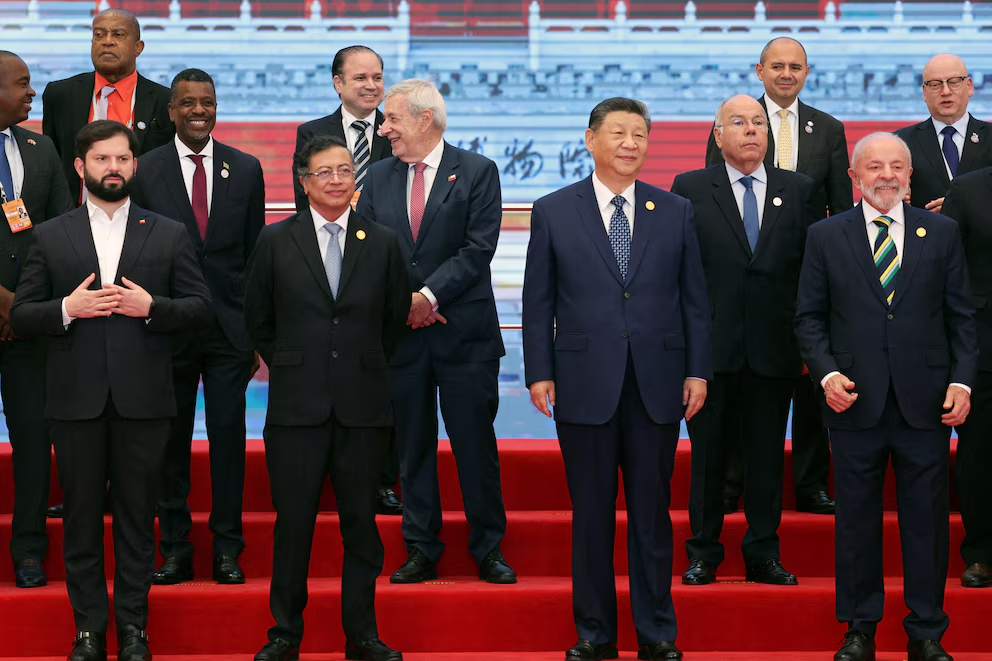
“Global Security Initiative” , the document devotes a broad section to security collaboration , which the People’s Republic of China refers to as its“Peace Program” . Although previous documents have mentioned China’s security-related activities in the region, the new document goes much further, giving itsblessing to the expansion of military training, exchanges, and activities in the region , including those involvingpolice and judicial personnel . It builds on the statements of intent from theChina-CELAC 2025-2027 plan , committing to expand law enforcement collaboration with the region. The document specifically mentions planned activities incombating corruption, money laundering, and cybercrime . Chinese President Xi Jinping, Brazilian President Luiz Inácio Lula da Silva, Chilean President Gabriel Boric, and Colombian President Gustavo Petro pose for a group photo before the opening ceremony of the China-CELAC Forum ministerial meeting in Beijing, China, on May 13, 2025. (REUTERS/Florence Lo/Pool)In the “Peace” section,
the document subtly criticizes the United States, declaring China’s opposition to “cyber hegemony,” presumably referring to U.S. attempts to exclude Chinese companies and components from Latin America’s digital infrastructure. It alsodeclares its support for the region as a “zone of peace” , likely referencing U.S. military operations in the Caribbean and the stated intention of the United States in its new National Security Strategy to expand U.S. military presence in the area and use it to launch lethal attacks against drug cartels “when necessary.”Finally, the section of the White Paper on“People-to-People Exchanges”represents a renewed effort by the People’s Republic of China to expand its soft powerand, possibly,
complement its espionage opportunities in the region through other commitments. On one hand, it declares the People’s Republic of China’s commitment to expand support for poverty reduction , social development andhealth in the region. On the other hand, it declares its intention toincrease “subnational” exchanges from China . The latter could be said to multiply the People’s Republic of China’s options to court mayors and other local officials below the radar of national scrutiny and the national government’s norms against cooperation with foreign governments. Historically, China’s policy white papers have been, without a doubt, good roadmaps for predicting the intentions of the People’s Republic of China in its areas of interest in the region. This document seems to declare its intention to advance confidently on all fronts, including sensitive sectors of infrastructure, technology, the military, and space, and people-to-people collaboration, which multiplies opportunities for influence and espionage, without deference or even acknowledgment of the sensitive points of the United States, which
will likely put it on a collision course with the United States in the region in the coming months and years. The author is a Senior Fellow at AthenaLab, a research professor on Latin America at the U.S. Army War College’s Institute for Strategic Studies.Published with the author’s permission. The opinions expressed here are strictly his own. Article originally published inwww.infobae.com.
Want to publish with us? Review our guidelines for external contributors.
View submission guidelines