Chile-Bolivia Relations: A Complex but Historic Opportunity
This article was translated automatically and may contain differences from the original. For reference, read the original.
- by Raimundo Jara
- Guest Contributions

Fuente: Minrel
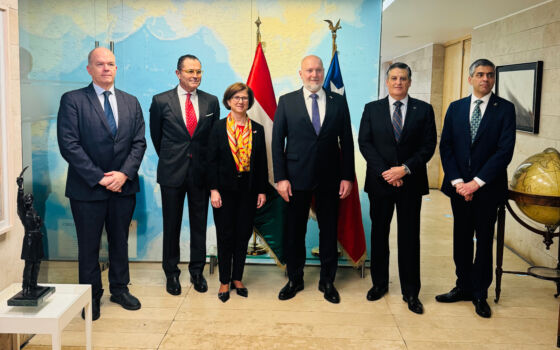
The end of 20 years of MAS dominance in Bolivia opens an unprecedented window of opportunity for our neighborhood. President Rodrigo Paz called for us to “stop certain nonsense” and promised, during his campaign and in office, to restore relations at the ambassadorial level. This was indeed the context for the recent visit to Santiago by Bolivian Foreign Minister Fernando Aramayo.
This visit was historic in itself, as it had been decades since a minister of that rank officially returned to the Chilean capital. It also reflected the distinctly pragmatic and, moreover, realistic approach of the new government in La Paz. In this context, efforts are being made to revitalize bilateral ties based on common issues such as borders, drug trafficking, security, trade, reciprocal investments, and the Sica Sica pipeline. This approach was evident in high-level meetings at Sofofa—the country’s most important business association—and at the Ministry of Foreign Affairs, with the signing of respective memorandums of understanding.
Foreign Minister Alberto van Klaveren described the visit as a “milestone” in the bilateral relationship. The reception from the Office of the President Elect (OPE) has also been open and pragmatic. During the campaign, José Antonio Kast supported his now-counterpart Rodrigo Paz, stating that “we have the same interest in restoring relations,” as they do not seek “to close the borders, but to have the collaboration of our neighbors.” However, the OPE is confident that the initiative will come from Bolivia, the country that severed diplomatic relations in 1978.
To move towards the desired outcome, Santiago and La Paz must address complex challenges that exceed the mutually beneficial issues mentioned. For our part, this includes studying past mistakes and, naturally, not repeating them; moving beyond the boastful narrative and behavior in sectors of the Chilean elite and population (in Bolivia, conversely, it is recognized as irredentist); renouncing ideological diplomacy of “the peoples” and “plurinational” that threatens the state as a unitary actor in foreign policy; forgetting the agenda of the thirteen points; perfecting compliance with the obligations of the 1904 Treaty for broad and free access to and from the Pacific for Bolivia (which encompasses numerous issues such as the Arica-La Paz train, docking conditions at Sica Sica port, and the reversal of the pipeline of the same name); among many others.
A special mention should be made of acknowledging and processing the error, at least from Chile, of not commemorating, in October 2024, the 120th anniversary of the signing of that treaty. This omission, which went unnoticed by the vast majority of the national press, meant disregarding the common, albeit complex, history of two neighboring countries. In journalistic terms, the structure was neglected while, in parallel, President Gabriel Boric and his then-counterpart Luis Arce were holding high-level discussions about the situation. These are the curiosities of our diplomacy. Taking responsibility for history is a sine qua non condition sine qua non to overcome the current state of relations. Fortunately, time offers a chance to remedy this oversight by commemorating 125 years in 2029 of a valid agreement, coinciding with the 100th anniversary of the 1929 Treaty with Peru, which, by the way, also involves—let’s leave euphemisms behind—La Paz.
As a digression, Paz and Aramayo have clarified that the interest in revitalizing relations with Chile does not come at the expense of their maritime aspirations, even citing the constitutionalization of this claim by Evo Morales in 2009, in contravention of the 1904 Treaty. It should be noted, however, that the Bolivian Foreign Minister himself admitted that “we also need to review the level of seriousness with which this issue was addressed,” adding that “there will also need to be accountability in Bolivia, in front of Bolivians, from the authorities who were in charge of this matter,” and dismissing the notion that this issue is the “anchor” for restoring relations.
In summary, the signals so far are promising in both countries. In Chile, there is great anticipation regarding the strategy of the elected president, who has professional international advisors with a strong past and present in Bolivia. Ultimately, this is the standard required to lead a complex but necessary endeavor.
Finally, it is uncertain how this convoluted equation, which requires strict political and diplomatic management, will fit within the profile of the designated foreign minister, a CEO for decades of one of the country’s main economic groups (Quiñenco, linked to the Luksic family), with extensive international networks that suggest a strategy focused primarily on commercial interests and attracting investments.
For the reassurance of readers, and judging by the statements of the future authorities, there will be greater certainties within the first 90 days following José Antonio Kast’s installation in La Moneda.
The opinions expressed in this section belong exclusively to their authors and do not necessarily represent the official position of the institution.
by Raimundo Jara
Subdirector Revista Realidad y Perspectivas (RyP) Programa de Relaciones Internacionales, Derecho U. de Chile