The challenge of institutionalizing municipalities as central actors in public security
This article was translated automatically and may contain differences from the original. For reference, read the original.

After decades of discussion and ambiguous definitions, Law 21,802 is published, formally institutionalizing the role of municipalities in crime prevention and public security. This advancement goes far beyond a simple transfer of competencies; it is the explicit recognition that effective prevention is, by nature, local, contextual, and multisectoral. The law represents a significant step forward in security policy by:
- Consolidating a preventive, social, and community approach as the main axis of municipal action in security matters.
- Structuring and formalizing a unique legal framework for practices that were already operating in a dispersed and heterogeneous manner, promoting national standards for professionalization.
- Establishing a formal mechanism for collaborative governance, by updating the operation of community councils and creating operational coordination committees, in order to improve territorial articulation between police, justice, and local governments.
MAIN STRUCTURAL MODIFICATIONS AND IMPLEMENTATION TIMELINE
A. NORMATIVE INNOVATIONS
1. Institutional strengthening
- Creation of the municipal security inspector (with suitability requirements and mandatory training).
- Strengthening of the Community Public Security Directorate.
2. Clear distinction regarding functions in the territory Autonomous preventive tasks are separated from support functions; the latter are under protocols and operational subordination to Carabineros.
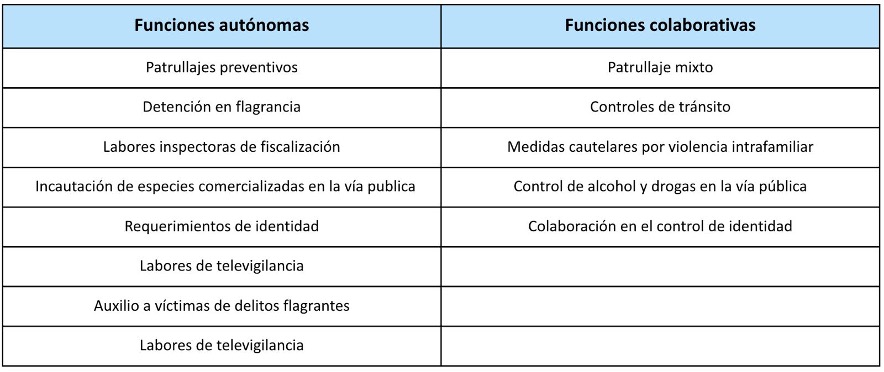
Source: Own elaboration
3. Tripartite hiring system
Three types of hiring are established to incorporate personnel, recognizing municipal diversity:
- Municipal officials (administrative statute).
- Municipal officials hired under the Labor Code (private labor regime with administrative responsibility). Personnel hired through municipal associations
- (hired under the Labor Code and must comply with obligations of integrity and transparency). Despite the contractual differences, there are cross-cutting conditions, such as the prohibition of recidivism for breaches of integrity; the duty of training (a national training system will be established), which includes training in human rights, gender perspective, proportional use of force, and first aid. Finally, all are subject to the same prohibitions (performing acts typical of the police, such as maintaining public order) and duties (confidentiality, reporting, and respect for human rights).
4.
Technology and data storage and exchange An interconnected platform will be implemented for the anonymized exchange of data between institutions. Additionally, systems of remote surveillance and audiovisual recording will be regulated, with an express prohibition on sound recording and maximum data retention periods.
5.
Urban design with a preventive approach An amendment to the General Urbanism Law is established to incorporate security criteria in territorial planning, constituting a long-term investment in security.
B.
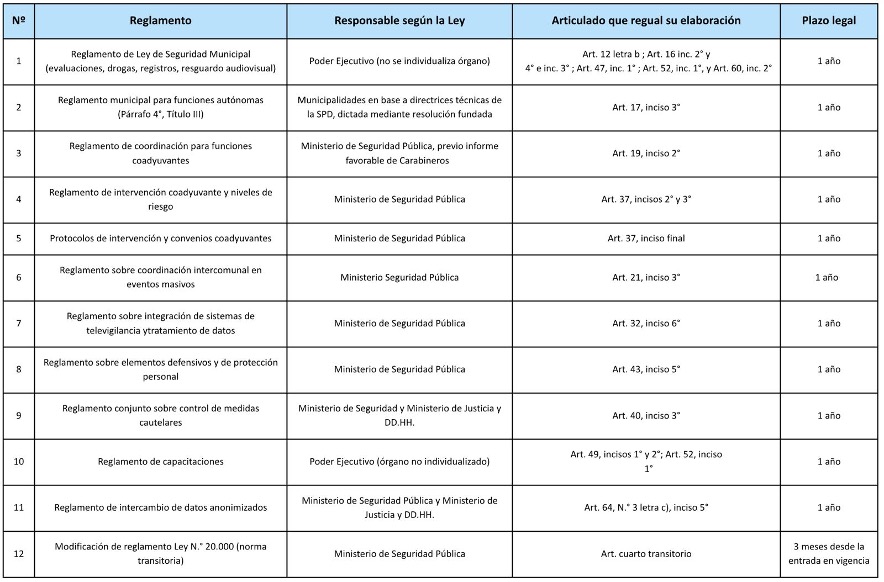
CRITICAL DEADLINES: THE REGULATORY RACE The effective implementation of the law depends on the issuance of a series of regulations, which must be developed within one year of its publication. This regulatory process is undoubtedly the backbone that will define operational, training, equipment, and coordination standards. The regulations are as follows:
Source: Own elaboration
CRITICAL VIEW: POTENTIAL RISKS OF THE NEW MODEL
1.
Strengths and opportunities Proximity legitimacy
- . A properly trained municipal security inspector can be a trusted and approachable actor for the community, thus facilitating reporting and early conflict resolution.Institutionalized local intelligence.
- The shared data platform, if implemented with technical rigor, can transform territorial intuition into actionable information—or improve existing information—allowing for focused and effective preventive public policies at all levels. Financial and operational flexibility for municipalities.
- The tripartite hiring system recognizes municipal diversity and avoids a one-size-fits-all approach, which is often inapplicable for small or highly vulnerable municipalities. Protection for security personnel.
- The law establishes, for the first time at the national level, the obligation to provide defensive and appropriate equipment, as well as the possibility of having life insurance, recognizing and mitigating the inherent risk of the role. 2.
Critical weaknesses and threats Risk of weak or delayed regulation
- . The effectiveness of the law depends on the technical quality and timeliness of the regulations. Hasty, bureaucratic, or unrealistic processes can undermine the content of the legislation.Possible disparity in implementation
- . Despite the mechanisms for association and transfer, there is a high risk of fragmentation and inequality. A municipality with higher revenues may have highly trained and equipped inspectors, while one with limited resources will depend on associative schemes and/or central transfers, with possible overload and less direct control. This scenario would not contribute and would increase existing gaps between municipalities. In this regard, it is crucial that the minimum standard, both in training and equipment, allows for the improvement and professionalization of security personnel functions.Overload and confusion of roles.
- The boundary between supportive function and police action is complex. Without exceptional training and constant supervision, there is a risk that security personnel may assume unprovided risks or operational conflicts with Carabineros due to poorly understood competency limits. CONCLUSIONS AND IMMINENT CHALLENGES
The law moves in the right direction by betting on local prevention, enforced coordination, and the creation of professional capacities. However, its success is not guaranteed. It depends more on the quality, timeliness, and demonstrated collaboration in its implementation than on the legal text itself. To achieve this, it is imperative to:
Demand and participate in high-quality technical regulation
- , with formal consultation spaces for municipalities and civil society.Actively monitor equity in implementation
- , developing indicators that measure not only crime reduction but also gaps in capacities, equipment, and training among municipalities.Ensure respect for fundamental rights,
- especially in the use of surveillance technology and in field interventions. Ultimately, this law ends the debate over whether municipalities should have a role in public security. However, the challenge that begins is much more complex: defining how that role is exercised effectively, equitably, and with respect for fundamental rights in 345 distinct realities that make up the municipal map of Chile. The process has just begun, and its critical observation will be essential for its success or failure.
Colaboradora AthenaLab