Update on the U.S. Military Intervention in Iran | April 9, 2026
This article was translated automatically and may contain differences from the original. For reference, read the original.
DOCUMENT NO. 4 ATHENALAB | Monitoring the Evolution of the Conflict
What has happened since our last report on the conflict?
In the past twenty days, the dynamics of the conflict between the United States and Iran have not changed significantly; however, the accumulated material damage and the pressure to reopen the Strait of Hormuz have been the most relevant aspects. When highlighting the main characteristics and facts, the following can be noted:
– Stability of the Iranian Regime: Despite precision operations, the succession of Mojtaba Khamenei as Supreme Leader has allowed the Islamic Revolutionary Guard Corps (IRGC) to maintain control of the state apparatus. The resilience of the command structure has exceeded previous estimates, demonstrating that the system has survived without fragmenting; apparently, with adjustments made as a result of previous stages of the conflict. The evolution of the situation indicates that the regime has prioritized internal stability over external pressure, neutralizing centers of political dissent.
– Strait of Hormuz: Iran has maintained an effective area denial capability in the strait, allowing the eventual and discretionary transit of some vessels. Of course, the implementation of a passage control system has altered global logistical costs; this system imposes tolls of between one and two million dollars per vessel to allow transit to the Gulf of Oman. Currently, vessels flagged from China, Russia, and India operate under direct coordination with the IRGC, while traffic from Western-owned vessels, or those linked to U.S. allies, remains restricted or subject to risks of seizure or attack.
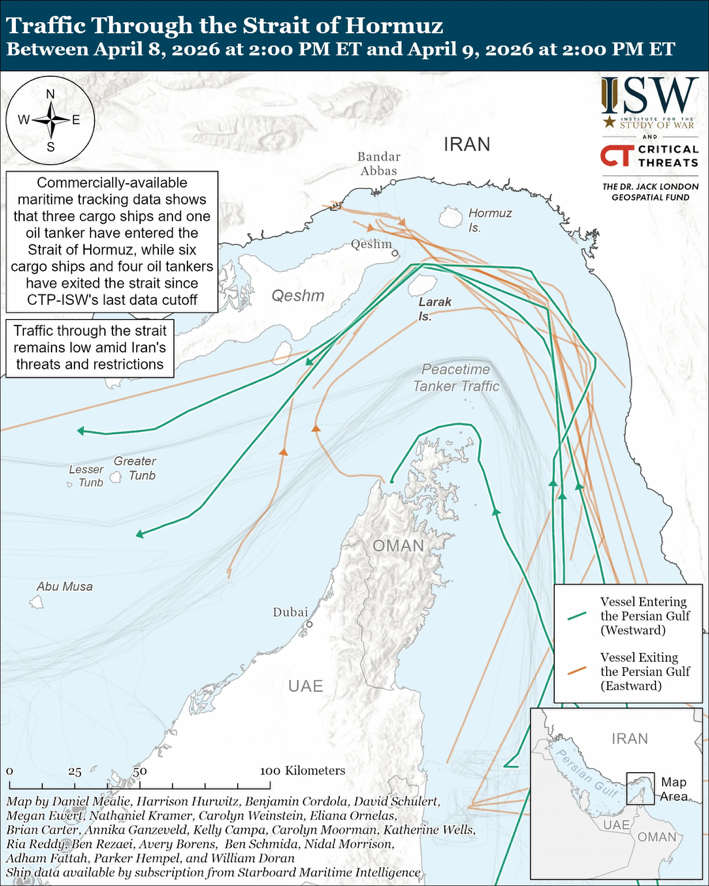
Limited traffic through the Strait of Hormuz between April 8 and 9.
Source: Institute for the Study of War (https://understandingwar.org/research/middle-east/iran-update-special-report-april-9-2026/)
– Potential Divergence of Objectives: Israel has consolidated operations in southern Lebanon, extending its attacks toward Beirut in order to degrade Hezbollah’s operational infrastructure. To date, this offensive has created a point of conflict that conditions the effectiveness of any agreement with Tehran. The persistence of Israeli attacks acts as an element of instability for the ceasefire between the U.S. and Iran, as Tehran perceives these actions as an indirect continuation of U.S. hostilities, given Hezbollah’s significance to the regime.

Hezbollah and Israeli attacks between April 8 and 9.
Source: Institute for the Study of War (https://understandingwar.org/research/middle-east/iran-update-special-report-april-9-2026/
– Islamabad Agreements: It is estimated that the most significant event in recent days has been the agreement between the United States and Iran to implement a 14-day ceasefire (initially), mediated by Pakistan. While this announcement led to a reduction in Brent crude prices, the effectiveness and stability of the agreement are in doubt due to events in the last 60 hours.
Current Situation and Evolution of the Ceasefire
The ceasefire initiated on April 7 presents a precarious stability due to significant differences in its scope and the guarantees demanded by the parties. In this context, based on the information available so far, it can be established that:
– Iranian Proposal: Tehran has proposed a maximalist 10-point negotiation framework. Among other things, it demands permanent non-aggression guarantees and formal recognition of its right to uranium enrichment for civilian purposes, as well as the right to control the passage of vessels through the Strait of Hormuz permanently. A critical point is the demand for economic compensation for damages suffered to its industrial infrastructure, including steel plants and refineries.
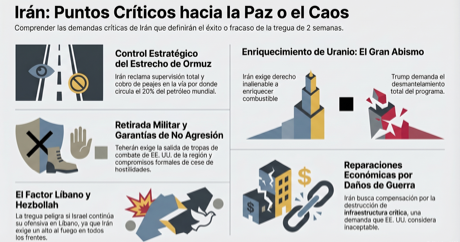
– Response from Washington: The U.S. administration considers the plan a starting point but maintains demands that complicate negotiations, which will resume at the end of the week. The total surrender of the enriched uranium inventory (approximately 450 kg) for international custody, or Iran’s right to control the Strait of Hormuz, are examples of this.
– Actions in Lebanon: Tehran conditions the maintenance of the truce on the cessation of Israeli activity in Lebanon, which evidences its relationship with the group. Conversely, Israel has maintained that its operations against Hezbollah are a matter of national security, independent of the commitment made by Washington. This lack of synchronization among allies appears to be the most immediate risk for the resumption of major confrontation.
– U.S.-Israel Objectives: The difference between what was announced on the night of April 7 regarding the cessation of operations and Israel’s actions in southern Lebanon shows, at the very least, a lack of coordination or consultation. While Washington seeks a diplomatic exit as soon as possible to stabilize global markets and mitigate political damage in an election year, Israel seems to prioritize the elimination of missile threats and proxies on its borders. While each state pursues and protects its interests, it would be expected that both countries would act in a more integrated manner.
– Global Pressure: Iran’s ability to regulate global energy flow has proven to be a more effective negotiating tool than its air defense. Control over the flow of crude oil (20% of global supply) grants Tehran an asymmetric capacity that directly impacts the stability of Western economies and the global cost of living.
Belligerents and Objectives
The stability of the ceasefire and the real possibilities of its becoming something more permanent continue to depend on the fulfillment of objectives and the perception in both countries regarding the chances of winning. On one hand, it seems that the United States has degraded, but not eliminated, all of Iran’s ballistic capabilities. However, the possibility of Iran conceding its ambition to continue its nuclear program appears to be further away than it was a month ago. This is not only due to the characteristics of the new authorities in Tehran but also because recent events and those in June 2025 reinforce the internal idea that an Iranian state with nuclear capabilities could be respected differently by its enemies and adversaries.
On the other hand, despite the elimination of much of the Iranian political and military leadership —in addition to losing most of its Navy— and seeing its military industrial capacity degrade to historic lows, facing the threat of destruction of what remains of productive and energy facilities, the regime considers survival through the U.S. military campaign a victory. It is true that the extensive damage will generate serious internal problems; however, for the regime, overcoming this period and remaining in power is a victory. Although its military forces have been devastated, they have managed to maintain the necessary resources to block passage through the Strait of Hormuz and use this as an increasingly powerful negotiating tool.
In this scenario, the United States has issued at least three ultimatums for maritime traffic to resume, but has not been completely successful. Even now, amid the ceasefire and the announced reopening, Iran continues to decide who crosses; apparently, Iran does not contemplate making significant concessions, despite threats of destruction. In a way, a situation is observed where it is not evaluated who gains more from peace, but rather who loses more from the continuation of war. Therefore, it is difficult to reach stable and permanent agreements, and what can be expected is that operations will continue to be prolonged.
Finally, two considerations. First, all indications suggest that the main parties involved will assert that they have won or defeated their enemy; however, none will have achieved their initial objectives. Second, regardless of the outcome of this stage of the conflict in the Middle East, it is unlikely that the underlying problems will be resolved. Consequently, it is quite possible that hostilities will arise again in the future.
Final Considerations
– While the news of a ceasefire has been positively received worldwide, the fragility of the agreement and the conditions that currently sustain it suggest that it should be observed with extreme caution and expectations should be tempered.
– Iran’s ability to regulate a significant portion of global energy flow has proven to be a more effective negotiating tool than its air defense. Control over the route through which one-fifth of the world’s oil supply passes has granted Tehran an asymmetric capacity that directly impacts the stability of Western economies and the global cost of living.
– The validation de facto of the unilateral imposition of tolls or restrictions in international straits —in this case, by Iran— sets an extremely delicate precedent. For countries dependent on maritime trade (such as Chile), the normalization of these practices threatens the stability of maritime routes.
– For U.S. allies in the Gulf, ceding control of the strait to Iran represents an unacceptable scenario. If the United States were to accept this demand —which is considered highly unlikely— it would imply recognizing Iran as an unavoidable power in the region and subjecting neighboring countries and other users of the strait to its economic and security terms.
– The development of military operations in recent weeks has reiterated the need to adequately define political objectives in the face of war and determine the best strategy to achieve them, which includes accepting expert advice (military and intelligence). Furthermore, it must be recognized that military resources and technology have both capabilities and limitations. Therefore, the strategy and the means to carry it out must be in absolute harmony, or there is a real risk of failure.
– The high price of oil continues to impact Chile directly and consistently. The rise in shipping costs and cargo insurance, combined with high hydrocarbon prices, creates constant pressure on national production costs. This affects the competitiveness of exports and, of course, also influences inflation.
– Given the above, the increase in fuel reserves should be evaluated, not only to mitigate the immediate effect of rising prices but also to ensure access to energy for longer periods, which increases the country’s strategic autonomy.
– Similarly, just as significant progress has been made in diversifying the national energy matrix, other energy sources, including nuclear energy, should be explored.