Strategic Decisions: From the Missile Crisis to the Middle East
This article was translated automatically and may contain differences from the original. For reference, read the original.

When we observe the current conflict in the Middle East and simultaneously hear comments from various perspectives attempting to explain what is happening, we cannot help but think of theories regarding decision-making processes and how they can provide greater clarity to better understand and explain phenomena in the international arena. Expressions from some analysts such as “there is no strategy in actor A,” or “the intelligence of country A or B has failed,” rather than generating clarity, end up oversimplifying the analysis and often confuse audiences regarding a truth that is always difficult to identify and interpret.
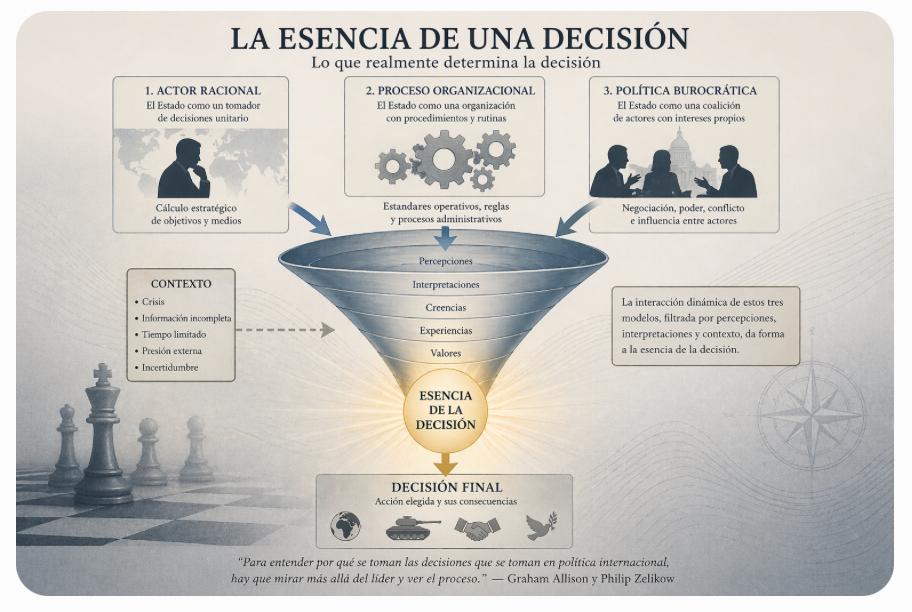
In considering the above, the models developed in the book Essence of Decision: Explaining the Cuban Missile Crisis[1], by authors Graham Allison and Philip Zelikow, emerge as a possible tool. It is one of the most influential texts in the field of foreign policy analysis. This book questions the idea that states predominantly act as coherent units, following a rational process in which they have evaluated the most important alternatives. The work develops three models of decision-making in crises and conflicts: the rational actor model; the organizational behavior model; and the governmental politics model. The main hypothesis is that no conflict or crisis can be analyzed from the perspective of a single model or lens.
Therefore, to approach a developing conflict and improve its analysis, we propose to conduct a brief analysis from the three models mentioned above, applying their main postulates to the current conflict developing between the United States, Israel, and Iran. We will argue that this framework remains fully relevant and we apply it to observable facts as of April 13, 2026, following the failure of the talks held in Islamabad. As a result, Washington began a naval blockade of Iranian ports, while simultaneously maintaining neutral transit to non-Iranian destinations through the Strait of Hormuz. Meanwhile, Israel continued its offensive on the town of Bint Jbeil in southern Lebanon, considered a stronghold of Hezbollah, while European allies such as the United Kingdom and France have refused to join the blockade, although they insisted on the need to reopen navigation in Hormuz. The conflict, therefore, combines relatively clear strategic objectives, specific organizational responses, and a politically fragmented coalition.
Consequently, the purpose of this brief article is to demonstrate that the framework of Allison and Zelikow allows for a better understanding of the current war than a purely geopolitical reading focused solely on “rational states.” The hypothesis is that the conflict can only be satisfactorily understood if the three models are articulated: the first explains the strategic ends, the second the organizational forms that decisions take, and the third the political fragmentation intra-state and inter-allied.
Models developed by Graham Allison and Philip Zelikow
We mentioned that the main contribution of Allison and Zelikow is to propose three models for explaining state decision-making. The first model, the rational actor model, assumes that the state acts as a unit that defines objectives, evaluates courses of action, and chooses the means that best maximizes its interests. The second, the organizational behavior model, holds that what we observe is often the product of organizations that operate through standard procedures, inherited capabilities, and bureaucratic routines. Finally, the third model, the governmental politics model, asserts that foreign policy decisions often emerge from negotiations, competitions, and compromises among actors situated in different positions within the state apparatus and, of course, with varying levels of influence. In other words, this last model emphasizes the interactions between superiors and subordinates within an organizational model.
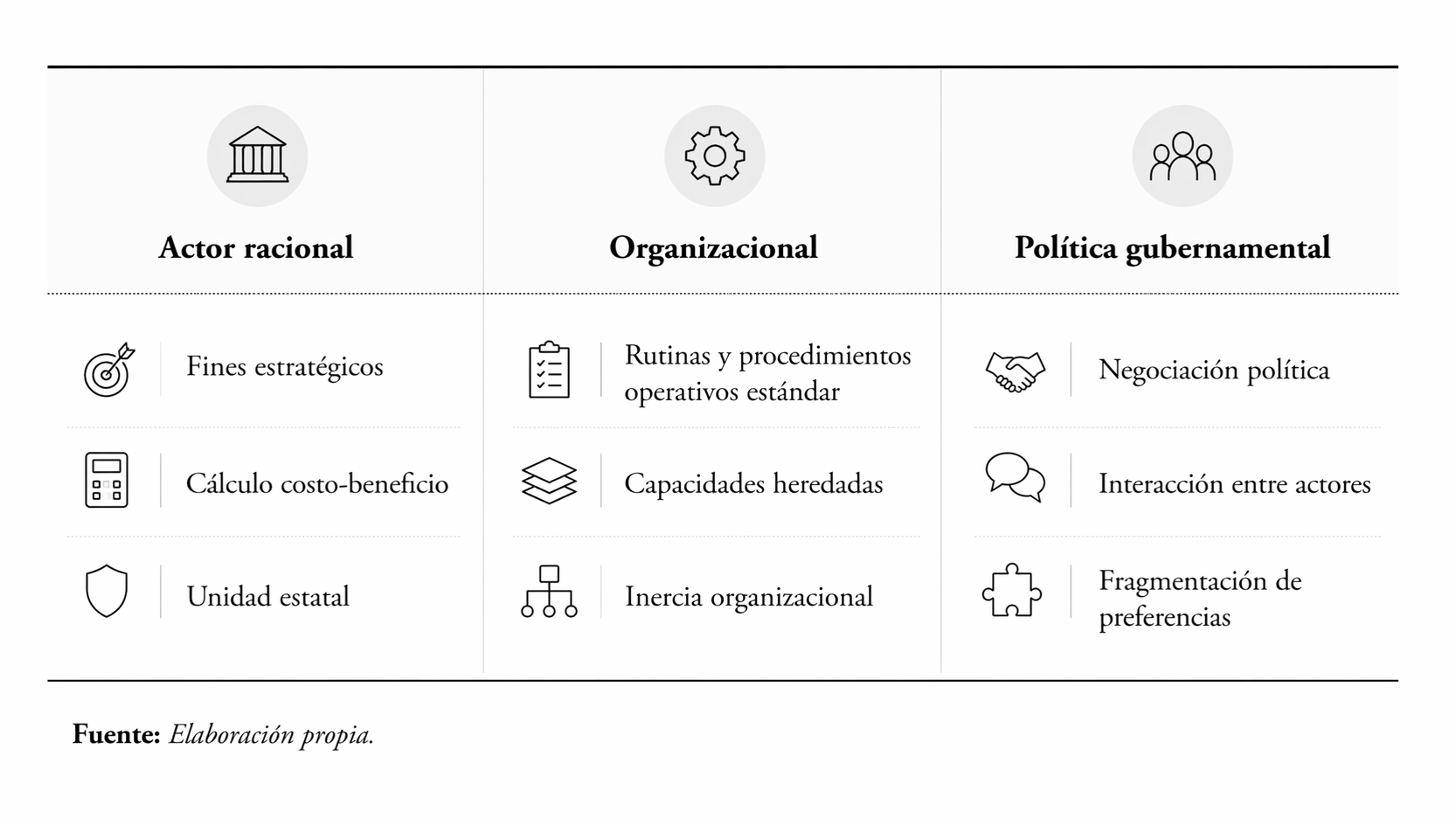
We have already highlighted that the utility of the book does not lie in choosing one of these models and discarding the others, but in showing that each illuminates a different dimension of the same phenomenon. It is like applying different lenses to the same sample under a microscope, keeping in mind that each lens reveals a particular dimension of the same fundamental and objective reality.
Thus, Allison and Zelikow themselves have insisted that the best explanations are those that intertwine factors identified by the three models. This idea is particularly relevant for contemporary crises, where strategic rationality coexists with bureaucratic friction, limited improvisation, and unstable coalitions.
Application of the models to the analysis of the conflict
1. Rational actor model
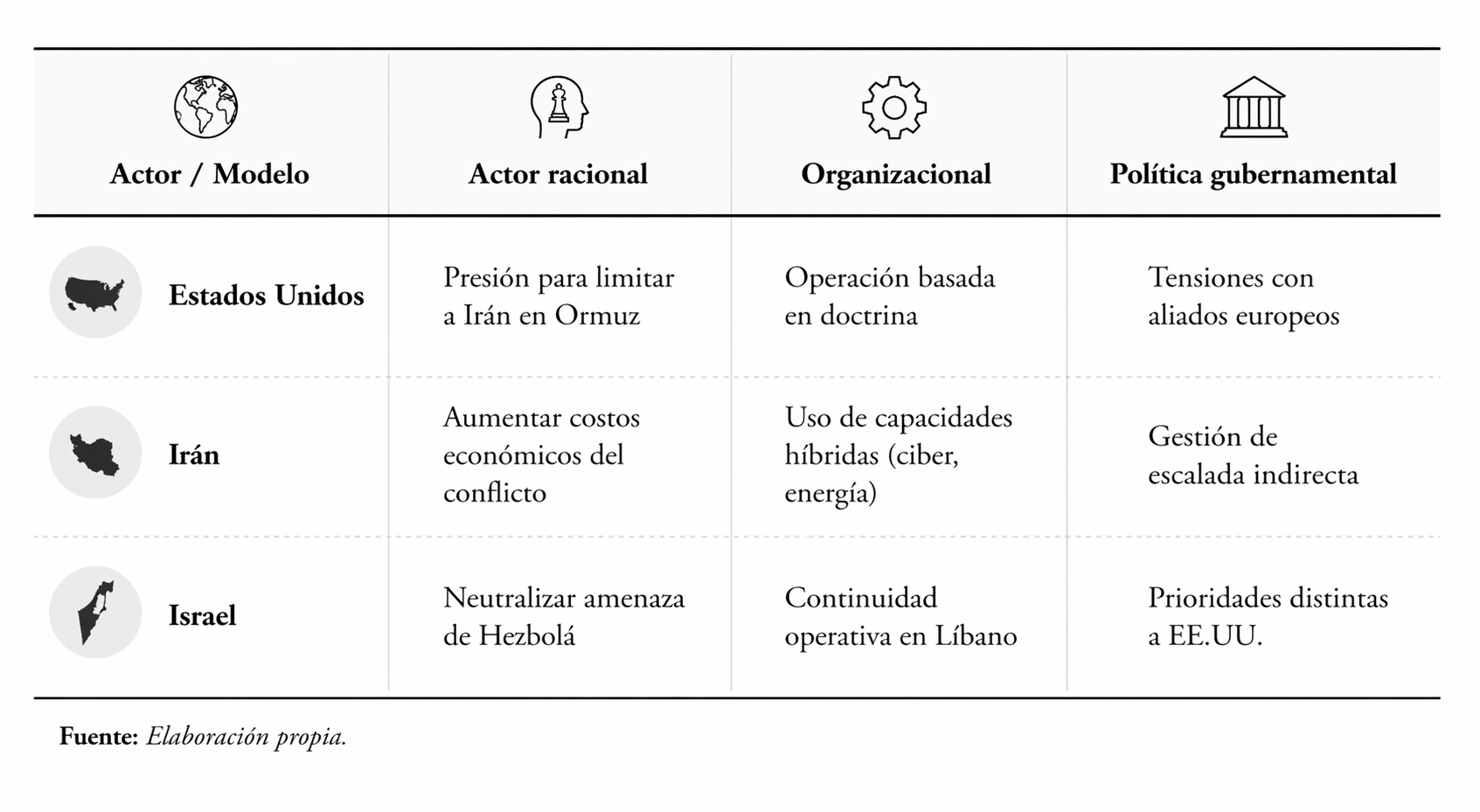
From this first model, the current war can be read as a confrontation between actors pursuing relatively defined and observable strategic ends. In the case of the United States, the blockade of April 13 appears as a coercive measure aimed at preventing Iran from consolidating control over the Strait of Hormuz as a leverage tool and reinforcing the demand that Tehran does not develop military nuclear capability. Various media outlets have reported that the blockade was activated after the failure of the Islamabad talks and that Washington maintained neutral passage to non-Iranian destinations, suggesting a logic of selective pressure: punishing Iran without completely shutting down global trade.
In this context, blocking Iran or preventing it from using the strait as a coercive lever is, from the U.S. perspective, a rational decision aimed at protecting a maritime chokepoint in the international system, economically pressuring Iran, as the United States has done thus far, with the aim of bringing it to the negotiating table and seeking a ceasefire that makes it possible to end the conflict.Iran, in turn, also fits into a rational actor logic, albeit asymmetrically. It lacks the conventional superiority of the United States and Israel but retains sufficient capability to turn the systemic vulnerability of Hormuz into a form of pressure and a strategic weapon. This is based on the use and combination of maritime coercion, energy pressure, cyberattacks, and indirect escalation of the conflict. From this perspective, Tehran does not need to militarily defeat Washington: it only needs to raise the economic and political costs of the war, according to the observable logic thus far.Israel can also be interpreted rationally. While Washington prioritizes the maritime front, Israel maintains its offensive against Hezbollah in southern Lebanon. As of April 13, media reports indicate that Israel expects to achieve complete operational control of the town of
Bint Jbeil
within a few days. From the first model, this behavior reflects a strategic differentiation between the Iranian dossier and the threat of Hezbollah: even if there is a partial truce with Tehran, Israel does not consider its security problem on the northern border resolved. The limitations of this first model are clear: it explains the ends well, but it is not sufficient to explain why decisions take exactly those forms. It shows why the United States blocks, why Iran uses Hormuz, and why Israel continues to operate in Lebanon, but it does not sufficiently illuminate the institutional and bureaucratic dimension of the decision-making processes of the various actors. Leadership in this model is a factor of analysis due to its direct influence on the final decision-making processes. 2.
Organizational behavior model
This model allows us to understand that decisions are not necessarily just abstract choices, but responses shaped by organizations with doctrines, cultures, capabilities, and standardized procedures. The U.S. blockade, for example, is not simply a presidential decision; it is an operation that depends on an Operational Command such as the Central Command of the U.S. armed forces and specific interdiction rules. It has also been observed that the resolution distinguishes between navigation to Iranian ports and neutral transit to other destinations, revealing a response configured by pre-existing operational repertoires and not necessarily by the unlimited creativity of political leadership. On the other hand, the continuity of the Israeli campaign in Lebanon is also more intelligible from this model. Once a military organization has deployed forces, intelligence, logistics, and combat sequences over a theater, organizational inertia weighs heavily. The operation in the town of Bint Jbeil suggests precisely that: a military machinery already activated, with its own tactical objectives and operational rhythms, which does not automatically stop because the diplomatic situation changes on another front. The second model, therefore, helps explain why the truce between the U.S. and Iran did not translate into an equivalent pause in Lebanon.
Additionally, in the case of Iran, both the Iranian Revolutionary Guard and the Quds Force, as well as the paramilitary Basij, clearly represent organizations that have influence in the decision-making processes within the Iranian regime across all 31 Iranian provinces. We could assume that their stance is relevant in Iran’s negotiations and decisions.
Moreover, this model allows for the incorporation of non-state actors. The disruption of Hormuz does not depend solely on military threats but also on the behavior of shipping companies, insurers, ports, and energy companies that operate with risk and compliance protocols. The very objective weight of the strait in global energy trade implies that small alterations in the perception of risk generate chain organizational reactions. Thus, the strategic outcome of the conflict also emerges from private organizations that are not part of the state apparatus but materially condition the functioning of the system.
3. Governmental politics model
This third model is particularly useful for understanding why the Western response has been fragmented. Various media outlets have reported that the
United Kingdom and France
refused to participate in the U.S. blockade, although both governments supported the reopening of the strait and promoted multinational defensive formulas to restore freedom of navigation once hostilities were contained. The President of the European Commission, Ursula von der Leyen, defined that objective as of “paramount importance” [2] . There is, therefore, partial agreement on the end, but not on the means. This is precisely the type of “political resultant” that Allison and Zelikow associate with negotiations among various actors with non-identical preferences.This model also sheds light on the relationship between Washington and Israel. Public evidence shows convergence in pressure on Iran, but not necessarily complete identity of agendas. Washington has reacted through a combination of blockade and conditional negotiation; Israel, on the other hand, maintains the priority of the Lebanese front. This is not necessarily a rupture, but rather a coalition whose members share general threats but do not prioritize the theaters of war or their security priorities in the same way. This assertion is ananalytical inference
based on the observable divergence between the U.S. maritime blockade and the continuity of the Israeli offensive in the town of Bint Jbeil. Furthermore, the very transition of the United States from the truce announced on April 7
to the maritime interdiction on April 13 can also be read from this approach. It was reported that the suspension of bombings for two weeks was conditioned on the reopening of the strait and that the truce was fragile from the outset. The failure of Islamabad and the subsequent leap to the blockade suggest a decision that is not only military but also political: an intermediate coercive measure capable of showing firmness without immediately returning to a massive air campaign. Again, the model does not directly prove what occurred within the U.S. government, but it does allow for a consistent interpretation with observable facts. Final Considerations The main lesson from the work considered for this brief analysis, “
Essence of Decision
applied to the war between the United States, Israel, and Iran is thatno model alone is sufficient to explain or understand observable phenomena . The first model, the rational actor model,explains strategic ends well: preventing Iran from transforming Hormuz and its nuclear program into a political advantage, sustaining Israeli security, and degrading Hezbollah. The second, the organizational behavior model, better explains the concrete forms of action: selective blockade, continuity of ongoing campaigns, and behavior of organizations operating with pre-existing routines and capabilities. In contrast, the third model, the governmental politics model, illuminates or clarifies the political dimension of the conflict: divergences among allies, partially overlapping agendas, and decisions that emerge as results of negotiations among various actors, rather than as products of a single will. In substantive terms, the conflict as of April 13, 2026, shows a transition from a phase of direct bombing to a phase of maritime coercion and political fragmentation
. The United States and Israel maintain conventional military superiority, but Iran retains strategic veto capability through Hormuz and the systemic risk it generates over energy, trade, and a potential regional escalation. It is precisely for this reason that the lesson or proposal of Allison and Zelikow remains relevant: the essence of strategic decision-making is rarely found in a single mind or a single rationality, or in a single motive.Rather, it arises from the interaction between ends, organizations, and politics
. It is in the joint consideration of these three elements that the possibilities of having better information and understanding the observed phenomenon with greater precision are expanded. Therefore, analyses must take these three elements into account to better express the reality of any developing crisis or conflict, thus illustrating more clearly to audiences or readers interested in following its evolution. Essence of Decisionexplains how decisions are made in foreign policy based on the Cuban missile crisis.
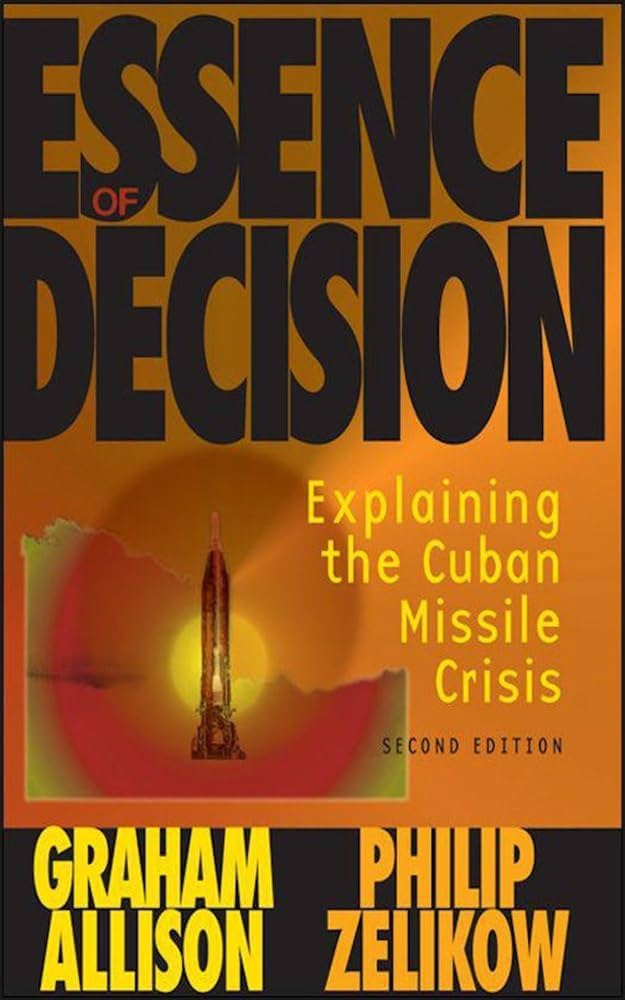
Graham Allison and Philip Zelikow argue that it is not enough to view the state as a rational and unitary actor. They propose three models: rational actor, organizational process, and bureaucratic politics. Thus, decisions depend on both strategic calculation and institutional routines and disputes among authorities. The book shows that international crises are better understood when strategy, bureaucracy, and internal power are analyzed simultaneously. Download this analysis
[1]
Allison, Graham T., and Philip Zelikow.
Essence of Decision: Explaining the Cuban Missile Crisis . 2nd ed. New York: Longman, 1999. [2]https://es.marketscreener.com/noticias/restablecer-el-tr-fico-en-el-estrecho-de-ormuz-es-de-importancia-primordial-afirma-von-der-leyen-ce7e50ded889f120#:~:text=La%20presidenta%20de%20la%20Comisión%20Europea%2C%20Ursula,de%20Ormuz%20es%20de%20importancia%20primordial.%20Sus&text=%2D13%20de%20abril%202026%20a%20las%2012:53%20%2D%20MarketScreener%20España.