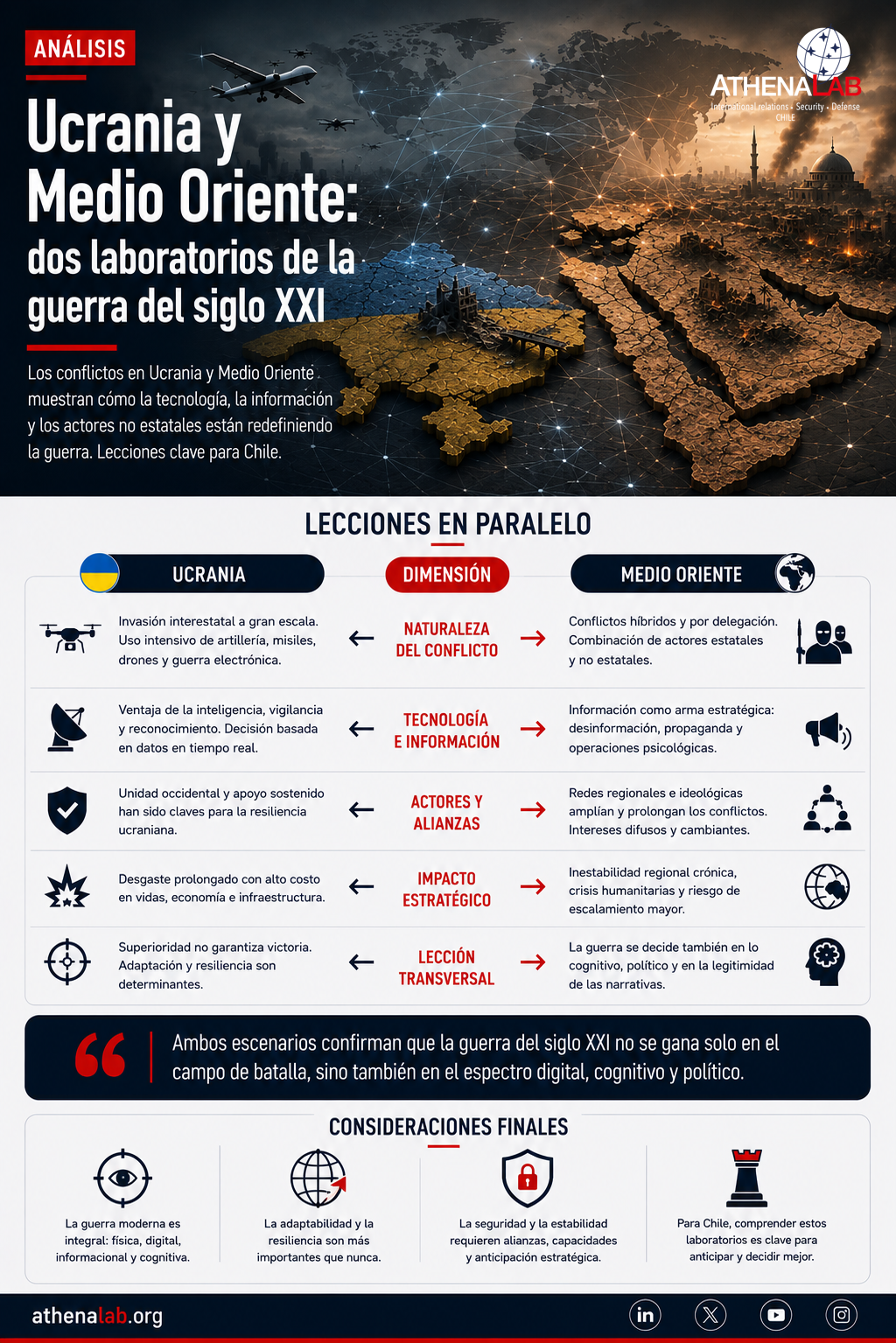
Ukraine and the Middle East: Two Laboratories of 21st Century Warfare
This article was translated automatically and may contain differences from the original. For reference, read the original.
1. Introduction
War, as a subject of study, has a nature and a character. The nature refers to its essence: that which remains relatively constant over time. The character, on the other hand, varies according to the historical context and the conditions in which it unfolds. Factors such as geography, doctrine, politics, and technology, among others, influence it. This article focuses precisely on the character of the two most relevant conflicts in the current international landscape—the war between Russia and Ukraine and the war in the Middle East—to identify useful lessons regarding the contemporary use of force.
One of the most visible features of current conflicts is the technological acceleration in weapon systems, driven by disruptive innovations and an increasingly close integration between civilian and military technology. The result is the consolidation of integrated operational ecosystems—observation, surveillance, target acquisition, intelligence, long-range fires, unmanned platforms, and electronic warfare—that shorten decision cycles and increase the speed at which a target can be detected, tracked, and attacked. Although the final decision remains, in most cases, human, there are already multiple examples of partial automation or limited autonomy in certain weapon systems.
From this perspective, both the war between Russia and Ukraine and the armed conflict in the Middle East should be understood less as isolated conflicts and more as laboratories in which military techniques, methods, and doctrines are being tested.
2. Lessons from the War between Russia and Ukraine
The war between Russia and Ukraine has shown that a lesser power can reduce asymmetries by intelligently combining unmanned systems, software, data centers, tactical dispersion, civil-military innovation, and industrial adaptation. Ukraine has effectively exploited the integration of intelligence and firepower to compensate for part of its material inferiority. The first lesson, therefore, is that military innovation can alter the relative balance on the battlefield, although it does not replace the need for mass, sustainment, and external support.
The second lesson is that technology has not eliminated the friction of war; it has only displaced it. The current battlefield offers more information and reduces some of the classic uncertainty, but at the same time generates new sources of complexity, such as dependence on links, software vulnerability, competition for the electromagnetic spectrum, partial autonomy of systems, and the need for digital resilience. The fog of war (fog of war, Clausewitz) does not disappear; it changes form. Therefore, technological acceleration coexists with greater operational complexity.
This complexity has favored a war of positions rather than a war of deep maneuver. Maneuver requires concentration, surprise, coordination, penetration, and exploitation in depth. Today, all of this is more difficult under conditions of constant surveillance, near real-time detection, and interference with command means. To maneuver successfully, it is no longer enough to gather forces; it is necessary to degrade the adversary’s ability to detect, transmit, and strike accurately. Maneuver remains possible, but its demands are greater.
A third lesson is transversal: modern warfare has not replaced attrition but has sophisticated it. Precision does not eliminate the need for volume, reserves, maintenance, replenishment, and industrial depth. Ukraine managed to maintain some artillery parity in the initial phase, but by June 2022, Russia had achieved an approximate advantage of 10:1 in fire volume. The conclusion is clear: except for the United States, no NATO member had sufficient stocks or industrial capacity, with limitations, to sustain a prolonged large-scale war. This necessitates a critical review of the just in timelogistics model. In high-intensity conflicts, a just in caselogic, based on reserves, redundancy, and resilience, is imposed. Force is no longer measured solely by the number of brigades, tanks, or aircraft, but by the national capacity to sustain combat for months or years.

The fourth lesson revolves around the contest for detection and precision. The electromagnetic spectrum has become a decisive domain. Navigation, communications, sensors, unmanned systems, and command and control depend on networks that can be interfered with, degraded, or nullified. Hence, a key doctrinal idea: precision is no longer a guaranteed attribute; one must fight for the conditions for its use. The integration of sensors, fires, electronic warfare, and distributed command has become a basic condition for combined operations. The force that cannot protect its links, degrade those of the adversary, and operate under conditions of interference will lose speed, cohesion, and the ability to destroy effectively.
In parallel, Ukraine has demonstrated that airspace can remain contested for long periods even under conditions of decisive air inferiority. Air defense has ceased to be a complement and has become a condition for operational survival. Cheap drones, cruise missiles, ballistic missiles, hypersonic systems, and combined attacks aimed at saturating defenses drastically expand the range of threats. The response can no longer rely solely on expensive interceptors. Future air defense must be multi-layered, distributed, adaptable, and also cost-effective.
The main conclusion in the war in Ukraine is political. Russia has caused massive destruction and occupied territory, but has not managed to transform its initial superiority into a quick political victory. Ukraine, for its part, has used force not only to resist but also to maintain national cohesion, secure Western support, and wear down its adversary. The Ukrainian case shows that future wars will depend less on a decisive platform and more on integrated systems capable of learning, sustaining themselves, and adapting over time. That is the true challenge and lesson observed.
3. Lessons from the War in the Middle East
The war between the United States, Israel, and Iran confirms another central transformation in the use of force. Military superiority no longer depends solely on destroying targets but on integrating precision air power, persistence, defense, intelligence, industrial resilience, and escalation control. Unlike conflicts centered on territorial occupation, this war combined aerospace campaigns, missile and drone attacks, maritime coercion in the Strait of Hormuz, operations against strategic infrastructure, and indirect pressure through associated actors. Although the main phase of direct combat may seem contained, the crisis continues on maritime, diplomatic, energy, and regional fronts. This constitutes the underlying problem.
The first lesson from this armed conflict is that precision air power can significantly degrade strategic targets, but does not guarantee definitive political results on its own. The destruction of facilities, command centers, air defenses, missile depots, or nuclear infrastructure may alter the immediate military balance, but does not ensure that the adversary will accept the imposed conditions. It is a classic lesson, now confirmed once again. Air power can destroy, disrupt, and disorganize very effectively, but it is much less effective when required to produce, on its own, a strategic surrender, a regime change, or a profound political transformation.
The second lesson is again transversal: modern precision campaigns remain wars of attrition, although that attrition is expressed in sophisticated inventories, supply chains, and replenishment times. In the weeks leading up to the ceasefire, the United States would have intensively employed a set of critical munitions, and in several cases, expenditure may have exceeded half of the inventories prior to the conflict. Replenishment, moreover, could take between one and four years. This has a greater strategic implication: a regional war can weaken deterrence capacity in another theater, particularly in the Indo-Pacific.
The third lesson relates to geography and strategy. Iran does not need to conventionally defeat the United States or Israel to generate global effects. It is enough to threaten, restrict, or condition navigation through the Strait of Hormuz. In 2025, nearly 20 million barrels per day of oil and petroleum products circulated through that route, in addition to a significant proportion of global LNG trade. Control or the threat over a chokepoint can compensate for military asymmetries. Hormuz functions not only as an operational space but as a geoeconomic weapon capable of transferring the cost of war to energy markets, insurers, shipping companies, importers, and global supply chains.
The fourth lesson is that the campaign against a state is not limited to the territory of that state. Iran retains the capacity to expand the theater through associated actors, especially Hezbollah and other regional groups. Similarly, by attacking other states in the region. Therefore, war cannot be understood as a strictly bilateral interaction. It operates over a regional network of militias, bases, ports, energy routes, embassies, civil infrastructure, economic interests, and public opinion. An attack on Iran may trigger responses in Iraq, Syria, Lebanon, Yemen, the Gulf, and even outside the region. Military planning must incorporate from the outset scenarios of indirect retaliation, sabotage, cyberattacks, pressure on allies, and information operations.
| For example, adjusting means and methods to objectives, or adjusting objectives to the reality at hand.. |

The decisive conclusion is again political. The use of force requires a theory of victory, that is, a coherent explanation of how military effects will produce the desired political outcome. Destroying targets does not automatically equate to winning. Degrading the nuclear program, striking command centers, or blocking ports may be insufficient if the adversary retains will, capacity for retaliation, and internal control.
4. Final Considerations
Both conflicts confirm that the nature of war remains essentially the same, but its character changes rapidly under the influence of doctrine, technology, capabilities, and political context. The main conclusion is not that a completely new war has emerged, but that the ways of employing force have become faster, more transparent, interdependent, and demanding. Future wars will depend less on isolated platforms and more on integrated systems capable of combining observation, decision, fire, protection, sustainment, and adaptation. But even that technical transformation remains subordinate to a classic condition: without a theory of victory that connects military means and political ends, tactical success may continue to coexist with strategic failure.
The center of gravity is not always military. In Iran, it may reside in the cohesion of the security apparatus, the narrative of resistance, regional coercion capacity, and control over strategic routes. Similarly, in Ukraine, it may be the will to fight and resilience of one of the actors. A campaign that destroys capabilities may fail strategically if it does not alter the political will of the adversary or, conversely, creates new incentives to prolong the confrontation.
Technology will continue to play a central role in the use of force. In this regard, it is relevant not only to focus the analysis on the comparison between opposing means and weapons. For example, it is not necessarily correct to compare the cost of a sophisticated interceptor missile versus a low-value drone; rather, one must consider the system necessary for these weapon systems to function efficiently, where databases, command and control systems, satellites, data centers, energy systems—among others—play a crucial role. The use of both systems will increasingly require greater reliance on integrated systems and artificial intelligence, which are typically not visible but are an integral part of the employed weapon system.
John Griffiths Spielman
Executive Director AthenaLab
Download document
Strategic Snapshot