The Makkah Pact and the New Deterrence Market: Key Aspects of the Collective Defense Agreement Between Saudi Arabia, Turkey, and Pakistan
This article was translated automatically and may contain differences from the original. For reference, read the original.
SUMMARY
On August 7, Saudi Arabia, Turkey, and Pakistan signed an agreement in Makkah declaring that an armed attack against any of the three will be considered an attack against all. This report explains the contents of the pact, its precedents, and the factors that may have triggered its signing. It is suggested that this new agreement is part of the reconfiguration of strategic alliances among countries due to an increasingly tense global context.
WHAT HAPPENED
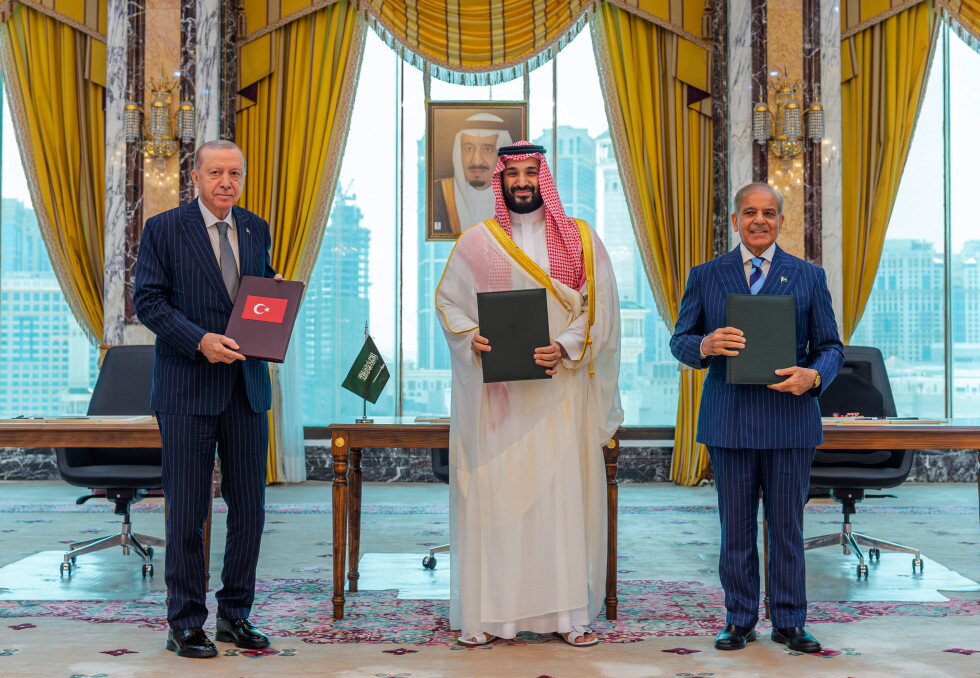
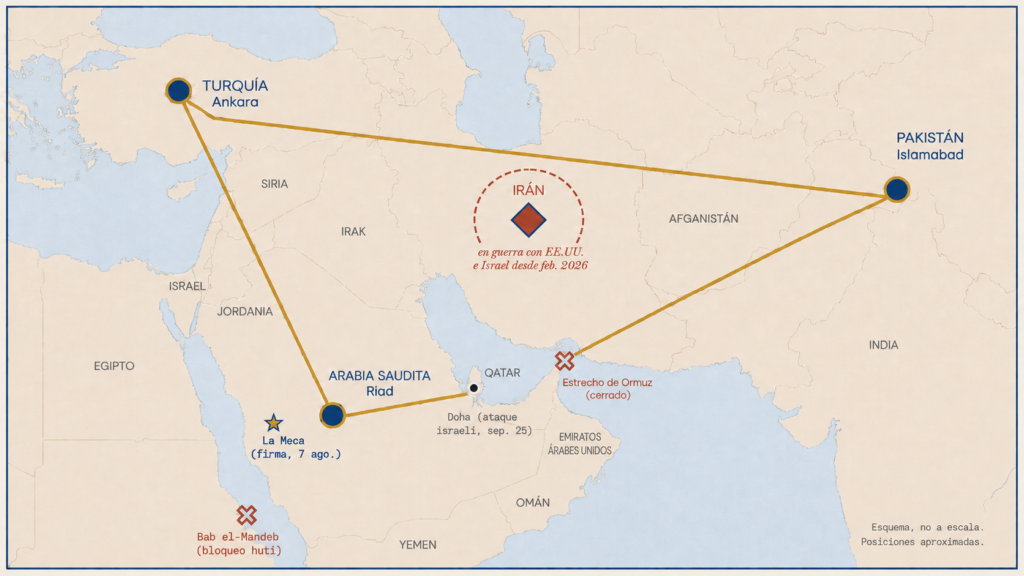
At the Al-Safa Palace in Makkah, Saudi Crown Prince Mohammed bin Salman, Turkish President Recep Tayyip Erdoğan, and Pakistani Prime Minister Shehbaz Sharif signed a Joint Defense Agreement. The official statement stipulates that any armed attack against one of the three states “will be considered an attack against all” and commits to the development of cooperation in all areas of defense.[1]. Turkish Foreign Minister Hakan Fidan provided further details about its institutional architecture. The agreement includes a committee of ministers, political and military instances, as well as a permanent secretariat based in Saudi Arabia. Minister Fidan compared this design to NATO’s Article 5[2].
The pact incorporates Turkey into the mutual defense agreement that Riyadh and Islamabad had already signed in September 2025[3] and is open to new members. Turkey identified Egypt as a candidate for the next stage. Saudi Arabia hastened to limit the scope of the agreement, clarifying that it does not constitute a military axis or a sectarian bloc and that it is not “linked to nuclear ambitions”[4].
THREE ACTORS AND AN ERODED SECURITY GUARANTEE
The convergence of these three countries carries political, military, and symbolic weight. Saudi Arabia contributes economic and energy resources, in addition to its religious centrality as the custodian of Islam’s holy sites. Turkey, for its part, has the second-largest army in NATO and an expanding defense industry. Pakistan adds one of the largest armies in the world and a unique status: it is the only Muslim nuclear power, with an estimated arsenal of around 170 warheads[5]. As a platform for collective security, the now-called Makkah Pact 2026 thus acquires a relevance that transcends the Middle East.
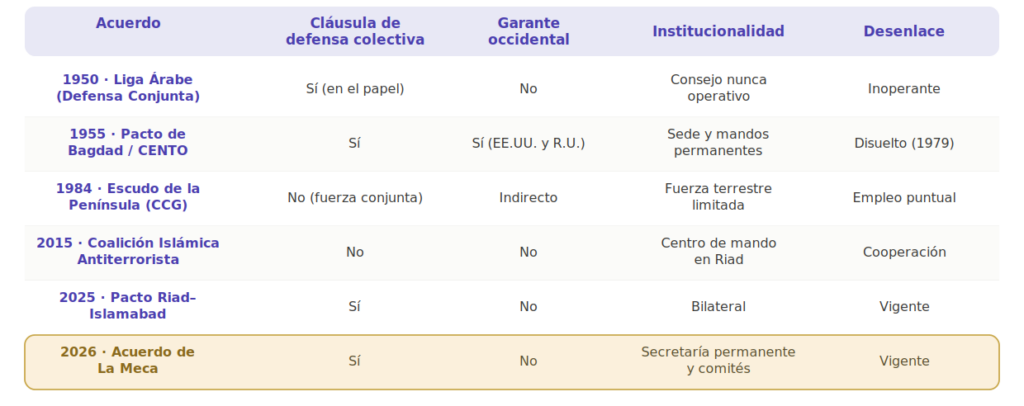
However, regional history advises caution before attributing it a capability that it has yet to demonstrate. The Arab League Joint Defense Treaty (1950) did not generate operational capacity, and the Baghdad Pact (1955) dissolved within a few years. In the 1980s, the Peninsula Shield Force of the Gulf Cooperation Council (GCC) followed a similar trajectory, and the Islamic Coalition Against Terrorism of 2015 failed to convert its political commitments into robust collective defense[6].
Figure 1. The interest triangle of the Makkah Pact 2026.
THE TRIGGERS
The pact was signed in August 2026, but its antecedents had been developing beforehand. The security guarantee offered by the United States in the region severely eroded after the Israeli airstrike against Hamas’s leadership in Doha, Qatar, in September 2025. The episode revealed an uncomfortable vulnerability, as the territory of a partner protected by Washington could be attacked by another U.S. ally without that protection preventing the strike. It is significant that, eight days later, Saudi Arabia and Pakistan finalized their bilateral pact.
More recently, the trilateral expansion of the pact found a second impetus in the war with Iran. Since the United States and Israel attacked that country in February 2026, Iranian reprisals have reached bases and facilities in eight countries in the region, including Saudi refineries. The conflict also closed the Strait of Hormuz, while the Houthi blockade of Bab el-Mandeb exacerbated maritime insecurity. Meanwhile, Turkey and Israel have deepened their diplomatic tensions[7].
Figure 2. A genealogy of attempts: collective defense in the Islamic world.
Source: Own elaboration based on historical sources and official statements.
THE RETURN OF INTERSTATE WARS AND THE RECONFIGURATION OF ALLIANCES
The Makkah Pact 2026 is best understood within a transformation that exceeds the Middle East. The return of interstate conflicts and the managed confrontation between the United States and China have made the strategic environment more uncertain, leading numerous countries to reassess the guarantees upon which their defense rests.
This reassessment takes various forms. NATO has raised its defense spending commitment to 5% of GDP[8]. In Europe, France and the United Kingdom have deepened the coordination of their nuclear capabilities, while in the Indo-Pacific, flexible mechanisms among countries sharing specific interests have gained traction[9]. Together, these movements show a trend toward complementing traditional alliances with arrangements that expand the operational margin of their members.
The Makkah agreement takes this logic a step further. The deterioration of the U.S. guarantee and the increased exposure of its regional partners accelerated the search for self-capabilities. Saudi Arabia, Turkey, and Pakistan responded with a regional defense commitment that strengthens their autonomy without displacing the strategic centrality of the United States. The outcome points to a Middle East where security begins to be organized with greater regional initiative, although Washington retains a decisive role.
A NUCLEAR UMBRELLA WITHOUT A SUPERPOWER?
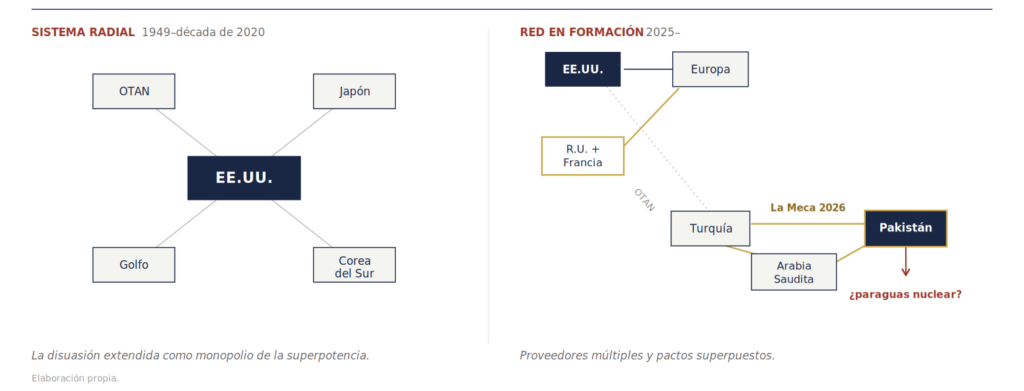
The most sensitive question of the agreement does not appear in the signed text. For nearly eighty years, extended deterrence (the promise to protect an ally under the backing of one’s own nuclear arsenal) has primarily rested on great powers. The United States has been its main provider through NATO and its alliances with Japan and South Korea.
The Makkah Pact 2026 presents a less common scenario: that a medium nuclear power extends, explicitly or implicitly, its deterrent capacity over other states. The text maintains significant ambiguity, as it avoids any reference to the nuclear component. Saudi Arabia has dismissed that interpretation, while Pakistan has refrained from clarifying the extent of its commitment. However, there is a relevant precedent. In September 2025, the Pakistani Defense Minister stated that the bilateral agreement with Riyadh included “all military means,” without clarifying whether this included its nuclear arsenal[10].
The implications allow for two readings. The first points to a stabilizing effect. An external umbrella could reduce Saudi Arabia’s incentives to develop its own nuclear capability, a possibility that Riyadh has hinted at in response to the Iranian program. The second opens a more disruptive scenario. The pact could set a precedent for medium nuclear powers to extend security guarantees outside traditional architectures, potentially linking them to financing or political alignment. India and Israel would have reasons to reassess their own strategic calculations[11].
Figure 3. The extended deterrence market opens up.
Source: Own elaboration.
KEYS TO OBSERVE
Four indicators will allow for the evaluation of how the new pact evolves:
- Institutional credibility. The first ministerial meeting will show whether the political commitment begins to translate into joint planning and shared capabilities, or remains in the declarative realm.
- Potential expansion. The inclusion of Egypt would change the scale of the agreement and could make it the core of a broader Islamic security architecture.
- Cross entrapment. Turkey’s dual membership raises a sensitive question: what would happen in a crisis that activated commitments from NATO and the Makkah 2026 in different directions?
- Nuclear signals. Any doctrinal change, exercise, or deployment that allows for determining whether the current nuclear ambiguity begins to acquire operational content will need to be observed.
DIEGO SAZO
Head of Research in International Relations
[1] Saudi Press Agency, “Saudi Arabia, Türkiye, and Pakistan Issue Joint Statement of the Makkah Al-Mukarramah Summit for Joint Defence”, August 7, 2026, https://www.spa.gov.sa/en/N2649227
[2] Article 5 of the Washington Treaty (1949) considers an armed attack against an ally as an attack against all, although it leaves each state to decide the measures it deems necessary, including armed force. It has only been invoked once, after the September 11, 2001 attacks.
[3] The Strategic Mutual Defense Agreement was signed in Riyadh on September 17, 2025, by Crown Prince Mohammed bin Salman and Prime Minister Shehbaz Sharif. The agreement introduced an unprecedented collective defense clause for the Saudi-Pakistani relationship, although the Gulf already had precedents of collective defense within the framework of the GCC. See Center for Strategic and International Studies, “Could the Pakistani-Saudi Defense Pact Be the First Step Toward a NATO-Style Alliance?”, October 14, 2025.
[4] Statements by Rayed Krimly, Saudi Undersecretary for Public Diplomacy, and President Erdoğan, reported in “Saudi Arabia, Pakistan and Turkiye Sign Defence Deal Amid Regional Turmoil”, Al Jazeera, August 7, 2026, https://www.aljazeera.com/news/2026/8/7/saudi-arabia-pakistan-and-turkiye-sign-defence-deal-amid-regional-turmoil
[5] SIPRI Yearbook 2025: Armaments, Disarmament and International Security (Oxford University Press, 2025). Pakistan also maintains a doctrine of “full-spectrum deterrence,” which includes short-range tactical nuclear weapons originally conceived in response to India.
[6] The Arab League Joint Defense and Economic Cooperation Treaty (1950) provided for a common defense council that never achieved operational capacity. The Baghdad Pact (1955), renamed CENTO after Iraq’s exit, dissolved in 1979 with the Iranian revolution. The Peninsula Shield (1984) is the joint force of the Gulf Cooperation Council, used sporadically, as in Bahrain in 2011. The Islamic Military Coalition Against Terrorism (2015) groups over 40 countries under Saudi leadership, without a mutual defense clause.
[7] Reuters, “Erdogan Says Israel’s Attacks on Syria, Lebanon Threaten Turkey Too”, June 10, 2026, https://www.reuters.com/world/middle-east/erdogan-says-israels-attacks-syria-lebanon-threaten-turkey-too-2026-06-10/
[8] Diego Sazo and Carmen Gresse, “Current European Rearmament: Why More Military Spending Does Not Guarantee Strategic Autonomy”, AthenaLab, August 3, 2026, https://www.athenalab.org/noticias/2026/08/03/el-rearme-europeo-actual-por-que-mas-gasto-militar-no-garantiza-autonomia-estrategica/
[9] John Griffiths and Diego Sazo, “Managed Confrontation: The Indo-Pacific After Shangri-La 2026”, AthenaLab, June 9, 2026, https://www.athenalab.org/noticias/2026/06/09/confrontacion-administrada-el-indo-pacifico-tras-shangri-la-2026/
[10] Statements by Pakistani Defense Minister Khawaja Asif to Geo TV, reported by Reuters and Al Jazeera, September 18 and 19, 2025.
[11] On the strategies of states seeking their own or external nuclear security, see Vipin Narang, Seeking the Bomb: Strategies of Nuclear Proliferation (Princeton University Press, 2022).