Public Security and Armed Forces
This article was translated automatically and may contain differences from the original. For reference, read the original.
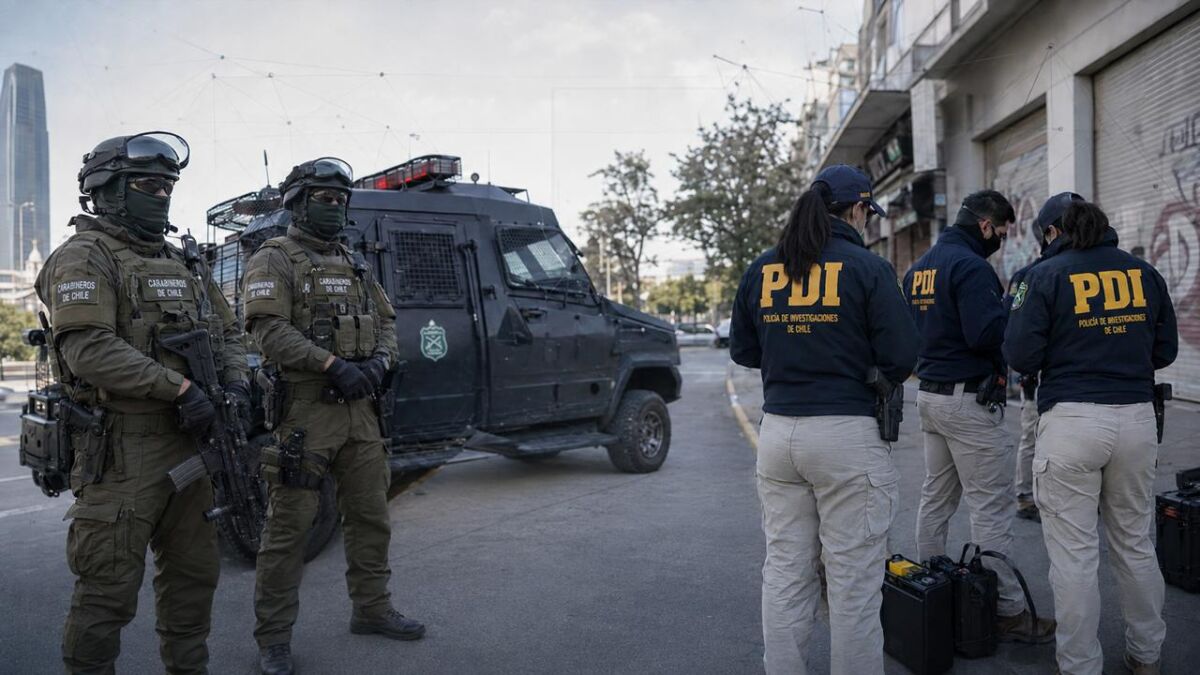
After several days of debate, on the afternoon of Monday, August 17, the message from the President of the Republic to the National Congress was made public, which, as stated in the text itself, “initiates a constitutional reform project that strengthens the national public security system and creates a new constitutional state of emergency for public security.”[1]. The document addresses modifications that can be summarized in three areas: explicitly introducing the duty of the State to safeguard public security, establishing registers of organized crime and terrorist organizations, and incorporating a new constitutional state of emergency. This analysis by AthenaLab will focus primarily on the last aspect, given the relevance of the project considering the participation of the Armed Forces (FFAA) in public security activities.
It is true that the security initiatives being promoted by the current government are not limited to legislative matters; rather, they greatly exceed them, including administrative measures and, certainly, decisions aimed at improving efficiency. However, the idea of adding a new constitutional exception to engage the FFAA in normally police missions raises concern.
WHAT THE PRESIDENTIAL MESSAGE PROPOSES
First, in what is relevant to this analysis, the initiative aims to explicitly add the term “public security” to Article 1 of the Political Constitution of the Republic (CPR), following the phrase “national security.” This is considered unnecessary, as it must be recognized that “public security is not distinct from national security, but rather its internal dimension: a species within a broader genus. The same applies to national defense, its external dimension.”[2].
As proposed, adding a new “undefined term to Article 1 of the Constitution, instead of clarifying the first, confuses it.”[3]. Therefore, before adding a new concept, it is advisable to clarify what is meant by national security and what role public security plays within it.
Similarly, the reform aims to create a new constitutional state of emergency (EEC) that would be added to the four already existing, termed “public security.” This EEC would consider the following:
- Cause: Serious and imminent threat to public security or when it has been severely affected;
- It is declared by the President of the Republic, determining the affected areas;
- It cannot extend for more than 120 days, but the presidential authority could extend it for the same period (up to 240 days);
- In case of requiring successive extensions, the agreement of Congress will be required;
- The determined areas will be under the authority of a General Officer designated by the president;
- The rights that could be suspended are: Personal freedom and mobility and the right to assemble.
- Likewise, the rights of: Personal freedom and mobility, the right to assemble, the right to associate, intercepting, opening or searching documents and all kinds of communications, and requisitioning goods could be restricted.
- In addition to indicating that a constitutional organic law will determine the powers and duties of the authority in charge, it will also define the powers of the Public Order and Security Forces, as well as the collaboration that the FFAA may provide and the applicable coordination, control, and accountability mechanisms.
To justify this initiative, the presidential message presents the following arguments:
- It establishes that the state duty of protection operates in two directions. Consequently, it holds that the State fails in its obligations both when it violates rights and when it omits to protect them.
- It identifies that the current regime is insufficient, as organized crime, without constituting the hypotheses of external attack, internal disturbance, or public calamity, affects public security, controls territories, and infiltrates institutions. Therefore, an instrument would be required that enables action before the situation becomes irreversible.
- It asserts that there is a constitutional precedent in the case of terrorism. It argues that while this phenomenon and organized crime are not equivalent in legal terms, they are functionally comparable due to their persistence, violence, and institutional penetration.
- The proposal states that Chile has undertaken demanding international commitments such as the Palermo Convention, ratified in November 2004, which obliges the country to have tools capable of dismantling organizations with transnational capacity. Consequently, the reform would provide the institutional framework necessary to fulfill that duty.
WHY THE REFORM IS UNNECESSARY
The Diagnosis
The first step before solving a problem is to identify, understand, and describe it. From this analysis, the type and nature of the issue will emerge, and consequently, the type and nature of the response. The internal security situation in Chile is complex, worse than it was ten years ago, although it is comparatively less risky than the rest of the Latin American region. There is a shared conviction that the government of Chile cannot be satisfied with the notion that we are not as bad off as others; rather, as the current administration is working, it must improve security conditions in a society that is more fearful.
The figures clearly indicate that violent crimes have increased, expressions of organized crime such as kidnapping, extortion, and contract killing have risen, and the use of firearms in the commission of crimes has reached levels not previously observed in the country. If in 2018 Chile had 4.5 homicides per 100,000 inhabitants, by 2022 it reached 6.7, and in 2024 it reached 6.0. At the same time, the perception of insecurity has risen to levels that place Chileans among the societies with the highest negative indices worldwide[4].
In summary, both the objective and subjective aspects of security have deteriorated[5]. However, all indications suggest that the nature of the problem remains one of a police order and within the sphere of public security. It is understandable that the State should not refrain from employing all available resources to address national security issues, but it would be expected to start by evaluating primary options before evolving toward more extreme alternatives, which will be analyzed later. If the threat of organized crime were such that it jeopardized the existence of the State, and the continuity of political authorities and police forces were overwhelmed without options to impose the rule of law, the idea of employing the FFAA in public security functions would be shared; however, it is not perceived that the country is in that situation.
On the contrary, it is estimated that, unlike most countries in the region, Chile has a stronger institutional framework and professional and effective police forces. It is true that the situation has progressively deteriorated in recent years and action must be taken with firmness and decisiveness, but at the same time, with prudence and strategic vision. When analyzing cases such as those of Mexico, Colombia, and Ecuador—all of which have involved the FFAA in the fight against organized crime—it is evident that they lived in very different contexts from those in Chile, presented more fragile democracies than the national one, and their police lacked the capabilities and recognition that our country possesses. Furthermore, the results of such decisions are, at best, limited. So far, despite everything, there is no evidence that the level of strength of organized crime has surpassed that of Carabineros or the Police Investigations (PDI).
Finally, it is perceived that the diagnosis for deciding on the proposed reform could be improved, and there is no clear and comprehensive strategy. In this regard, before employing the FFAA, it would be advisable to clarify some doubts:
- What is the problem that is intended to be solved by incorporating the FFAA into public security matters, beyond what is already considered in the CPR? Is it merely to have the possibility of employing them at some future point?
- If they are employed, what functions are intended for the FFAA in public security matters?
- How many personnel are needed, and what type of units? Do the FFAA have sufficient personnel and resources?
- For how long would the units be deployed, and in how many areas simultaneously?
- What is the State willing to have the FFAA cease doing, and what risks is it willing to assume for this?
The public force is in effect
Secondly, if it is accepted that the problem faced is of an internal order, which even constitutes a matter of national security, it is estimated that the constitutional modification is unnecessary, as the order and security forces are still adequate to combat organized crime. This does not deny that we are facing new problems, but it is believed that the solution lies in adapting and strengthening the institutions that have been created and organized for such functions, whose essential nature is to combat this scourge.
For example, in the case of Carabineros, Constitutional Organic Law No. 18961 identifies, in the first article of the text, that this institution “exists to give effect to the law; its purpose is to guarantee and maintain public order and internal public security throughout the territory of the Republic.” From this, it is logical to think that, should it be necessary to support the functions of the uniformed police, it would be in those tasks complementary to their essential mission and not in what defines them. Involving the armed forces in such tasks, when the order and security forces continue to perform their function and are adequate, is considered unnecessary.
If the problem were that the police are overwhelmed or incapacitated to impose order, then we should resort to other instruments. On the contrary, if the issue is that they are becoming insufficient, then the solution lies in making them sufficient, both in terms of quantity and capacity. Consequently, before exploring an alternative that facilitates the employment of the FFAA, it is expected that initiatives aimed at increasing their efficiency will be evaluated. Ideas that have circulated in recent discussions, such as increasing the personnel of Carabineros and the PDI, take time and have complexities.
However, what can be done more quickly, and where the FFAA and other institutions can participate, is to help free officials from tasks that are secondary in light of the challenges to be faced. If the essential function of the uniformed police is to guarantee and maintain public order, and that of the PDI is to conduct investigations, then they should focus and specialize primarily in that.
If the strength of the civil police lies in complex investigations, it could address complex inquiries related to drug trafficking, the search and recovery of vehicles, benefiting the uniformed police. If the size and urgency of the challenge are so great that it leads us to consider employing the FFAA in public security, then we should opt to replace Carabineros—temporarily or permanently—in responsibilities such as mountain rescues, judicial notifications, some traffic control tasks, or even ceremonial tasks such as guarding the Presidential Palace. There are capabilities for this, and it does not require substantive changes such as a constitutional reform.
There is no doubt that the entire State and society must support the challenge of combating organized crime, but it must do so by exploiting the various capabilities in the best way. So far, there is no evidence that the police are incapable of confronting organized crime.
There are already regulations to address the challenge
Thirdly, if it is still evaluated to employ the FFAA in public security functions because the situation so requires, it is considered that the initiative is unnecessary since the current legal framework already contemplates this alternative in the CPR. However, if the motivation to promote the constitutional reform is to make the employment of defense institutions more flexible for use in less serious situations than those contemplated until now, then the discussion is different. We hope that this is not the case.
On the contrary, it is observed that the EEC of Emergency provides sufficient tools for the State to deploy the FFAA to face public security tasks when the deterioration warrants it.
FIGURE 1. Comparative chart between the EEC of Emergency and the EEC proposed in the constitutional reform
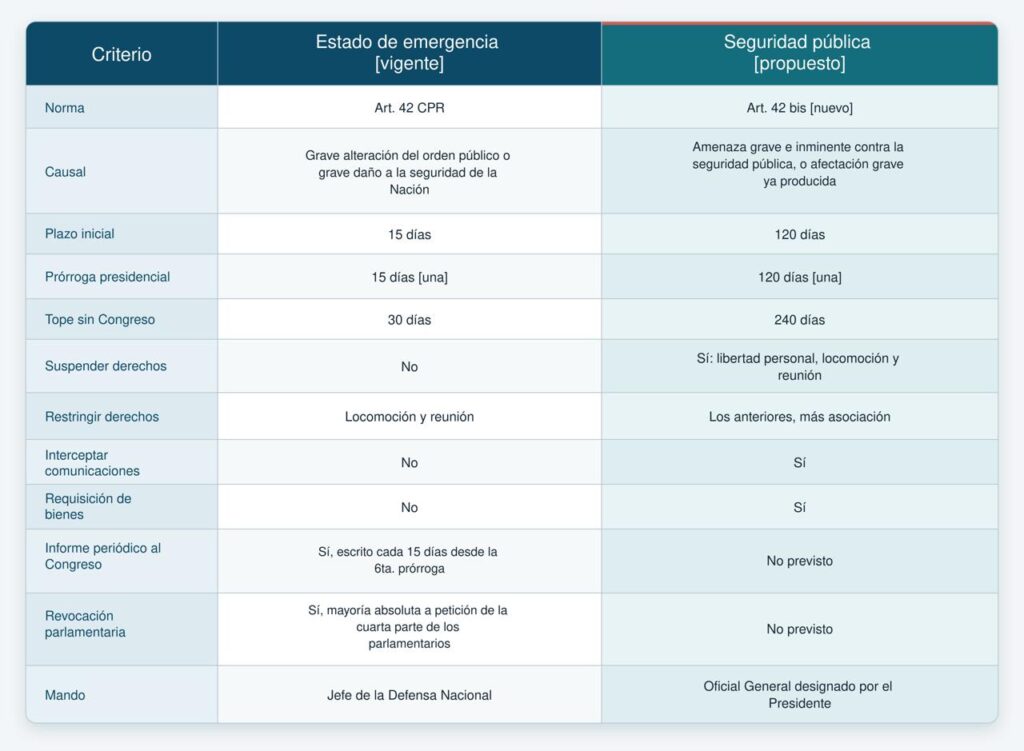
Source: Own elaboration based on the provisions of the CPR and Presidential Message No. 134-374, dated August 10, 2026
WHY THE REFORM IS INCONVENIENT
Just as the proposal is considered unnecessary, it is also deemed inconvenient. The inconvenience is affirmed by the fact that Chile presents sufficient institutional strength to continue addressing current challenges. That said, it is recognized that part of the institutional framework is not sufficient or efficient for the problems posed by organized crime, and thus improvements must be made. Changes in the functioning of courts, the performance and effectiveness of the prosecution are examples of this. No one suggests diminishing the autonomy of the Judiciary; however, it is clear that democratic control of the powers of the State must be exercised when they are not up to the circumstances or, definitively, do not fulfill the function assigned to them by the CPR.
It is estimated that dragging the FFAA into fulfilling public security functions for long periods without the gravity of the matter requiring it is, in a sense, to acknowledge the failure of the State and the police. Clearly, this is not the case, and we are far from it. The police still maintain high levels of capability and respect from society. Perhaps what is lacking is the decisive role of politics in this. The commitment of the current authorities is not in doubt, as their efforts and the measures being promoted are recognized; however, the political class in general is significantly responsible for the deterioration in respect for the norms and authority that the police have traditionally represented in this Republic. The relativization of property destruction as a supposed form of citizen expression, the judicial persecution of police and military personnel in the context of the events that occurred in October 2019 and subsequently, is difficult to conceal at this point.
Likewise, the incorporation of the FFAA in the manner proposed is considered inconvenient, as the results of Latin American experiences have not been positive in the medium and long term. Experiences are important and should be weighed according to the particular context and institutional reality of each country, not necessarily importing solutions.
Furthermore, the project under analysis opens alternatives that, at another time and with different authorities, could be used as an excuse and for different purposes, more related to control over society. An EEC in which rights are limited and individual freedoms are affected, which can be extended for up to 240 days before being subject to Congressional oversight, weakens democratic control over exceptionalism.
Similarly, it is inconvenient because the spectrum of missions that could be demanded of the FFAA, whether in time, geographic space, or personnel demand, is not clear and leaves too much open to interpretation. This, in turn, demands even more from the defense institutions, which have been fulfilling tasks under exceptional circumstances for years, with fewer personnel, for longer periods, and with an increasingly limited budget. This new EEC would only exacerbate the problem, affecting the essential function of the FFAA, which is the defense of the country.
It is not to assert that the FFAA cannot act in internal scenarios or to confront public security problems. There is currently a legal framework for them to do so, and indeed, they have done so. What is indicated is that the conditions and circumstances do not justify it, and that, if done in the current context, it is neither good, necessary, nor convenient. If the public security emergency were such, it would be expected that before modifying the CPR, the National Security Council would be convened to hear the opinions of the various authorities represented. This has not happened. If the emergency were of such magnitude as to convene the FFAA, it would be understood that the police have been overwhelmed, which is not the case. There is a deterioration of our internal security, but it must be addressed with the appropriate instruments. Let us use the full force of the State, strategically, with a long-term vision, without the need to modify the institutional framework based on a diagnosis that needs to be improved and completed.
Finally, it is estimated that the ambiguity of stating that the authority in charge of the area declared in EEC will be a General Officer without specifying the type of institution is also inconvenient. This is because the fact that the FFAA must intervene in public security matters suggests that the responsible forces have been surpassed, thus requiring the employment of different institutions and authorities, in this case, from national defense.
It is recognized that public security is of interest to the population and that there is currently support for it; however, if that were the reason, other ideas should also be considered, such as the support for eliminating general taxes like the value-added tax (VAT), but that does not mean that the authorities advance in that direction, as they recognize that it is not good for the national community and the common good in the long term.
WHAT CAN BE DONE THEN
Consequently, if from this perspective the proposed reform is considered unnecessary and inconvenient, what can we do? In this regard, the current government has developed and is developing multiple initiatives, which is commendable. The Ministry of Public Security leads actions in various areas, as has been observed in relation to prisons, legislative initiatives, and clear demonstrations of support for police action, just to name a few examples. However, gathering proposals from various discussions, areas and actions that can be effective are identified, and before advancing the idea of reforming the constitution, it is worth evaluating and testing them. In addition to what has already been proposed in this document:
- Modernize and improve the justice and criminal prosecution system to be effective and meet societal demands;
- Strengthen prevention as a legitimate long-term model;
- Consolidate and perfect the existing institutional framework in all areas that the public security system encompasses;
- Prioritize the specialization of the police in more concentrated areas, where the PDI could focus primarily on complex investigations, while Carabineros handle security and public order functions;
- Support the police’s role in tasks that are secondary to their essential roles, with the participation of other State institutions, in order to free up resources and efforts for the main tasks;
- Develop a National Security Architecture as proposed by AthenaLab, strengthening the national intelligence system;
- Demonstrate to the various institutions and individuals engaged in combating organized crime a cross-party political will of support, not only the backing of the current government authorities as has been seen, but from the entire spectrum. Otherwise, trust will not be generated, and the decision to act on behalf of society as a whole and to protect the common good will continue to weaken.
Ultimately, everything is aimed at recovering and strengthening the rule of law and the State of law. This means that the State must not refrain from imposing public order, utilizing the monopoly on the legitimate use of force that society, through the CPR, has granted it.
FINAL CONSIDERATIONS
- The analysis presented here aims only to contribute to the discussion generated by the new constitutional reform initiative. It is not a corporate defense of certain institutions, as has been suggested by individuals related to the matter, nor does it intend to be the final word.
- It also does not seek to deny or exclude the FFAA in case they are necessary to confront public security problems—they have done so—but it is believed that this is not the case, and there are already adequate instruments, so we should strengthen the institutional rationality we already have.
- It is recognized that the advance of organized crime demands urgent innovation, adaptability, and modernization of legal and institutional instruments, but it is not advisable to distort State institutions for issues that may be urgent but could be addressed with other measures as proposed in this document.
- If Chile is currently experiencing an emergency situation, then let us activate the structure provided and available. If not, let us modernize and strengthen the organizations dedicated to continuing to protect us, in a solution that considers the entire State and all of society.
MARCELO MASALLERAS
Director of Studies, AthenaLab
[1] Message No. 134-374, dated August 10, 2026, from the President of the Republic to the President of the Senate.
[2] AthenaLab, “What is (and what is not) national security,” August 14, 2026. Available at: https://www.athenalab.org/noticias/2026/08/14/que-es-y-que-no-es-la-seguridad-nacional-algunas-ideas-en-relacion-a-la-reforma-constitucional-al-articulo-1-de-la-constitucion/
[3] AthenaLab, “What is (and what is not) national security.”
[4] Ipsos, “Chileans lead the global ranking among those who perceive the greatest increase in crime in their neighborhood,” June 14, 2023. Available at: https://www.ipsos.com/es-cl/chilenos-lideran-ranking-mundial-entre-quienes-perciben-mayor-aumento-de-delincuencia-en-su-barrio
[5] On the objective and subjective dimensions of security, see Arnold Wolfers, Discord and Collaboration: Essays on International Politics, (The John Hopkins Press, 1962) 150.