Update on the United States Military Intervention in Iran | September 4, 2026
This article was translated automatically and may contain differences from the original. For reference, read the original.
DOCUMENT NO. 5 ATHENALAB | Monitoring the Evolution of the Conflict
The current stage of the conflict in the Middle East, triggered on February 28, 2026, following a series of coordinated attacks by the United States and Israel against the Islamic Republic of Iran, has reconfigured the security architecture in the region and generated global economic instability. The military campaign, initially conceived to impact Tehran’s nuclear program and destroy long-range attack capabilities, received an immediate and asymmetrically adapted response through an area denial strategy and economic coercion, severely pressuring maritime traffic through the Strait of Hormuz.
Six months into the hostilities, the situation shows a clear stalemate. In addition to expanding to other actors, the diplomatic route has proven ineffective. Although the U.S.-Israeli coalition has demonstrated undeniable technical superiority and achieved airspace dominance over Iran, this tactical excellence has not translated into strategic success. The Memorandum of Understanding from last June had a brief impact, and the conflict has devolved into a war of attrition, with continuous attacks by U.S. forces and Iran’s refusal to ensure the safe passage of commercial vessels through the strait.
WHAT HAS HAPPENED IN THE LAST MONTHS OF CONFLICT?
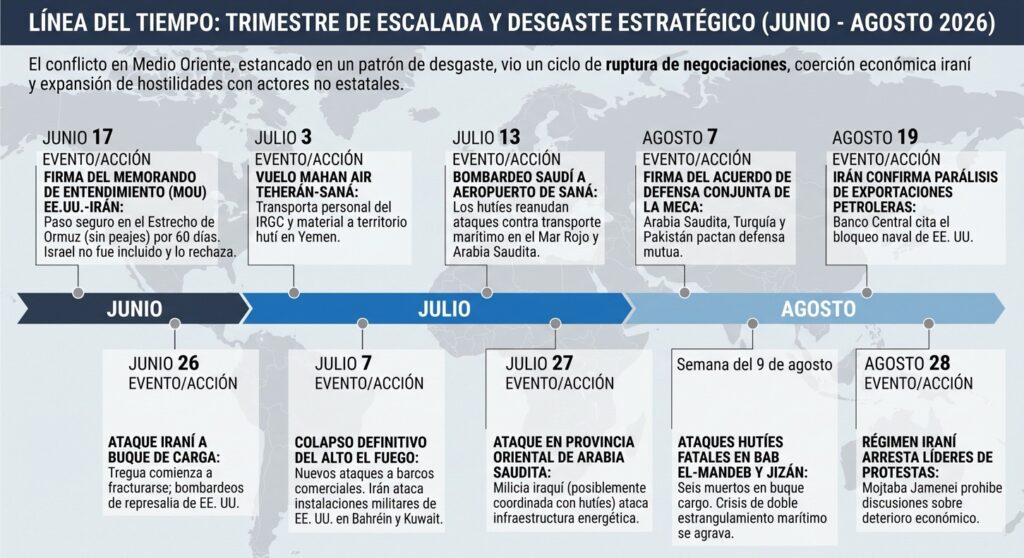
Among the main events that occurred in the last quarter, the following can be highlighted:
- Memorandum of Understanding (MOU): On June 17, the United States and Iran signed a document that, among other things, stipulated the safe passage of commercial vessels through the Strait of Hormuz without tolls for a period of 60 days.[1] Israel was not included in the negotiations nor had access to the document prior to its signing, despite the commitments affecting it, which generated deep rejection from Tel Aviv.[2] However, on June 26, the truce began to fracture when Iran attacked a cargo ship, provoking a reaction from Washington.[3] Since then, attacks and mutual accusations have not ceased.
- Conflict Expands to Yemen: It was reported that on July 3, a direct flight from Mahan Air between Tehran and Sana’a transported personnel and material from the Islamic Revolutionary Guard Corps (IRGC) to territory controlled by the Houthis. Days later, on July 13, Saudi forces bombed the runway of the Yemeni capital’s airport. As a result, Houthi rebels resumed their attacks on maritime transport in the Red Sea and Saudi infrastructure.[4] Later, on August 9, Houthi forces attacked a cargo ship in the Bab el-Mandeb, bombed an oil refinery in Jizan (Saudi Arabia), and attacked forces in the city of al-Mokha.
- Mecca Pact: On August 7, Saudi Arabia, Pakistan, and Turkey signed a defense agreement declaring that an armed attack against any of the three would be considered an attack against all. This pact adds to the broader reconfiguration of alliances in a context of increasing international tension. The peculiarity of this case is that, despite the ambiguity of the text, a medium nuclear power like Pakistan commits its deterrent capacity in favor of other states, something that was previously restricted to major nuclear powers. [5]
- Tightening of the Iranian Regime: In the last days of August, Tehran has reinforced control over society. On one hand, through the official Telegram account associated with Leader Mojtaba Jamenei, Iranian officials were prohibited from making statements that highlighted the country’s economic deterioration. Similarly, on August 28, the arrest of 30 alleged leaders of the protests from the winter of 2025-2026 was announced.[6]
- Increased Economic Pressure: In mid-August, U.S. Treasury Secretary Scott Bessent announced “Economic D-Day,” calling it “the largest financial offensive ever seen.” Among other measures, the initiative aims to cut the economic flows sustaining the Iranian regime, isolating it.[7] However, experts like Lawrence Freedman estimate that such a measure will be ineffective without China’s participation, which has refused to support the blockade.
CURRENT SITUATION OF THE BELLIGERENTS
United States | Washington insists on a military strategy designed to simultaneously affect the entirety of the Iranian system at all levels. This is complemented by economic pressure, limiting or preventing crude oil exports. Despite the success and tactical precision of the attacks, their strategic effectiveness has been very limited, failing to achieve more significant effects.[8] What seems to be inadequately assessed by the United States is the regime’s capacity in Tehran to absorb punishment at the cost of the population and the country’s critical infrastructure.
So far, it is difficult to understand the real reasons why the U.S. government became involved in a conflict from which, at this point, it is challenging to exit and achieve a result truly beneficial to its interests. The consequences of operations and negotiations, after six months, place the United States in an uncomfortable position; it has not managed to convince Tehran to sacrifice its nuclear program; it has been unable to defend its partners in the region, and Iran continues to attack them; and while the war is not over, despite having the most powerful Navy and Air Force in the world, it has not been able to secure navigation in the Strait of Hormuz, which constitutes a modest outcome, at least, so far.
Iran | The Persian government finds itself in a complex situation. On one hand, its defenses remain unable to stop U.S. air attacks, thus it continues to receive punishment regularly.[9] Its economy is further deteriorating due to imposed sanctions and the blockade on hydrocarbon exports. At the same time, the industrial capacity for missile manufacturing has been severely affected, limiting, though not eliminating, its response options. The accumulated situation has caused internal frictions between a more pragmatic faction led by President Pezeshkian, who seeks an end to the conflict, and a more radical line of the IRGC aligned with Mojtaba Jamenei, focused on repressing any internal dissent or social discontent. Nevertheless, despite the changes, the course seems to remain the same.[10]
The real effect of the attacks cannot be assessed due to limited access to information; however, it is possible to conclude that although they cause considerable damage, they are unable to alter the political trajectory of the conflict. Despite the degradation of military capabilities, economic suffocation, and some internal instability, Iran retains sufficient capacity to control its population and deny transit through the strait, which has generated a problem with global reach. This tool, while forcing an immense economic impact, has allowed it to confront Washington.[11]
It seems that beyond the pressure on the global economy, Iran seeks definitive control over the Strait of Hormuz. Along with the possibility of generating income from safe transit fees, having authority over navigation could allow Iran to prevent the entry of extra-regional vessels, such as those of the U.S. Navy.
Israel | After half a year on this battlefield, the Israeli assessment may not be positive. On one hand, it has decapitated the Iranian high command, destroyed a significant part of the ballistic missile arsenal, and delayed Iran’s nuclear program. However, the Iranian regime has demonstrated greater resilience than anticipated, and the succession of command has operated thus far, which could be considered an initial miscalculation. Similarly, the Iranian armed forces, especially the IRGC, continue to possess sufficient capabilities to affect transit through the strait and attack positions in other Gulf states.[12]
On the other hand, Hezbollah remains a threat from Lebanon, necessitating continued military pressure on its northern front. This issue becomes more relevant since the MOU of June 17 conditioned the effectiveness of the agreement on the cessation of actions in that area, which Israel has not accepted, insisting on maintaining a security zone that acts as a buffer. Furthermore, perhaps most delicately, these activities—in the midst of negotiations to halt the conflict—have affected its relationship with the United States, undoubtedly Tel Aviv’s most important partner.[13]
China | The economic effects of the conflict on Beijing have been minimal. The diversification of its energy matrix, as well as the accumulation of significant reserves, has allowed China to face the closure of the strait with relative calm. Despite its passive position, China has acted strategically by refusing to be part of the total economic pressure on Iran driven by the United States, maintaining a low but steady level of purchases, which provides minimal relief to Tehran.[14]
Consequently, China, without actively intervening in the conflict, reinforces its position against U.S. foreign policy, demonstrating a clear distance from Washington’s desires, while, without investing resources, observes how its main competitor loses prestige, diverts resources, reduces arsenals that are difficult and slow to replenish, and ultimately weakens in a long-term race.
Gulf Countries | The Gulf monarchies find themselves in a position of vulnerability. Historically, Riyadh mitigated the risk of the Strait of Hormuz by exporting part of its oil through the Red Sea. However, the opening of a second front by the Yemeni insurgency has affected the Bab el-Mandeb route for Saudi vessels, undermining a clear strategic advantage. The perception that the United States has not been effective as a security guarantor—being perceived even as prioritizing Israeli objectives over Gulf stability—has forced the search for other solutions, such as the aforementioned Mecca pact in the case of Saudi Arabia.[15]
FINAL CONSIDERATIONS
The current scenario presents challenges that go beyond an expected ceasefire. Among what can be identified, the following can be highlighted:
- The conflict continues to expand, and the solution seems less clear each day. The positions of the actors in the conflict remain maximalist, where Iran’s nuclear program, free navigation in the Strait of Hormuz, and the future of Hezbollah in Lebanon remain incompatible. The real possibility of achieving stable peace seems distant, at least given the situation observed while writing this document.
- Diplomatic and military efforts have been unable to force transit through such a relevant route for the global economy. Despite U.S. efforts, the daily passage of more than 10-12 vessels is not achieved, which is a fraction of the more than one hundred prior to the war. Simultaneously, the Houthi intervention poses a second problem in the Bab el-Mandeb, which only increases stress on the global hydrocarbon market and the economies of the Gulf.
- It is estimated that Iran will not relinquish its coercive capacity through the closure of Hormuz for minor concessions, but will continue its strategy to normalize a de facto control as a top priority. Without a formal agreement that restores safe and unrestricted international transit—or a large-scale ground military intervention, which is highly unlikely—the closure appears chronic.
- The strategic position of the United States in the Middle East has weakened, either due to the extension of the conflict and the inability to impose its terms in the six months of war, or due to the sense of vulnerability that has spread among the Gulf monarchies. This condition is pushing countries in the region to seek security alternatives and some level of independence. Thus, the Middle East emerges more fragmented, militarized, and vulnerable to asymmetric disruption by actors like Iran.
- Once again, it is observed that military power is only an instrument of politics to carry out war, undoubtedly the most relevant when it comes to causing damage, but not the only one. Within this, strategic bombing and maritime blockade have not proven effective, as has happened multiple times since World War II. To achieve certain objectives, especially those related to affecting vital interests of states, the intervention of ground forces becomes an irreplaceable element, given the need to occupy territories to impose will over other actors.
- The ability to overcome the early elimination of a significant number of leaders and a strong military punishment, and still react relatively quickly and organized, has demonstrated the adaptability and resilience of the Iranian authoritarian regime, which was not adequately anticipated.
MARCELO MASALLERAS
Director of Studies AthenaLab
[1] BBC, “US-Iran memorandum of understanding in full,” June 18, 2026, available at: https://www.bbc.com/news/articles/c4gy700j0eko.
[2] Lawrence Freedman, “Trump turns on Netanyahu: What does the Iran debacle mean for the future of US-Israeli relations?” Comment is Freed, June 21, 2026.
[3] Lawrence Freedman, “Trump’s War Won’t Go Away: Why has the fight over the Strait of Hormuz restarted? Can a permanent resolution be found?” July 18, 2026.
[4] Michael Ratney, “The Houthis Enter the Iran War and Everything Gets Worse,” CSIS, August 13, 2026, available at: https://www.csis.org/analysis/houthis-enter-iran-war-and-everything-gets-worse. [5]Saeid Jafari, “The Regional Order Iran Wanted Is Taking Shape Without It,” Foreign Policy, August 11, 2026, available at: https://foreignpolicy.com/2026/08/11/mecca-turkey-saudi-arabia-pakistan-iran-gulf-hormuz-nato/.
[6] Institute for the Study of War, “Iran update,” August 28, 2026, ISW, available at: https://understandingwar.org/research/middle-east/iran-update-august-28-2026/. [7]U.S. Department of the Treasury, “Treasury Launches Unprecedented Campaign Against Iranian Regime on Economic D-Day,” August 24, 2026, available at: https://home.treasury.gov/news/pressreleases/sb0613.
[8] Bret Devereaux, “The U.S. Is Learning the Wrong Lessons in Iran,” Foreign Policy, August 21, 2026, available at: https://foreignpolicy.com/2026/08/21/iran-military-lessons-tactics-strategy-trump/?tpcc=editors_picks&utm_source=Sailthru&utm_medium=email&utm_campaign=Editors%20Picks%20-%2008212026&utm_term=editors_picks. [9]Bret Devereaux.
[10] Institute for the Study of War. [11]Brian Carter, “How Iran Hopes To Control The Strait Of Hormuz: It’s Not Just About Fees,” Institute for the Study of War, May 23, 2026, available at: https://understandingwar.org/research/middle-east/how-iran-hopes-to-control-the-strait-of-hormuz-its-not-just-about-fees/.
[12] Lawrence Freedman, “Trump turns on Netanyahu: What does the Iran debacle mean for the future of US-Israeli relations?” [13]Lawrence Freedman, “Trump turns on Netanyahu: What does the Iran debacle mean for the future of US-Israeli relations?”
[14] Center for Strategic & International Studies, “The Iran War at Six Months: Energy, Markets, and National Security,” CSIS, August 24, 2026, available at: https://www.youtube.com/live/7UyuhTpPzfA?si=ER9QObc3pSHhMLuE.
[15] Dina Esfandiary, Becca Wasser, and Ziad Daoud, “The Impossible Middle East After the Iran War, the Region Has No Good Options,” Foreign Affairs, August 27, 2026, available at: https://www.foreignaffairs.com/middle-east/impossible-middle-east.
. .
. .