25 Years Since the 9/11 Terrorist Attacks
This article was translated automatically and may contain differences from the original. For reference, read the original.
INTRODUCTION
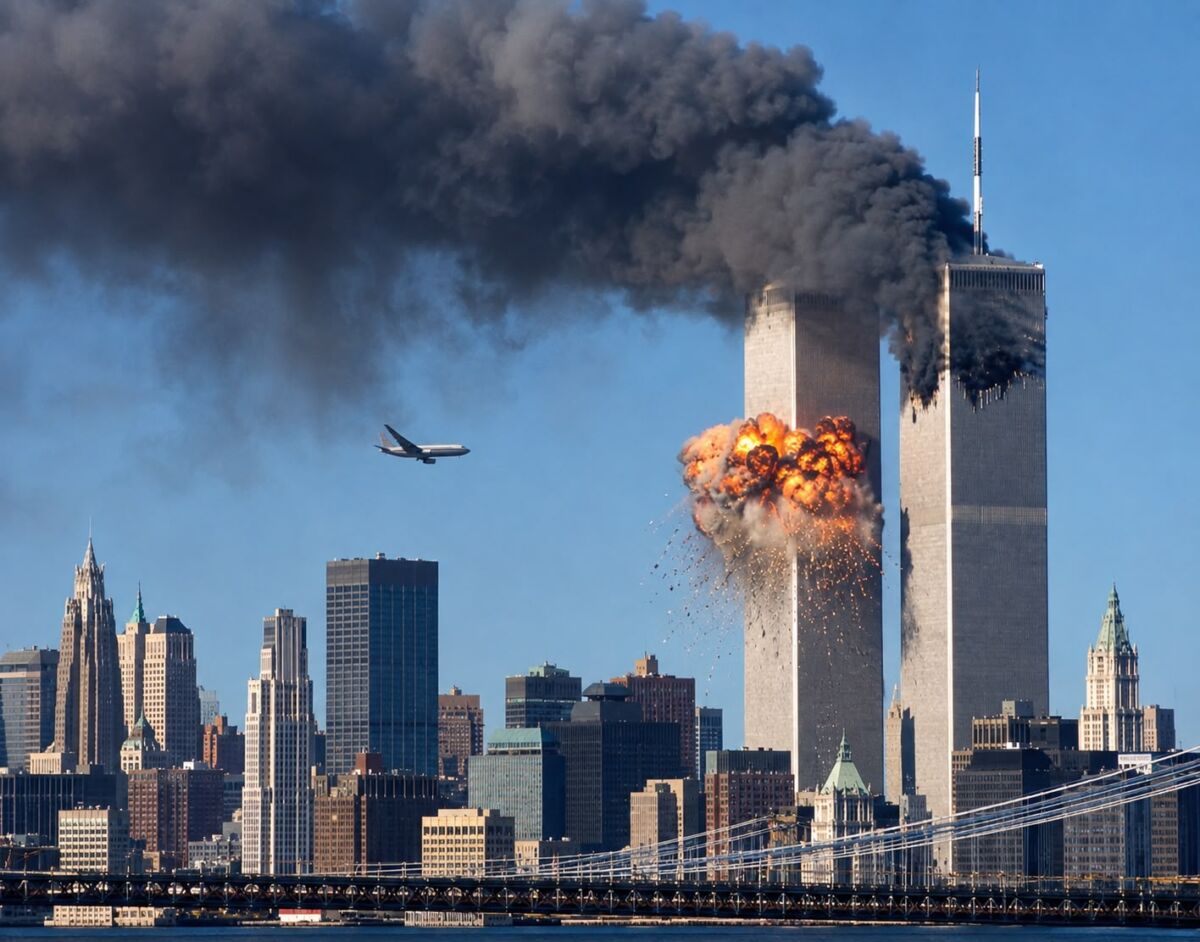
The September 11, 2001 (9/11) attacks against various targets on U.S. soil by Al-Qaeda were the catalyst for a structural transformation in the nature of transnational terrorism. The U.S. response, focused on the military priority of the “war on terror,” succeeded in dismantling the centralized threat of Al-Qaeda. However, it simultaneously accelerated the decentralization of the phenomenon, giving rise to more diffuse and adaptive forms of terrorism.
Twenty-five years later, jihadist terrorism no longer occupies a dominant position on the international security agenda and has been overshadowed by great power competition. Nevertheless, its effects, such as the fragmentation of terrorism and securitization, remain a lasting legacy even in countries distant from the original conflict, such as Chile. The following analysis examines the 9/11 attack through the lens of terrorism literature; then, it briefly evaluates the Western response; subsequently, it describes the current state of terrorism in few words, and finally, it discusses certain implications for Chile.
1. 9/11 THROUGH THE LITERATURE OF TERRORISM
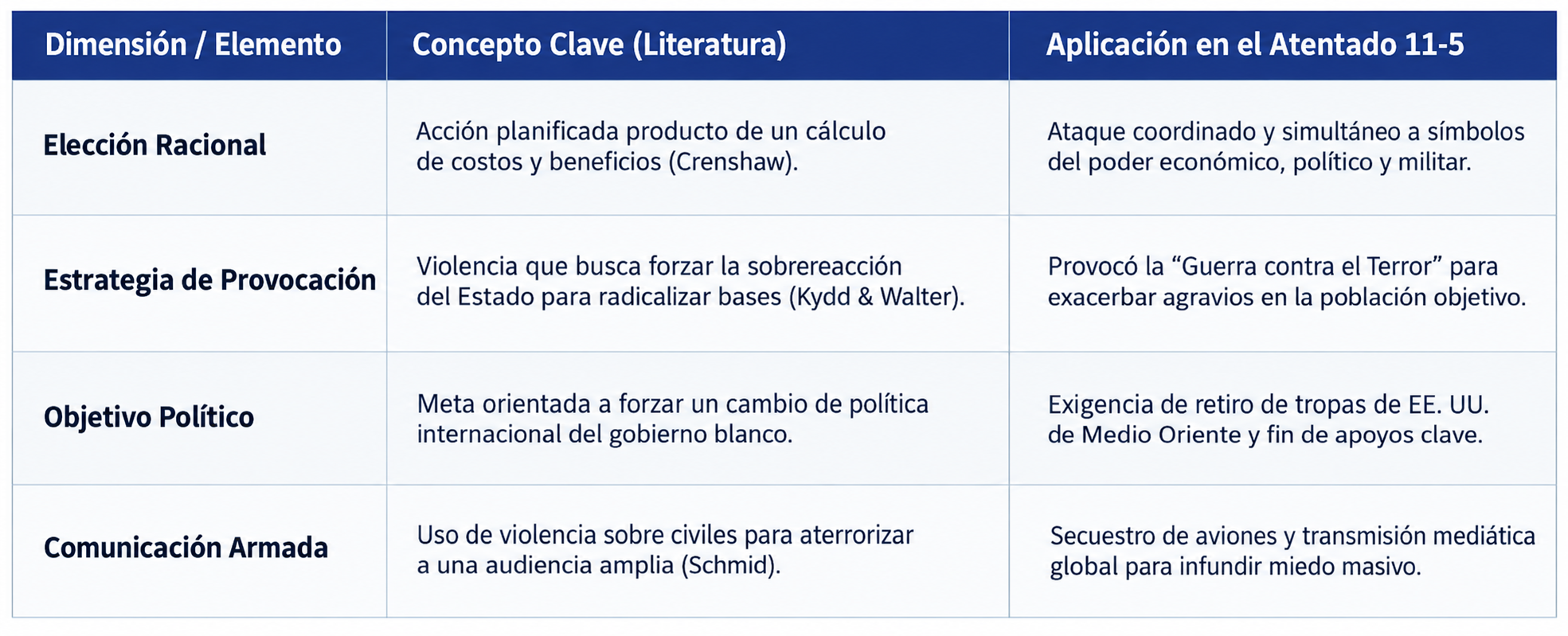
Considering the multiplicity of definitions that academia offers regarding the concept of terrorism,the Al-Qaeda attack satisfies nearly all of them, as it was a previously organized violent act against civilians, which had a political purpose and caused an impact on the audience. The literature supporting each of these dimensions will be reviewed, starting with the rational and planned nature of the attack. The rational choice model, proposed by Martha Crenshaw[1] in agreement with Mulaj[2], Hoffman[3] and Schmid[4], argues that terrorism constitutes a form of political violence resulting from a rational choice, with civilians as its primary victims. This implies the existence of a planning process and a weighing of costs and benefits, rather than a spontaneous action.
Such rational choice requires a concrete strategy to materialize. In this regard, Kydd and Walter[5] argue that terrorism constitutes a form of costly signaling, and therefore, no counter-terrorism policy can be formulated or be effective without first understanding the strategic logic that underpins it. Of the five strategies they identify—attrition, intimidation, provocation, sabotage, and outbidding—9/11 falls within the logic of provocation, as a weak actor used violence to force a state overreaction capable of radicalizing the civilian population that supports its political objective.
Regarding the political objectives of terrorism, Kydd and Walter identify five categories: policy change, territorial change, regime change, social control, and maintenance of the status quo, or a combination of them. In the case of Al-Qaeda, the predominant objective was policy change, as the attack aimed to compel the United States to withdraw its troops from the Middle East and its economic support for Israel.
Another central element of terrorism is the notion of “armed communication,” as described by Schmid, which emphasizes the psychological impact on a large audience, beyond material damage[6]. This impact is achieved by violently attacking civilians or non-combatants, with the aim of instilling fear under the logic of “I could be next,” generating pressure on the government to achieve the specific political objective of the terrorists. Thus, the effectiveness of the act depends on media amplification, and 9/11 perfectly illustrates this logic by using thousands of innocent victims as a visual backdrop to terrify public opinion and challenge the American state.
Consequently, Al-Qaeda, which planned and executed a clear provocation strategy against the West, represented by the United States; which hijacked commercial airplanes to simultaneously attack symbols of capitalism, democracy, and military power, deliberately crowded and populated; and which killed over 3,000 people to compel the United States to withdraw its support for Israel and Saudi Arabia, fulfills the fundamental elements that literature attributes to the phenomenon of terrorism.
Figure 1. Key Elements for the Definition of Terrorism
Source: Own elaboration based on Crenshaw, Kydd and Walter, and Schmid.
2. EFFECTIVENESS OF THE RESPONSE
The response to 9/11, materialized in counter-terrorism policies and military intervention, succeeded in containing the threat by reducing Al-Qaeda’s immediate operational capacity, but failed to address the underlying causes. Through the “Global War on Terror” (GWOT), it was mistakenly assumed that destroying the organization would weaken its ideology, ignoring the underlying factors that allow terrorism to expand.
The Western military response after 9/11 demonstrated some limitations of this strategy to eradicate the threat of global jihadism in the long term. While allied actions succeeded in degrading Al-Qaeda’s operational capacity and preventing attacks of similar magnitude, the strategy of capturing and eliminating leaders, known as organizational decapitation, proved insufficient. This tactical approach by the West overlooked that jihadism is not a conventional hierarchical structure, but a bureaucratized, decentralized, and ideologically rooted network capable of surviving the decapitation of its leadership[7].
These tactical deficiencies were compounded by counterproductive strategic consequences, stemming from the excessive use of force, extreme surveillance, and the erosion of certain human rights. The Western response contributed to destabilizing the Middle East, creating both the “permissive conditions” (the environment of instability) and the precipitating factors (direct abuses) that Crenshaw identifies as conducive to the spread of terrorism. In line with the previously explained strategic logic of provocation, the violation of freedoms not only eroded Western legitimacy but also fueled the radical narrative by exacerbating the grievances that drive recruitment.
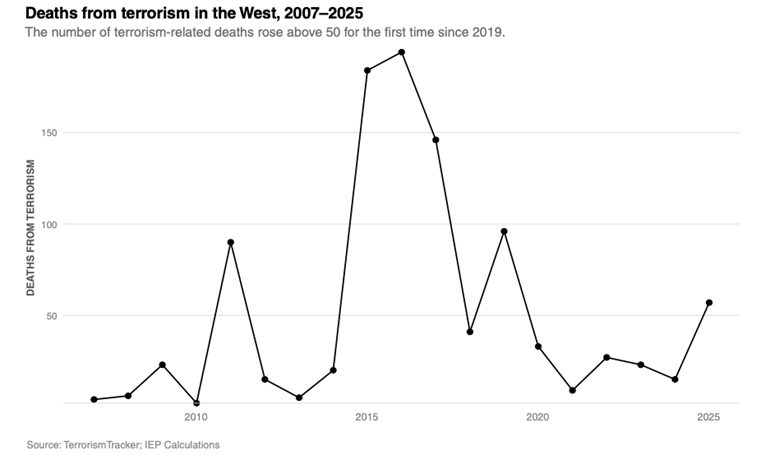
In terms of effectiveness, the military response can also be evaluated based on its cost. If the objective was to neutralize the threat from a group with comparatively marginal resources, the investment of nearly $8 trillion and the deaths of over 900,000 people[8] over twenty years are disproportionate. As evidenced in the Global Terrorism Index[9], the West did not eliminate the terrorist threat. Moreover, it experienced a severe increase in attacks and deaths between 2015 and 2017 due to the proliferation of smaller-scale terrorist incidents, which demonstrates the decentralization and adaptation of the phenomenon. The disproportion between the investment and the persistence of the threat constitutes, in itself, evidence of low effectiveness[10].
Figure 2. Terrorism-related Deaths in the West, 2007–2025. Source: Institute for Economics & Peace, Global Terrorism Index 2026 (Sydney: Institute for Economics & Peace, 2026), 34, figure 2.5.
However, international cooperation represents the most enduring success in the realm of terrorism prevention and dismantling. UN Security Council Resolution 1373 (2001)[11], which established global counter-terrorism measures and the expansion of the FATF regime[12] to combat the financing of terrorism, gave rise to a multilateral cooperation infrastructure that remains in place today. The significance of this point lies in how it modified the global paradigm regarding cooperation in international security following 9/11.
3. CURRENT STATE OF THE PHENOMENON
Far from eradicating terrorism, it is possible to indicate that the Western response propelled its transformation. This is particularly true in its jihadist aspect, giving rise to regional franchises such as ISIS-Khorasan, Al Shabaab, and JNIM in the Sahel[13], a phenomenon largely explained by the invasions of Afghanistan in 2001 and Iraq in 2003. The absence of centralized coordination forced terrorists to implement new mechanisms capable of resisting U.S. military pressure, such as the radicalization of youth from Western countries, “lone wolf” attacks, and the simplification of weapons used, such as knives and vehicles. This not only represented a change in the nature of the threat at the global level but also complicated the prevention of terrorist acts.[14]
Twenty-five years later, and despite the emergence of new terrorist groups, the phenomenon has lost centrality on the Western security agenda, overshadowed by great power competition. This displacement coexists with counter-terrorism organizations, whose policies continue to focus on immediate security and the prevention of attacks through the recognition of behavioral patterns. The combination of both factors prevents addressing the social and economic conditions that allow the expansion of terrorism as a flexible political action strategy, adaptable to multiple causes and, therefore, more difficult to contain.
The advancement of artificial intelligence and social media has transformed contemporary terrorism, accelerating radicalization processes and driving new extremist threats. Online radicalization times have drastically decreased, from an average of 18 months in 2005 to just a couple of weeks in 2026[15]. This finds its most critical manifestation in far-right terrorism driven by “accelerationism” and the SIEGE culture, ideologies that seek the collapse of democratic society through extreme racial violence[16]. By operating through decentralized digital propaganda, an autonomous and unpredictable model of terrorism is generated.
4. IMPLICATIONS FOR CHILE
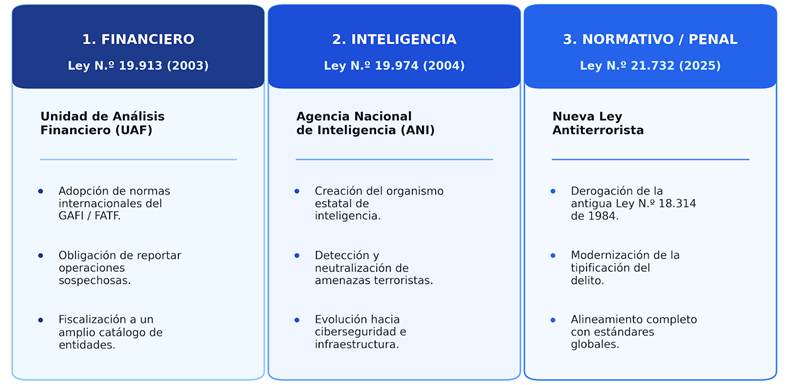
Chile, despite being geographically distant from the attacks that triggered the “war on terror,” integrated part of the security architecture that 9/11 unleashed in the West into its legislation and institutions. In this regard, the country implemented initiatives in the financial, intelligence, and legal realms; three areas in which the legacy of the terrorist attacks has been durably established.
The first initiative involved the implementation of international financial standards. The recommendations arising from 9/11 progressively became a mandatory reference for national regulatory designs. In this context, Chile adopted special recommendations against the financing of terrorism issued by the FATF through Law 19913 and created the Financial Analysis Unit (UAF) in 2003[17], which subjected an extensive catalog of subjects to the duty of reporting suspicious operations.
The second was the institutionalization of a state intelligence agency. This process, in the Chilean case, materialized in Law 19974, enacted in 2004, which created the National Intelligence Agency (ANI).[18] In its original wording, the law tasked the Agency with implementing intelligence measures to detect, neutralize, and counteract the actions of national and international terrorist groups. Subsequent reforms diluted that specific function within a broader catalog of powers, which today encompasses cybersecurity, critical infrastructure, and new data access authorities.[19]
The third avenue corresponds to the replacement of Law 18314, in effect since 1984, with new anti-terrorism legislation that aligns national regulations with the international standards that emerged after 9/11. This process culminated in Law 21732, enacted in February 2025[20], which repeals the previous regulations and, among other aspects, updates the definition of the crime of terrorism.
Together, these legal and institutional developments demonstrate how the legacy of 9/11 is reflected in Chile through the implementation of new financial standards, the creation of an intelligence agency with functions that contribute to addressing the phenomenon of terrorism, and new legislation that confronts the phenomenon.
Figure 3. Pillars of Legal and Institutional Evolution in Chile
Source: Own elaboration based on national legislation (Laws No. 19,913, 19,974, and 21,732)
5. CONCLUSIONS
From the above, it is feasible to infer two conclusions regarding the legacy of 9/11. The first pertains to the strategic logic of contemporary terrorism, and the second relates to the institutional effects of the Western response.
First, terrorism continues to confirm the structural asymmetry that Kydd and Walter identify in their costly signaling model, according to which an actor with marginal resources can force a more powerful state to incur disproportionate costs without eliminating the underlying causes of violence. That asymmetry, which persisted beyond the fragmentation of Al-Qaeda and the elimination of its leaders, has shifted toward new decentralized actors of jihadism that replicate the same logic of provocation.
Second, the legacy of 9/11 can also be observed in the permanent expansion of issues that states consider as national security concerns. This phenomenon, which occurred as a consequence of the war on terror, today shapes the frameworks for classifying other phenomena of political and social violence that supposedly affect national security.
ALEJANDRO AMIGO
Senior Researcher, AthenaLab
MICAELA TRAMER
Researcher
[1] Crenshaw, Martha. The Causes of Terrorism. Comparative Politics 13, no. 4, 1981.
[2] Mulaj, Klejda, ed. Violent Non-state Actors in World Politics.. New York: Columbia University Press, 2010.
[3] Hoffman, Bruce. Inside Terrorism.. New York: Columbia University Press, 2006.
[4] Schmid, Alex P. Defining Terrorism.. International Centre for Counter-Terrorism (ICCT), 2023. https://icct.nl/publication/defining-terrorism
[5] Kydd, Andrew H., and Barbara F. Walter. The Strategies of Terrorism. International Security 31, no. 1, 2006) https://www.belfercenter.org/sites/default/files/pantheon/files/files/publication/is3101_pp049-080_kydd_walter.pdf
[6] Schmid, Alex P. Defining Terrorism.
[7] Europol. European Union Terrorism Situation and Trend Report 2023., Luxembourg: Office for Official Publications of the European Union, 2023.
[8] Kimball, Jill. “Costs of the 20-Year War on Terror: $8 Trillion and 900,000 Deaths.” Brown University News, September 1, 2021. https://www.brown.edu/news/2021-09-01/costsofwar
[9] Institute for Economics & Peace. Global Terrorism Index 2026.. Sydney: Institute for Economics & Peace, 2026.
[10] Mueller, John and Mark G. Stewart. Terror, Security and Money: Balancing the Risks, Benefits, and Costs of Homeland Security.. Oxford: Oxford University Press, 2011.
[11] United Nations. Security Council. “Resolution 1373” (2001). S/RES/1373, September 28, 2001.
[12] Financial Action Task Force (FATF). “History of the FATF.” Accessed September 8, 2026. https://www.fatf-gafi.org/en/the-fatf/what-we-do.html
[13] National Consortium for the Study of Terrorism and Responses to Terrorism (START). “Global Terrorism Database.” Processed by Our World in Data, 2022.
[14] Mohamed Taib. Muslim Extremism After Two Decades of the ‘Global War on Terror.’ Academia.sg, 2021. https://www.academia.sg/academic-views/muslim-extremism-after-two-decades-of-the-global-war-on-terror/
[15] Institute for Economics & Peace. “Global Terrorism Index 2026.”
[16] Europol. TE-SAT Report, 45.
[17] Law 19913, which creates the Financial Analysis Unit and modifies various provisions regarding money laundering. Official Journal of the Republic of Chile,, December 18, 2003. https://www.bcn.cl/leychile/navegar?idNorma=219119
[18] Law 19974, on the State Intelligence System and creating the National Intelligence Agency. Official Journal of the Republic of Chile, October 2, 2004. https://www.bcn.cl/leychile/navegar?idNorma=230999
[19] Law 21821, Strengthening and Modernizing the State Intelligence System, May 30, 2026. https://bcn.cl/xe83Sx
[20] “Chile Has a New Anti-Terrorism Law: Here Are Its Main Contents.” https://www.gob.cl/noticias/chile-tiene-nueva-ley-antiterrorista-conoce-principales-contenidos/