Maritime Notes on the Russian Invasion of Ukraine
This article was translated automatically and may contain differences from the original. For reference, read the original.
- por Juan Pablo Toro
- Análisis
“Nature offers Russia a natural fortress like no other in the world: the Black Sea”
Nicolai Danilevsky
If maritime strategy is about “access,” as James Holmes indicates, we can assert that, in the context of the current Russian invasion of Ukraine, the aggressor country will seek to take control of Ukrainian ports to deny access to the Black Sea, through which it connects to various global markets as an exporter of raw materials, especially agro-industrial products. Although both are countries that essentially project power on land, their confrontations at and from the sea have something to teach us.
1) It is important to have a navy that is equipped and prepared
Ukraine lost a significant portion of its fleet, shipyards, storage facilities, and naval aviation when Russia annexed the Crimean Peninsula in 2014, as it included the base at Sevastopol. Of 17 surface combat units, the Ukrainian Navy was left with only five. Its last frigate, the “Hetman Sahaidachny,” was reportedly sunk by its own crew to prevent it from falling into Russian hands.
From Russia’s perspective, taking control of Crimea gives it access to a warm-water port in the Black Sea, as most of its maritime terminals in the northern part of the country freeze in winter. Its fleet stationed in this body of water, which connects to the Mediterranean Sea, is one of three that the Russian Navy possesses, along with the Northern and Pacific fleets. Several of its units participated in the military campaign in Syria.
In this current war, Russian ships have launched cruise missiles (from the Kalibr family) at land targets against Ukrainian forces and have also fired their guns at coastal holdings and small vessels. It is important to note that the Russian Navy is primarily a defensive navy whose purpose is to create security bubbles around bodies of water in the ex-Soviet space, such as the Black Sea itself, through capabilities aimed at anti-access and area denial (A2/AD).[1].
While Ukraine launched a program to rebuild its fleet with British support—mainly through the acquisition of patrol vessels to regain coastal surveillance capability and anti-ship missiles—this process projected for 2035 did not materialize before the invasion on February 24.
This indicates that once naval power is lost, it is very difficult to reconstitute it in such a short time, whether due to will or available funds. The construction of vessels (ideally a permanent local activity), the training of their crews, and their operational deployment take time.
2) Protecting maritime trade routes is a fundamental task of the Navy
In recent days, we have seen attacks on cargo ships of various flags of convenience in the Black Sea under unclear circumstances. Social media suggests they were used as “shields” to prevent anti-ship missile attacks, or that they were struck by mistake.
While a vessel can move practically anywhere, there are true highways known as sea lines of communication (SLOCs). These are traversed by container ships, bulk carriers, oil tankers, and roll-on roll-off (which carry vehicles).
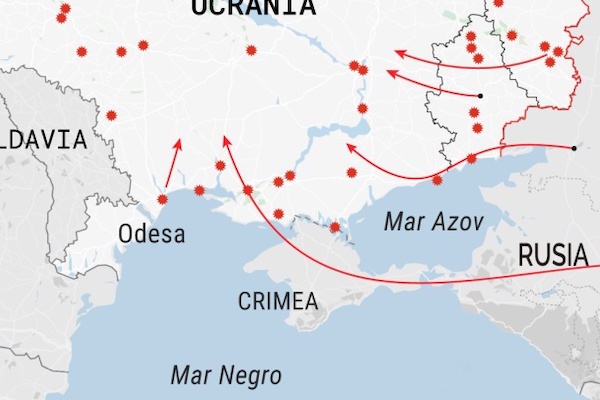
These lines are not kept open by default. They can be disrupted by hostile state forces (such as enemy navies) or non-state forces (pirates and terrorists). Given that “commerce is king,” as Alfred T. Mahan said, a primary function of navies is to ensure the security of SLOCs.If anything distinguishes a modern navy from a post-modern one, in a definition taken from Geoffrey Till, it is precisely its ability to contribute to the stability of globalization, which, as we know, requires oceans to function. Not only is 90% of global trade maritime, but most digital data circulates through undersea fiber optic cables.In the case of the Russian invasion of Ukraine, undoubtedly the SLOCs connecting its export ports to global markets were abruptly interrupted by the actions of the Russian navy, which appears to be preparing to land in Odessa—the country’s third-largest city—after attacking Kherson.
The southern theater of war is a vital element of the overall design of the Russian campaign for Ukraine. It contains the 13 maritime ports of Ukraine, which in 2021 exported over 150 million tons of cargo. This represents 60% of Ukraine’s exports and 50% of its imports. Possession of Odessa, in particular, would give Russia a land bridge to Crimea while strangling the Ukrainian economy.
With this, Russia also protects a flank and cuts potential maritime supply lines to the defenders. The North Atlantic Treaty Organization (NATO) currently has no ships in the Black Sea, which leads us to the next point.
3) Control of maritime passages
Turkey decided to close the Bosporus and Dardanelles straits, which connect the Black Sea to the Mediterranean, to warships not registered in the area, invoking the Montreux Convention (1936).
Thus, neither Russian reinforcements, which are in the Mediterranean from other fleets, nor NATO ships (Turkey is a member) will be able to enter the theater of operations.
The importance of a maritime strait or an interoceanic passage depends on its position, that is, its location on the nautical chart. Whoever controls one of these “bottlenecks” would have a significant tool of pressure, although there are skeptics who say that with the range of current missiles, this is, in reality, irrelevant.
Although in the current scenario, Russia does not seem willing to challenge Turkey by forcing the passage of its ships, which rather proves the former. Ankara’s decision shows us how feasible it is today to restrict freedom of navigation depending on the circumstances.
In the same area, two Ukrainian patrol boats and a tugboat were immobilized and their 24 crew members detained by Russian coast guards after an exchange of gunfire in November 2018, when the former approached the Kerch Strait, which separates the Black Sea from the Sea of Azov. While the Russian Federal Security Service claimed that the Ukrainian vessels entered without prior notice, Ukraine maintained that, according to a bilateral treaty from 2003, military vessels from both countries enjoy freedom of navigation in the Kerch Strait and the Sea of Azov. Ultimately, the sailors were released and the vessels returned to Ukraine almost a year later, amid bilateral and international negotiations.
The noteworthy point is that countries will not always understand freedom of navigation in the same way, especially if they have unresolved disputes. And having control of a strait helps impose, at least, the terms on the country that holds it.
[1]
[1] Delanoë, Igor: “Russian Naval Strategy,” in
Marine Studies, No. 17, January 2020, Centre d’Études Stratégiques de la Marine, p. 36. *Also published in theNavy Journal.