The new strategic realities arising from the 'Land Warfare Conference 2022'
This article was translated automatically and may contain differences from the original. For reference, read the original.
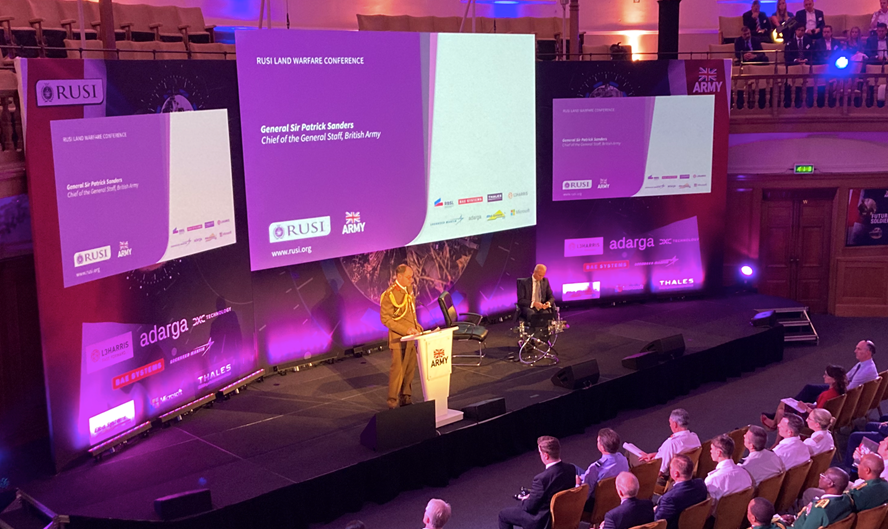
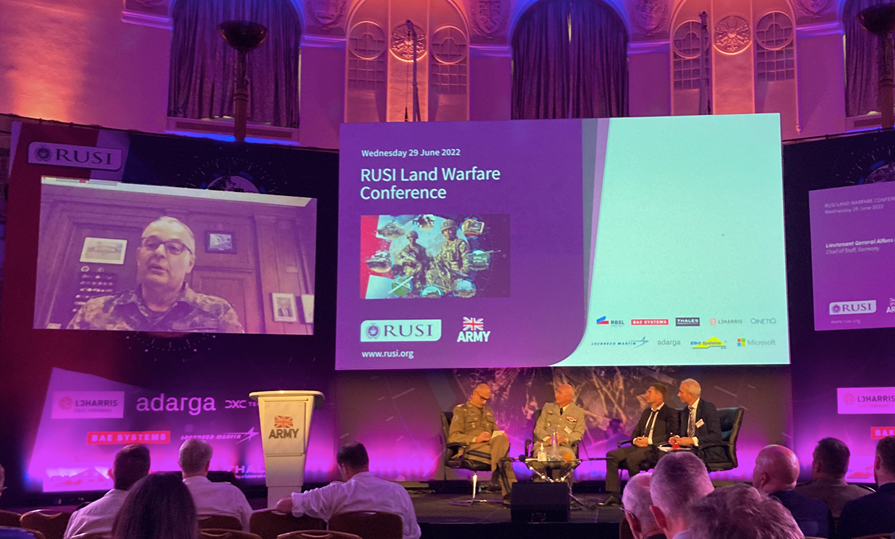
The war between Russia and Ukraine dominated much of the discussion at the traditional ‘Land Warfare Conference,’ organized by the Royal United Services Institute (RUSI) in the United Kingdom[1], held on June 28 and 29 in London, from both the perspective of military operations and the impact of the invasion on the European security landscape. The following lines will present the most relevant aspects of the conference, as well as the main conclusions that, in the opinion of Athenalab, can be drawn from such a significant event.
MAIN TOPICS DISCUSSED
The newly appointed Chief of the British Army, General Sir Patrick Sanders, in his first public address since taking office, assessed the strategic situation, identifying China—particularly in its projection towards the Indo-Pacific—and, above all, Russia in Europe as the main threats to the United Kingdom. He characterized the current situation as akin to that faced by the old continent in 1937, emphasizing that the current crisis must be navigated with the available means, as if force were to be employed that very year.
In this context, General Sanders presented his command concept, which has as its main objective and focus of his management to ‘mobilize’ the British Army as an irreplaceable tool to confront the growing Russian threat and prevent war in Europe, prioritizing high operational availability.
As action axes, he pointed to: integrating with other countries of the North Atlantic Treaty Organization (NATO), especially in joint and combined planning; accelerating ongoing modernization processes, adding multidomain and command and control capabilities; rethinking the way combat is conducted, shifting from a strong focus on counterinsurgency capabilities to one that prioritizes combined arms units; and evaluating the current structure of the Army, particularly the reduced expeditionary force that currently exists. He added that credible deterrence requires having means deployed in strategic locations and that, at least in Europe, land dominance will be the decisive area for future operations.
Later, the UK Secretary of State for Defence, Ben Wallace, analyzed the European strategic environment; however, he avoided making deep definitions, as the NATO summit was concurrently taking place in Madrid, which resulted in the new ‘Strategic Concept 2022’ of the Atlantic Alliance.[2] In his remarks, Wallace highlighted the threat posed by Russia and its president, Vladimir Putin. He also referred to the utility and relevance of land forces in the current battlefield, as demonstrated by the Russo-Ukrainian conflict. As a consequence of a successive policy of defense budget reductions in the UK, particularly regarding the British Army, he acknowledged the weaknesses of a reduced expeditionary force, announcing a significant investment in capabilities to be executed over the next ten years, in order to form an effective force capable of protecting British citizens, as part of NATO.
For her part, the U.S. Under Secretary of the Army, Christine Wormuth, was clear in recognizing that 20 years of counterinsurgency and counterterrorism operations have significantly affected the strategic and operational capabilities of the Army and its allies.
In this way, the role of this institution in the new North American defense strategy, with a clear focus on multidomain operations and the integration of forces in joint and combined environments, will be determined by three pillars: First, the ability to execute military campaigns, prioritizing strategic geographic areas, where access, presence, and influence of the U.S. will be ensured. Second, achieving integrated deterrence aimed at China and Russia, which considers preparation, training, and doctrine to prevail in multidomain environments with allied armed forces, transitioning from brigade (Brigade Combat Team) to army division as the basic unit. Third, building advantages by developing new technologies and operational concepts, with accelerated and large-scale experimentation. All of the above aims to build a credible force capable of addressing emerging threats, clearly referencing China, Russia, Iran, and North Korea.
EUROPEAN SECURITY
During the various sessions of the conference, a central theme was the security situation in Europe. In this regard, there is consensus that this war has completely changed NATO’s strategic posture and that of other European countries, forcing states like Finland and Sweden to decide to apply for membership in the alliance. According to the Chief of the German Army, General Alfons Mais, the Russian invasion constitutes a turning point in European security, akin to the fall of the Berlin Wall over 30 years ago. The current situation of NATO forces is defined as inadequate, as they were not prepared to face it in a timely manner, necessitating adjustments to plans, doctrine, deployment, sustainment, among other aspects.
Among the ideas proposed by the German military to address this, the obligation to focus not on revolutionary developments but rather on those capabilities that function adequately and at reasonable costs is highlighted. However, despite the expected increase in defense budgets, Europe will continue to depend on the United States, both for its conventional forces and its strategic capabilities, including nuclear ones. In this regard, it is worth mentioning that the Chief of the General Staff of the Polish Armed Forces, General Rajmund Andrzejczak, also characterized the current situation in Europe as akin to that experienced in 1937, particularly for Poland, emphasizing that both history and the context in which events unfold are always relevant.
Regarding Russia, beyond qualifying the invasion of Ukraine as illegal and illegitimate and having severely affected the security situation of all Europe, experts agree that Russian military power—less effective than previously estimated before the war—has been degraded, especially in the officer corps, but still maintains sufficient capabilities to continue the war.
Nevertheless, despite initial setbacks, Moscow still possesses certain capabilities for the mass employment of fire bases that provide it with a significant advantage over its adversary, derived from the large stock of weaponry—of questionable operational condition—and, particularly, of large-caliber ammunition (according to estimates by some experts, Russia could continue with the enormous consumption of high-caliber ammunition, estimated at about 16,000 shells per day, for several years). Additionally, it must be noted that Russian forces have adapted their combat tactics, techniques, and procedures as a result of their initial errors and failures.
Similarly, Russia has not been affected in its industrial capacity, allowing it to continue military production in areas not limited by Western sanctions. Internally, the Russian population does not have a real picture of the war, and its support for operations may continue despite the large number of casualties (estimated at over 30,000 dead and wounded); however, what is estimated to be intolerable for the Russians is a failure of the offensive, which will condition Putin’s decisions regarding his position of power.
Regarding the situation in Ukraine, it is concluded that this country still has a real chance of winning the war, but that success is conditioned by two factors: the will to fight of the Ukrainian people and, as important as the former, the decision of the West to maintain material support for its war effort.
While the first aspect is highlighted, given the stage in which the conflict is situated, characterized by a Russian strategy of attrition and wear over maneuver, the opportunity for Ukrainian armed forces to continue fighting lies in the sustainment of artillery material and ammunition, the latter being a critical and decisive aspect. Along with this, Ukrainian representatives expressed the need to effectively strike the Russian economy and the possibility of financing the war effort, in addition to influencing the perception of the Russian population regarding the war.
TRADITIONAL OPERATIONS
Regarding the concept of the battlefield, while there is a discussion about the obligation to develop new capabilities that provide competitive advantages relative to China and Russia, it is noteworthy that a rather traditional approach to operations predominates. In this sense, land, maritime, and air domains are prioritized as those where there are greater capabilities to inflict material damage, compared to the domains of outer space and cyber operations, which are considered more as enablers of the former, at least for now. The capacity for adaptability will be fundamental, as will fostering a spirit of innovation within the forces.
At the operational level, the capacity for integration, adequate and realistic planning, as well as reinforcing the moral component must be enhanced. At the tactical level, it is proposed to prioritize and strengthen mission-type command, trust, and training. Finally, it is recognized that the current land battlefield must incorporate in its analysis actions in urban centers, as this has been a characteristic that has not disappeared; on the contrary, there is a repeated convergence of forces in populated centers.
Finally, a concept that was discussed and recurred throughout the two days is ‘interoperability‘[3]. In general terms, it is emphasized that the objective of the forces is to achieve integration both among the forces of different armed institutions, among agencies of the same state, among components of different countries, and especially across the various domains of the battlefield. Technically, the need for capabilities that allow different systems to communicate effectively is recognized, which requires human, procedural, and technological elements. In this regard, Polish General Andrzejczak emphasized that to develop a real capability, this concept is not solely about technology, but also involves cultural, educational, and leadership aspects.
FINAL CONSIDERATIONS
- While the Russian offensive attitude is not new, the invasion of Ukraine triggered a profound strategic change in Europe, generating a general and visible perception of insecurity. This has led to a significant change in NATO’s security concept.
- The general perception is that Europe seems to have awakened from a long sleep, which began in 1991, deepened with military counterinsurgency and counterterrorism campaigns, and gradually eroded its strategic and operational capabilities to the point of weakening the ability to mobilize large combined arms units or to maintain minimum stocks of weaponry and ammunition to face crisis and war situations.
- Europe and NATO face the dilemma of addressing, on one hand, the emergence of China and its expansionist policy in the Indo-Pacific sphere, and at the same time, tackling Russian aggression on its own continent. The former primarily affects its economic interests and values and principles, such as free navigation, democracy, and respect for human rights, while the latter poses a direct threat and, for some states, an existential one.
- Consequently, the challenge is to find the strategic balance that allows for containing Chinese expansion while simultaneously confronting Russia. All this occurs in a moment of historical economic contraction and reduction of European armed forces. In this regard, it is estimated that the United States will assume leadership in the Indo-Pacific with support from European states (mainly with maritime means), while NATO will do so in Europe, with American support.
- The outcome of the war in Ukraine will depend, on one hand, on the will to fight of the Ukrainian people and their armed forces, and, significantly, on the ability of the West to continue providing means, particularly ensuring the supply of artillery ammunition. The war of attrition that the current conflict has transformed into poses a strategic challenge for NATO, which no longer has appropriate and advanced stocks to confront the Russian threat, and simultaneously, its industrial capacity does not allow it to quickly address this shortfall. Additionally, NATO must evaluate the minimum level of ammunition it is willing to sacrifice before generating logistical vulnerabilities to face potential, yet real, crises in Europe, the Indo-Pacific, or other unforeseen crises (Middle East, Iran, Korean Peninsula, etc.).
- The emergence of space and cyber domains, as well as the massive and coordinated use of information operations, while a reality affecting the conduct of war, do not represent the same impact as the land, naval, and air dimensions; rather, at least for now, they have been articulated more as enhancers of the other capabilities. The nature of war remains unchanged; however, its character evolves over time and according to the context in which conflicts unfold.
- Interoperability must be understood beyond the strictly technological, requiring other aspects for its development, such as the culture of organizations, education, and leadership. This condition must extend to the various defense institutions, other agencies, allied state forces, and cross all dimensions of the battlefield domains.
- Participation in alliances and other collective security organizations multiplies states’ possibilities to face a crisis and complement strategic capabilities in an environment of resource scarcity and budget reductions; however, it generates obligations that must be assumed and accepted.
Lessons for Chile
- Operationally, the need to maintain permanent military capabilities upon which other residual capabilities can be built is emphasized. In the case of Chile, it must first ensure that the armed forces are capable of contributing to deterrence or winning the war, and as a complement, have other capabilities to support activities such as assistance in disaster situations, emergency, internal security, etc., ensuring overall interoperability.
- The structure of the international system was unable to prevent the Russian invasion of Ukraine, demonstrating Chile’s obligation to safeguard its own security and defense, preparing and managing all instruments of national power to protect national interests and Chileans, wherever they may be.
- The development of industrial capacity in defense matters reemerges as a relevant element for the security of states. In this case, Chile must rethink its industry, reinforcing fundamental programs such as sustainment capacity, major maintenance of various weapon systems and platforms, and the production of ammunition of different calibers.
- Finally, the state, including Chile, maintains the obligation to develop a minimum logistical capacity that allows for facing ‘initial operations’ and building what is necessary to continue with a potential war. In this sense, the weapon systems that serve as the basis for the armed forces, particularly the minimum stocks of ammunition and fuel, appear only as starting points.
[1] RUSI, the leading British think tank dedicated to security and defense issues, completed the 21st edition of the land warfare conference, bringing together, in addition to the academic community, the defense industry and members of the British armed forces and other countries, high civil and military authorities, such as the UK Secretary of State for Defence Hon. Ben Wallace, the U.S. Under Secretary of the Army Hon. Christine Wormuth, the Chief of the General Staff of the British Army General Sir Patrick Sanders, the Chief of the General Staff of the Polish Armed Forces, and the Chief of the General Staff of the German Army.
Over the two days of presentations and discussions, multiple topics were addressed, which can be summarized as follows: the change in the European security paradigm, the utility of land forces in deterrence, the development of forces and the soldier of the future, disruptive technologies and the conventional battlefield, integration in complex environments, the commitment of various actors in integrated operations, and interoperability amid the transformation of armed forces.
[2] For more information, it is recommended to read the report prepared by Athenalab on this topic, available at: http://www.athenalab.org/wp-content/uploads/2022/06/OTAN-Comentario-1.pdf
[3] This concept is left in English, as it addresses both the interpretation of ‘interoperability’ (the ability of two systems to communicate) and ‘interoperability’ (related to the capacity for integration).