The Threat of Nuclear Weapons
This article was translated automatically and may contain differences from the original. For reference, read the original.
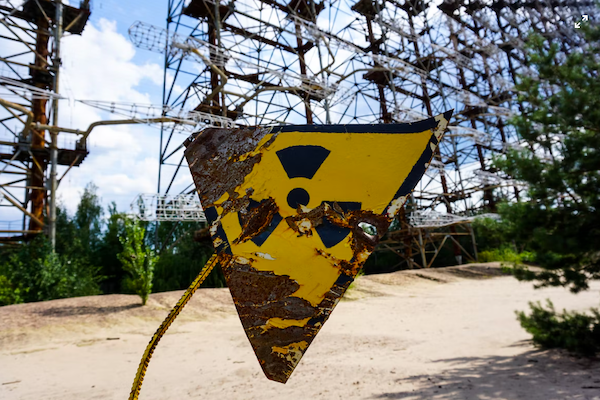
August 9 marks the anniversary of the atomic bomb dropped by the United States on the city of Nagasaki, which, along with Hiroshima (attacked three days earlier on August 6, 1945), represents the only instances of the use of such weapons for military purposes, both on Japanese territory and in the final days of World War II. This type of weapon changed the nature of warfare and strategic conceptualization, forcing the Japanese Empire to sign a peace treaty and significantly shaping the development of the Cold War.
Following the Russian invasion of Ukraine last February and the material support provided by Western powers, Kremlin authorities have issued certain threats regarding the potential use of atomic weapons in the event of intervention. This, combined with North Korea’s advancements in this area and the attempts of other states, such as Iran, to become nuclear powers, has generated concern and instability in a realm that was believed to be contained by the international community.
In this context, questions arise about the level of security and stability in the international system, what limitations exist for the development of such weapons, and what can be expected in the future regarding these weapons of mass destruction.
DEVELOPMENT AND LIMITATION
After 1945, the victorious powers of the war began a frantic race to dominate the atom and acquire the type of weaponry that the United States had introduced. Thus, successively, the Soviet Union in 1949, the United Kingdom in 1952, France in 1960, and China in 1964 achieved this goal. The competition did not stop there; both sides continued experimenting to achieve greater power and destructive capability, culminating in the detonation of the hydrogen bomb by the United States in 1952. Subsequently, efforts focused on delivery systems, starting with aerial platforms and progressing to air-launched missiles, ground bases, and surface ships, ultimately leading to underwater launch capabilities.
During the Cold War, the main powers that developed these weapons focused their efforts on limiting their proliferation to other states and, likewise, on restricting nuclear warhead stockpiles, considering that the potential amassed could annihilate their opponent multiple times. The concept of “Mutually Assured Destruction” (MAD) was defined to identify the possibility that, in the event of an attack by one, the destruction of the other was also assured. Various systems and platforms were developed to ensure remaining capabilities to execute a second strike after having received an initial blow.
This entire scenario experienced one of its most tense moments when, in 1962, the Soviet Union began installing missiles in Cuban territory, just a few hundred kilometers from the North American mainland. What became known as the “Missile Crisis” left the entire world on edge due to the imminent and real threat of a nuclear conflict. Ultimately, diplomacy prevailed, and with concessions from both blocs, the conflict de-escalated to levels of relative normalcy for the time. Another moment of high tension that brought the world possibly closer to nuclear confrontation was the events surrounding NATO’s military exercise “Able Archer” in 1983, which was interpreted by Soviet authorities and intelligence services as an imminent attack against them. In the end, nothing happened.
Since the atomic bombs were detonated over Japan, the international community has sought to create a legal framework that prohibits such weapons. Of course, the process has managed to unite the intentions of the vast majority of states that make up the United Nations; however, it has not achieved any progress in getting those who possess these weapons to renounce them.
Within the international framework to regulate this area, three treaties stand out. The Treaty on the Non-Proliferation of Nuclear Weapons aims to prevent any state from transferring such weapons in any form, as well as prohibiting assistance or inducement for their manufacture, and forbidding any country from receiving these devices from a third party. The second is the Comprehensive Nuclear-Test-Ban Treaty, which aims to prevent signatory states from conducting any nuclear tests or detonations, nor allowing such tests to be conducted on their territory. The third is the Treaty on the Prohibition of Nuclear Weapons, which, as its name indicates, prohibits the development, transfer, receipt, use, or threat of use of these weapons, as well as assistance or inducement for the development of nuclear weapons, and also prohibits the installation or deployment of these weapons on their territory.
In the regional context, the Treaty of Tlatelolco (1967) defined Latin America and the Caribbean as a nuclear-weapon-free zone, agreeing that the areas covered by the treaty would not be subject to the development, acquisition, testing, or deployment of atomic weapons.
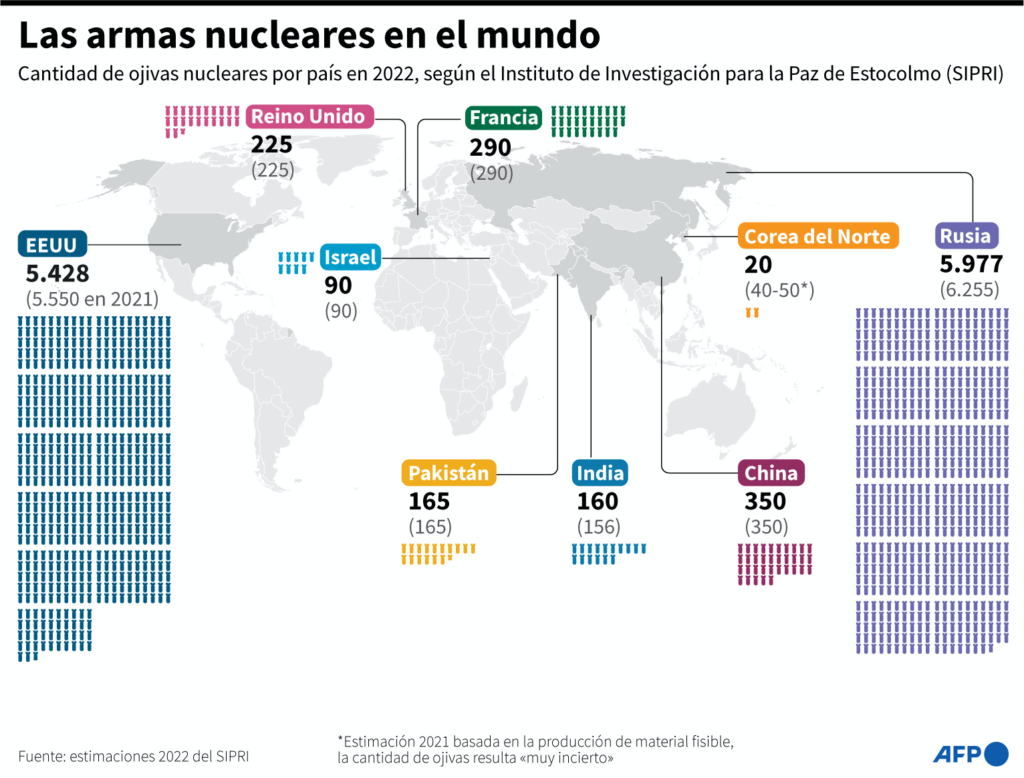
Nevertheless, the number of countries with nuclear weapons continued to rise, reaching a total of nine today. In addition to the previously mentioned powers, India joined in 1974, its neighbor Pakistan in 1998, and, with certainty but never confirmed or denied, Israel. This group must also include North Korea, which withdrew from the Treaty on the Non-Proliferation of Nuclear Weapons, developing its own arsenal, with significant effects on regional security. Currently, it is estimated that the total number of nuclear warheads available worldwide exceeds 10,000, distributed as follows: United States 5,428, Russia 6,257, United Kingdom 225, France 290, China 350, India 160, Pakistan 165, Israel 90, and North Korea 20 (See infographic).
The problem does not end with this group. Other states have initiated nuclear programs for military purposes. It is no secret that Iran has developed sufficient facilities and expertise to achieve its goal of possessing nuclear weapons, despite the opposition from the United States and other Western powers, which has intensified in recent years. Libya developed a program for the same purpose, but it was detected. Syria is another relatively recent case, where scientists and other technicians from North Korea and/or Iran may have been involved.
WHAT TO EXPECT
Although there has been a reduction in the number of nuclear warheads since the end of the Cold War—when nuclear warheads numbered in the tens of thousands—it is true that there are still several thousand of them. Moreover, the states that possess these capabilities continue to refine their arsenals and delivery devices.
The possibility of using nuclear weapons is remote; however, it is not ruled out. Those who possess these weapons have them because they are willing to use them, at least defensively or for deterrence. International regulations have been ineffective in limiting the development of weapons, let alone achieving their destruction. Not all states are party to the agreements, and in any case, those with the intention can withdraw from them, as North Korea did. Ultimately, there are no real incentives to renounce them; evidence of this is what happened with Ukraine after the dissolution of the Soviet Union. In 1991, Ukraine possessed the third-largest nuclear arsenal, but it was persuaded by the United States, the United Kingdom, and Russia to relinquish its weapons (nuclear warheads, missiles, vehicles, and bombers) to the latter in exchange for certain conditions that would ensure its territorial integrity and political independence, in what is known as the Budapest Memorandum (1994). Everyone knows what happened afterward in 2014 and 2022. One must ask whether, had Ukraine retained its nuclear capability, Russia would have dared to invade it.
More recently, following the Russian invasion of Ukraine and in light of the escalating support from the West for the latter, Kremlin authorities have referenced Russia’s nuclear capabilities on multiple occasions, as an open signal of deterrence against potential Western intervention in the war. It is also not ruled out that Moscow may use tactical nuclear weapons, depending on how operations evolve and whether it achieves its objectives or, conversely, sees its ambitions seriously threatened.
Consequently, when discussing nuclear weapons, it can be observed that today the world is in a more complex or deteriorated situation than at the end of the Cold War. While there are fewer weapons, more countries possess them, which multiplies the possibilities of use; those who have them do not rule out their employment and even subtly threaten with their arsenal; other states continue their attempts to achieve such capabilities, fueling regional instabilities and potential escalations that could become a security dilemma, forcing others to acquire them as a defensive measure; on the other hand, terrorist groups are exhausting efforts to obtain nuclear weapons or fissile material to carry out their actions. Furthermore, nothing guarantees that a misinterpretation of events or even human error could trigger the use of these weapons.
In 1945, two bombs were dropped on civilian populations, a difficult decision based on calculations of thousands of civilian and military casualties in the event of an invasion of the Japanese islands; nothing indicates that today similar or other justifications could not be used to justify the use of atomic energy as a weapon of mass destruction.