Security Agenda: The Fast Track Movements
This article was translated automatically and may contain differences from the original. For reference, read the original.
- by Pilar Lizana & Agustín Soto
- Analysis
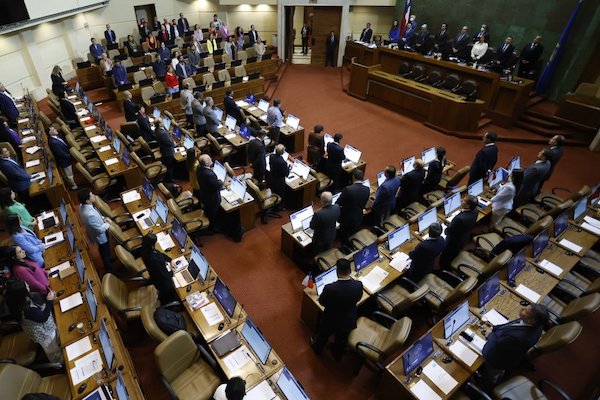
With two weeks remaining until the final proposed deadline for concluding the processing of public security bills, it is necessary to analyze the composition of the proposed legislative package, the progress made, and where the main delays currently lie.
On April 14, the security agenda or fast track legislation was initiated as a response to the security crisis that raised the national homicide rate to 6.7 murders per 100,000 inhabitants[1] in 2022; which increased the fear indicator to its highest level in a decade, at 90.6%[2] of respondents reported perceiving an increase in crime in the country; and led to 36.5%[3] of those surveyed declaring they were exposed to manifestations of organized crime such as narco-funerals, homicides due to settling scores, kidnappings, gang confrontations, fireworks, etc.
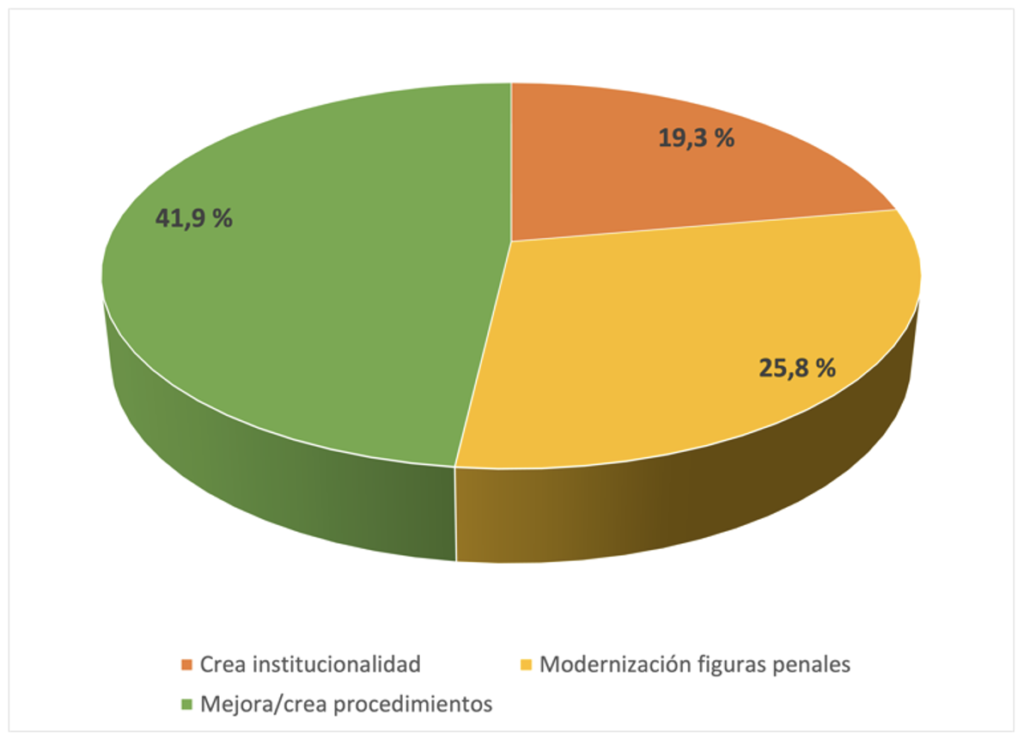
Of the 31 prioritized projects in April, 19.3% correspond to those that create institutions, 25.8% to those that modernize criminal figures, and 41.9% improve/create procedures[4].
Of these, 56% originated from presidential messages, while the rest came from parliamentary motions.
The 31 projects have been introduced during the administrations of Michelle Bachelet, Sebastián Piñera, and Gabriel Boric, with the latter introducing the most projects (67% of the messages). This is explained by the changing national criminal landscape that is generating a security crisis, prompting Chileans to pressure authorities for concrete measures to improve it.
As of September this year, the month in which the second deadline of 150 days to dispatch the projects was met, fourteen (45.1%) had been dispatched and only eight (25.8%) published[5].
Currently, the fourth and final deadline is approaching. This does not have a specific date, but all indications suggest it expires on December 31, as the projects defined for it must be dispatched before the end of the year.
What is the status of the projects, which have advanced, which remain unchanged, and which may be stalled are aspects that will be reviewed next.
Changes in the fast track
Four deadlines were established: Upcoming days, 75 days, 150 days, and the end of the year. Of these, the only one with all its projects published is the first, while none of the projects in the 150-day deadline have been dispatched.
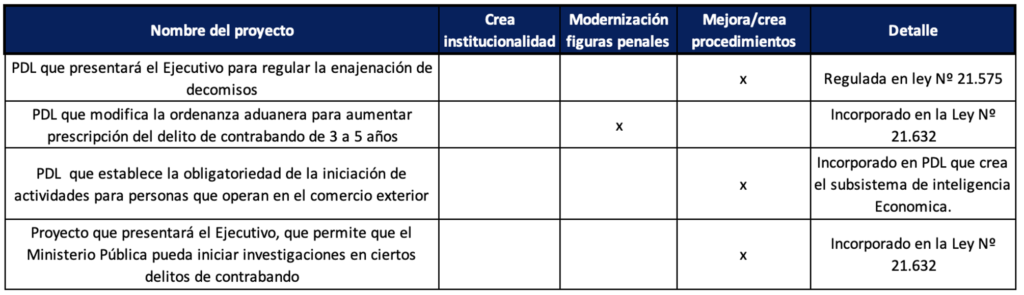
In analyzing the movement of the bills, it is relevant to mention that four of the 31 bills were incorporated into other projects or have already been regulated by other laws, leaving a total of 27 projects within the legislative agenda.
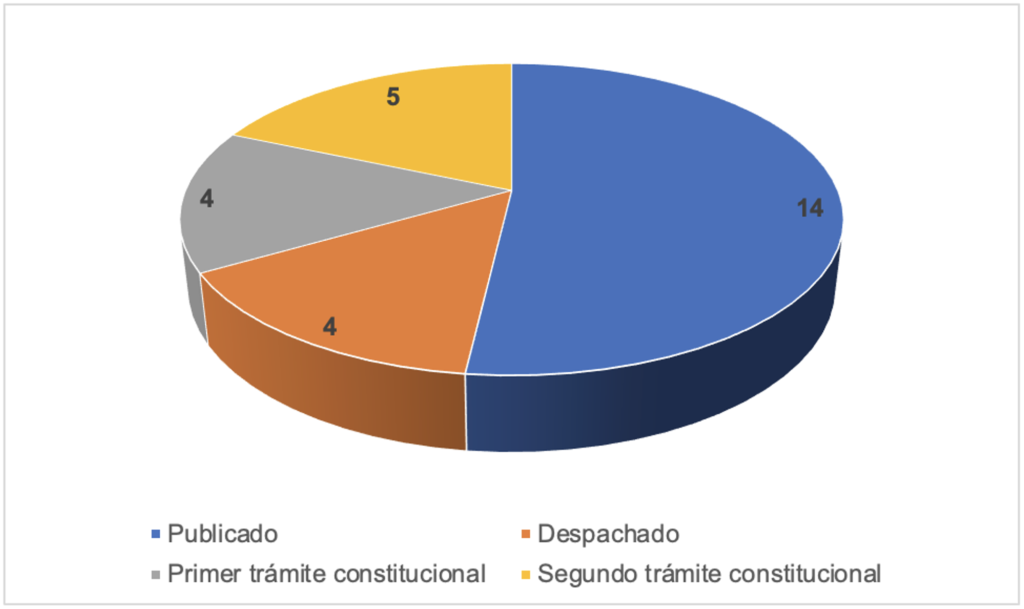
Congress aims to dispatch the projects within the mentioned deadlines; however, for concrete results, it is essential that those dispatched bills are published in the Official Gazette so that they can come into effect. Currently, 51.8% of the projects have been published, while 14.8% are classified as dispatched[6], another 14.8% are in the first constitutional procedure, and 18.5% in the second constitutional procedure[7].
Of the four project packages, the one with the most delays corresponds to the 150-day deadline. Of the six projects, none have been dispatched: four are in the first constitutional procedure, meaning in the chamber of origin; while the other two have only advanced to their second constitutional procedure.
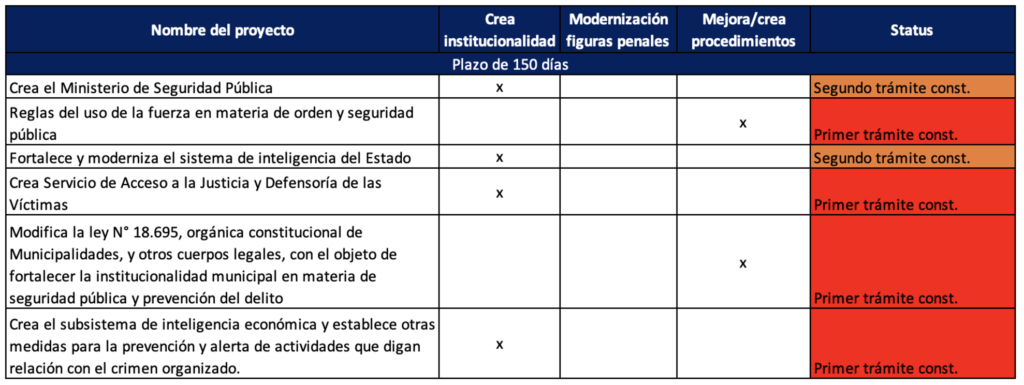
Among them, the one that has spent the most time in parliament is the one that strengthens and modernizes the intelligence system. This was introduced on November 13, 2018; followed by the one that creates the victims’ advocacy, introduced on January 5, 2021; then the Ministry of Public Security, introduced on September 27, 2021, and all the others entered in 2023.
Of these projects, the one that has garnered the most attention is related to the creation of the Ministry of Public Security, while the one concerning the rules of the use of force has clearly evidenced the political differences among the actors who must discuss it.
Regarding the project that creates the Ministry of Public Security, it is important to mention that it seeks to separate the security function from the political function of the Ministry of the Interior, along with proposing intersectoral coordination that provides a multidisciplinary perspective on the challenges posed by crime.
In the case of the rules of the use of force, the main aspects to review are those related to proportionality and rationality in the use of available means, as proportionality does not mean equity, and what is relevant is the rational use of that means when needed.
One of the highly anticipated projects is the one that creates the economic intelligence subsystem. It allows for lifting banking secrecy and adds new preventive functions to the Financial Analysis Unit.
Of these six projects, the one creating a new ministry and the intelligence system could be among those that see movement before the end of the year. However, there is a low probability of achieving their dispatch in 2023.
Final Considerations
The security crisis forced the ruling coalition to change its narrative, modify its program, and promote projects that they previously voted against in Congress. Today, all this has materialized in the 27 projects contained in the fast track legislation, which is designing a security architecture through a bottom-up process that aims to prepare the State to face the new challenges in this area.
Although the movements of the legislative agenda have not fully met the defined deadlines, it has made progress.
Security is the primary demand of citizens. The urgency of this issue is such that the CEP survey[8] showed that 45% agree with the suppression of all public and private freedoms to control crime.
Crime is impacting the heart of democracy. The fact that citizens prefer to cede freedoms in order to obtain security signifies a significant weakness of the State, as living in a context of peace necessarily means enjoying all our freedoms.
The security agenda is the way the Legislative and Executive branches have found to address citizen pressure, which, it should be noted, has been the main driving force behind the urgencies in this matter.
While the above is of utmost importance, as it has generated relevant actions, it should not be forgotten that security is a function of the State. It is the State that must provide a peaceful environment for its citizens.
Although the deadlines have not been fully met, for those observing from the outside, there appears to be significant State action, which, viewed from within, has received criticism, especially due to the ideological debate that has marked some projects.
Ultimately, beyond the optimistic or pessimistic outlook, what matters is that the projects advance, the laws are published, and, most importantly, that the security architecture we so desperately need to confront the new criminal landscape is generated. Otherwise, we will only enumerate projects that will not be perceived as successful in practice.
By December 31, we may find an incomplete fast track accused of being a slow track. Some of this could change after the constitutional plebiscite on December 17, but not entirely, as a new Constitution will not resolve the security crisis in the short term. It is essential that the tools provided by the new laws are accompanied by a determined political will capable of assuming the risks and costs involved in pursuing organized crime.
[1] Center for the Prevention of Homicides and Violent Crimes, “1st National Report on Completed Homicides: An Integrated and Institutional Vision 2018 – 2022,” July 2023. Available at: https://prevenciondehomicidios.cl/wp-content/uploads/2023/07/Informe-homicidios-2018-2022.pdf[2] Undersecretariat for Crime Prevention, “19th National Urban Citizen Security Survey 2022,” November 2023. Available at: https://www.ine.gob.cl/docs/default-source/seguridad-ciudadana/publicaciones-y-anuarios/2022/nacional/síntesis-de-resultados-19-enusc-2022—nacional.pdf?sfvrsn=2854ad13_2
[3] Paz Ciudadana Foundation, “Index of Exposure to Organized Crime,” January 2023. Available at: https://pazciudadana.cl/proyectos/documentos/indice-de-exposicion-a-la-criminalidad-organizada/
[4] Pilar Lizana and Agustín Soto, “Security Analysis: How Fast is the Fast Track Progressing?” September 28, 2023. Available at: https://www.athenalab.org/analisis-agenda-de-seguridad-que-tan-rapido-avanza-el-fast-track/
[5] Ibid.
[6] It should be noted that, as of the publication date of this article, the project related to the audiovisual recording of police actions had been enacted and was awaiting publication in the Official Gazette. Therefore, this project has been considered dispatched for the purposes of this analysis.
[7] In the
first constitutional procedure the project enters the chamber of origin, which after discussion sends it for its second constitutional procedure . If no agreement is reached, it moves to thethird constitutional procedure in a mixed commission. When the project regulates matters requiring constitutional control, it advances to a fourth procedure in the Constitutional Court; once the procedure in the TC is completed, it is sent to the President for its enactment . Once enacted, it is publishedin the Official Gazette. [8] Center for Public Studies, “National Public Opinion Study CEP 90,” November 20, 2023. Available at: https://www.cepchile.cl/encuesta/encuesta-cep-n-90/