Latin America on the Second Anniversary of the Russian Invasion of Ukraine
This article was translated automatically and may contain differences from the original. For reference, read the original.
- por Violetta Udovik
- Colaboraciones externas
Yurii Diudin, the first resident ambassador of Ukraine in Chile, formally presented his credentials to President Gabriel Boric on December 29, 2023. Previously, he served as the Extraordinary and Plenipotentiary Ambassador of Ukraine to the Republic of Argentina from 2013 to 2019. Between 2015 and 2019, he also held simultaneous positions as the Extraordinary and Plenipotentiary Ambassador of Ukraine in Chile, Paraguay, and Uruguay.
This appointment, made just before the second anniversary of Russia’s large-scale invasion of Ukraine and the tenth anniversary of the Russo-Ukrainian war, which began with the occupation of Crimea in 2014, demonstrates Ukraine’s willingness to strengthen ties with the region.
It also coincides with the announcement of the first Ukrainian Strategy for Developing Relations with Latin America and the Caribbean, made by Ukraine’s Foreign Minister, Dmytro Kuleba, in January of this year. This five-year strategy aims to strengthen political, commercial, economic, cultural, and humanitarian relations with the Latin American and Caribbean region, in the context of confrontation due to Russian aggression and the need for support for the restoration of peace in Ukraine.
In detail, first and foremost, Ukraine needs military support, both lethal and non-lethal. In a recent interview with La Tercera, Ambassador Diudin mentioned that while Ukraine values Chile’s stance, it would appreciate the practical realization of the support for demining previously offered by President Boric. Additionally, the Ukrainian diplomat noted that Chile could provide non-lethal equipment, such as bulletproof vests or helmets, as well as send ambulances for transporting the wounded.
In this context, it is noteworthy that most countries in the region express their political solidarity with Ukraine, with the exception of Cuba, Venezuela, and Nicaragua. Nicaragua has consistently opposed United Nations General Assembly resolutions condemning the war, while Cuba has abstained and Venezuela chose not to vote.
President Luiz Inácio Lula da Silva, leader of the largest economy in the region, stated that he wishes to contribute to ending the war. While Brazil opposed the Russian invasion in four UN resolutions, it has not joined the international democratic coalition seeking to end the Russian offensive against its neighboring country. In turn, Mexican leader Andrés Manuel López Obrador has maintained an ambiguous stance, criticizing the aid provided to Ukraine by the United States.
Chile and Colombia, on the other hand, in addition to political support, committed to providing assistance in demining operations. In the case of Colombia, the popular initiative of solidarity with the Ukrainian people called “Aguanta Ucrania,” led by Sergio Jaramillo, former peace commissioner in Colombia, writer Héctor Abad Faciolince, and journalist Catalina Gómez Ángel, is also noteworthy.
Second, the Ukrainian government is interested in organizing a summit in Latin America, an idea proposed by Volodymyr Zelensky in early 2023.
It is important to highlight that in July, the Ukrainian president was unable to attend the Summit of Heads of State and Government of the European Union (EU) and the Community of Latin American and Caribbean States (CELAC) in Brussels due to a veto on his participation, indicating a rejection by the participants of this event. However, with the change of president in Argentina, the situation began to shift. In November 2023, the then-elected leader Javier Milei proposed organizing a peace summit in collaboration with other Latin American nations to address the war between Russia and Ukraine.
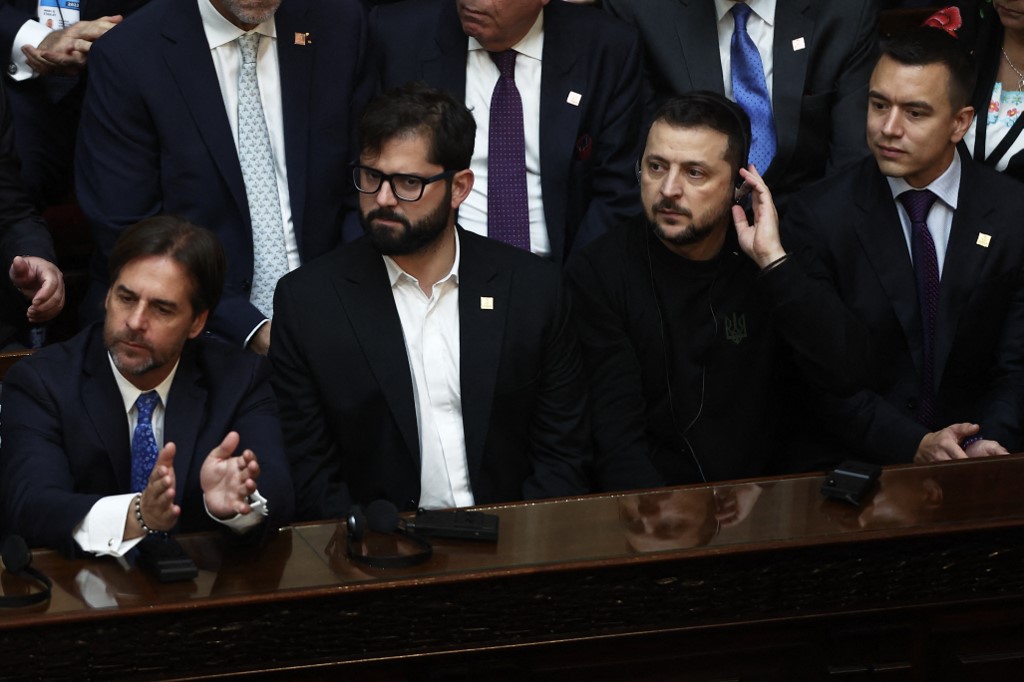
In December, Zelensky himself participated in Milei’s presidential inauguration, marking his first visit to Latin America since the start of the Russian military invasion in 2022. During the ceremony, Zelensky not only met with his Argentine counterpart but also with the leaders of Ecuador, Paraguay, and Uruguay. Additionally, he had an informal conversation with President Boric. They had previously met during the UN General Assembly in September 2023.
Regarding the third important point, Ukraine seeks the participation of Latin American countries in its peace formula announced in October 2022. President Zelensky proposed that countries around the world choose from this formula the points they can implement, with the aim of ultimately achieving the necessary security architecture for global stability.
The goal of the Ukrainian formula is to “end Russian aggression and restore the strength of international law for Ukraine and all other nations.” It clearly states the complete withdrawal of Russian troops from Ukrainian territory to the internationally recognized borders of 1991, which include Crimea and Donbas. It also includes other important points such as radiological and nuclear security; food and energy security; the release of all prisoners and deportees; implementation of the UN Charter; restoration of Ukraine’s territorial integrity and the global order; cessation of hostilities; justice; immediate environmental protection; prevention of escalation; and confirmation of the end of the war.
On January 14 of this year, the fourth round of peace talks opened in Davos, Switzerland, among national security advisors and foreign policy advisors from various countries. The first days of these meetings took place in Copenhagen, Denmark, in June 2023; in Jeddah, Saudi Arabia, in August 2023; and also in Malta, in October 2023.
According to Ruslan Spirin, Ukraine’s Special Representative for Latin America, the number of participants in the third meeting in Malta grew from forty to sixty-five, including delegations from many Latin American countries such as Chile, Argentina, Brazil, Uruguay, and Mexico. Related to the recent meeting in Davos, this was attended by representatives from 81 countries and international organizations, including six from South America.
This demonstrates a growing interest from the region, which is a positive sign for the future implementation of the Ukrainian peace formula. Active participation from Latin American countries is also expected at the World Peace Summit, which will take place in Switzerland, aimed at helping to end the Russo-Ukrainian war, thereby ensuring a just resolution of the conflict and strengthening international law.
Although it is still difficult to achieve a unified voice from Latin American countries in explicit support of Ukraine’s struggle for freedom and its right to exist as a nation-state, Chile’s firm position and the change in Argentina may mark the beginning of more positive prospects. Adding to this is the potential end of the “pink tide” in Latin America, due to the upcoming elections in the region this year, especially in Mexico and with some possibility in Venezuela, which could lead to a more balanced political situation and motivate more countries to define their position as supporters of Ukraine.
*The comments and opinions expressed in this document represent the views of their authors, not necessarily those of the institution.
*Photo: France Presse
por Violetta Udovik
Doctora en Historia y cientista política
¿Quieres publicar con nosotros? Revisa nuestras normas para colaboradores externos.
Ver normas de publicación