The Security Challenges of Bolivia and the Response of the Paz Government
This article was translated automatically and may contain differences from the original. For reference, read the original.
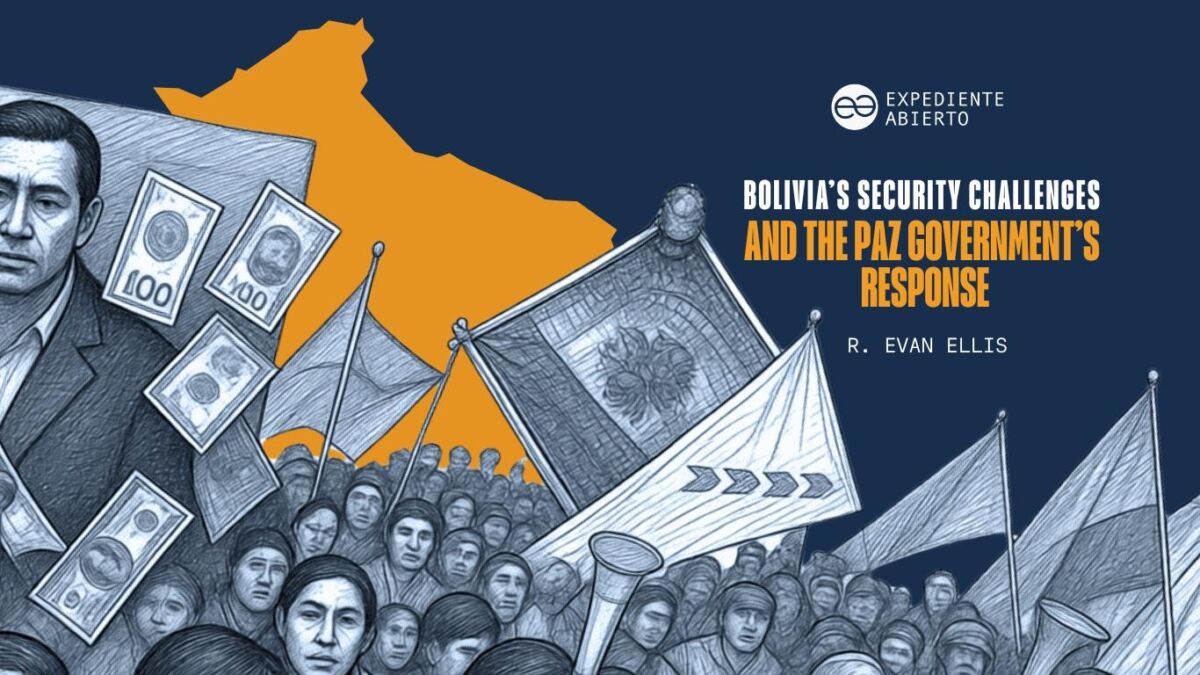
Bolivia faces a series of interrelated security challenges.
On June 2, 2026, Bolivia’s Minister of Defense, Marcelo Salinas, resigned after more than a month of protests and blockades that left the capital without food, fuel, or medical supplies, disrupting economic and political life throughout the country and threatening to overthrow the government of Rodrigo Paz. The protests addressed various issues, such as the shortage of dollars and other goods, the poor quality of gasoline acquired through a state contract that damaged numerous vehicles, demands for wage increases, and the repeal of the new property law, Law 147. However, a unique aspect of the Bolivian situation was that at the center of the funding, mobilization, and duration of the protests were the actions of former president Evo Morales and the cocoa producers from the Chapare region. This region and its coca producers undoubtedly constitute the core of cocaine production in the country, which is exported to Europe, Oceania, and other international markets through a network of drug traffickers, some of whom use Bolivia as a base of operations or refuge. Beyond drug trafficking and other illicit activities, the protests in Bolivia have reached a level of insurgency, although they are not commonly recognized as such, in the gray area. The actors involved are well-funded and coordinated, engaging in the seizure or blockade of military-relevant targets, such as key road segments, with the aim of isolating the capital and paralyzing the economy. They use highly lethal weaponry, such as dynamite and, at times, firearms, even ambushing police and other government forces. Meanwhile, the Bolivian government and security forces treat these actors as civilians, not combatants, fearing an escalation of the conflict or imprisonment, as has already occurred, if their political, military, or police leaders act with excessive aggression.
Bolivia, strategically located in the heart of South America, faces a series of interrelated security challenges centered on cocaine production and drug trafficking, illegal mining, and internal instability caused by radicalized groups. The recently inaugurated government of Rodrigo Paz is working to address these challenges, in part through a fundamental reorientation of its foreign policy to rebuild cooperation with the United States. However, it has also found that this reorientation is accelerating the mobilization of those seeking to overthrow its government.
From May 21 to 31, 2026, the author visited Bolivia during the political and security crisis the country was experiencing, interviewing over 40 Bolivian experts about the challenges and the evolving situation in the country. This work, one of three derived from those interactions and supplementary research, analyzes the nation’s security challenges and the efforts of the Paz government to address them.
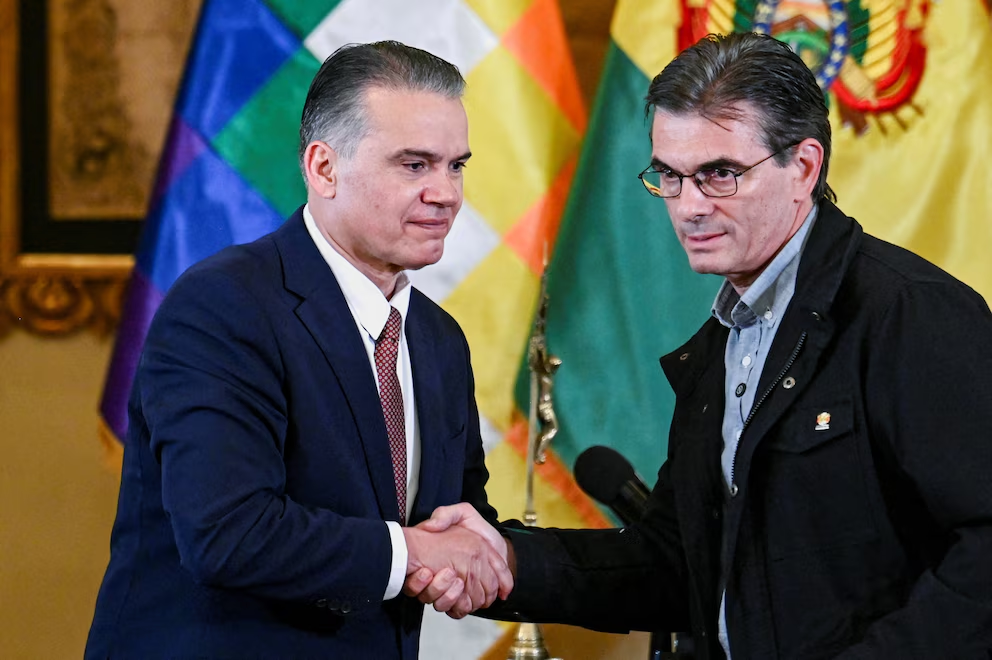
Security Challenges in Bolivia
DRUG TRAFFICKING. Bolivia is currently a source of coca, a producer of cocaine, and a transit country for drugs, as well as a money laundering center and refuge for international criminals linked to drug trafficking. The country’s role in international drug trafficking expanded significantly under the leftist populist governments of the Movement for Socialism (MAS) of Evo Morales and his successor and later opponent, Luis Arce. This role was further expanded with the expulsion of the U.S. Drug Enforcement Administration (DEA) by Morales’s government in 2008, following Morales’s accusations that the DEA had spied on his romantic partners and taken other measures to undermine his government. According to those consulted for this report, the absence of the DEA and the elimination of associated U.S. programs to combat corruption within the Bolivian police, including its anti-narcotics force FELCN, led to an increase in corruption and a decrease in the effectiveness of these agencies. In Bolivia, the cultivation and use of coca leaves in limited quantities for traditional purposes is legal, and the area permitted for such cultivation was expanded by Evo Morales through Law 906 in March 2017. However, the area cultivated in Bolivia, according to the United Nations Office on Drugs and Crime (UNODC), is 34,000 hectares, significantly exceeding the 24,000 hectares permitted by that law. The area cultivated in 2024 represented a 10% increase in just one year compared to 2023. Coca production in Bolivia is concentrated mainly in two regions: Yungas and Chapare, within the department of Cochabamba. According to experts consulted for this study, the coca from Yungas has characteristics more suitable for chewing and other human uses, while the alkaloid content and other qualities of the coca from Chapare are more optimized for cocaine production. Consequently, Chapare has become the epicenter of cocaine production, as well as its transformation into cocaine in clandestine laboratories. The six federations of coca growers from the Tropic of Chapare, led by Evo Morales, have undoubtedly become the nerve center of cocaine production in Bolivia and its links to transnational criminal networks.
Cocaine and intermediate products produced in Chapare are distributed to markets primarily in Europe and Oceania through multiple routes, with the assistance of significant transnational organized crime groups. These include the First Capital Command (PCC) and the Red Command (CV). Mexican cartels such as Sinaloa and Jalisco New Generation (CJNG), the Paraguayan group Insfrán, the Serbian mafia, and various Colombian groups, among others, have a presence in Bolivia and participate in this drug trafficking.
Historically, Bolivian coca leaves were transformed into coca base, an intermediate product, which was then transported by air to northern Argentina for final processing. Today, Bolivia produces much more refined cocaine, which is exported through multiple routes. These include transport from Chapare to the east, to Brazil, or to the southeast, to Paraguay, or directly to Argentina. While some of this coca, particularly the low-quality “paco,” is consumed in the region, most is loaded onto transatlantic merchant ships in major ports such as Rosario or Buenos Aires, Argentina, or Montevideo, Uruguay. Some cocaine from Peru also transits through Bolivia along these routes. Additionally, a portion of the cocaine leaving Chapare is sent westward, to northern Chile or Peru, ultimately destined for markets in Oceania or Europe through ports such as Iquique or Arica, Chile.
Of the two main Brazilian transnational organized crime groups operating in Bolivia, the PCC focuses on smuggling cocaine southeast, while the CV tends to concentrate in the north, including the department of La Paz and Pando toward Brazil.
In recent months, significant figures from transnational organized crime have been discovered operating from Bolivia. Among them are Sebastián Marsett, head of the First Command of Uruguay (PCU), a PCC affiliate, and Gerson Palmero, from the First Capital Command. Both were arrested in Santa Cruz. Marsett lived comfortably in the exclusive neighborhood of Las Palmas, alongside the Bolivian business and political elite, and owned a major football team in the department.
ILLEGAL MINING. Beyond cocaine, Bolivia has a significant illegal mining industry, a subsector of the informal mining sector, poorly regulated but widespread in the country, representing over 80% of the Bolivian economy. The relative economic importance of this mining has increased with the price of gold, which hovers around $4,500 per ounce at the time of writing this report, making illegal mining in Bolivia more lucrative than drug trafficking in many cases.
As a reflection of the magnitude of the informal mining sector, Bolivia is currently the largest importer and exporter of mercury in the world. The use of mercury in informal mining has devastating environmental consequences, including lethal contamination of water, vegetation, and wildlife.
Illegal mining has also been used to launder money from drug trafficking and other illicit activities, especially since gold extracted informally is often purchased in cash.
Similar to cocaine, there is a synergy between illegal mining and Bolivia and Peru. When Peru has intensified repression against illegal mining or increased controls over the origin of its gold, some of this gold is smuggled into Bolivia, where it is considered easier to obtain falsified documents proving that the gold comes from Bolivian mines. Conversely, when the Bolivian central bank has purchased gold from the informal sector to increase its reserves at market prices, Bolivians have smuggled it into Peru to sell it at higher prices in the illicit economy.
As in Peru, elements of Chinese organized crime also have a presence in Bolivia’s informal and illegal gold sector as buyers of the product, as well as suppliers of dredging equipment and materials such as mercury, among other functions.
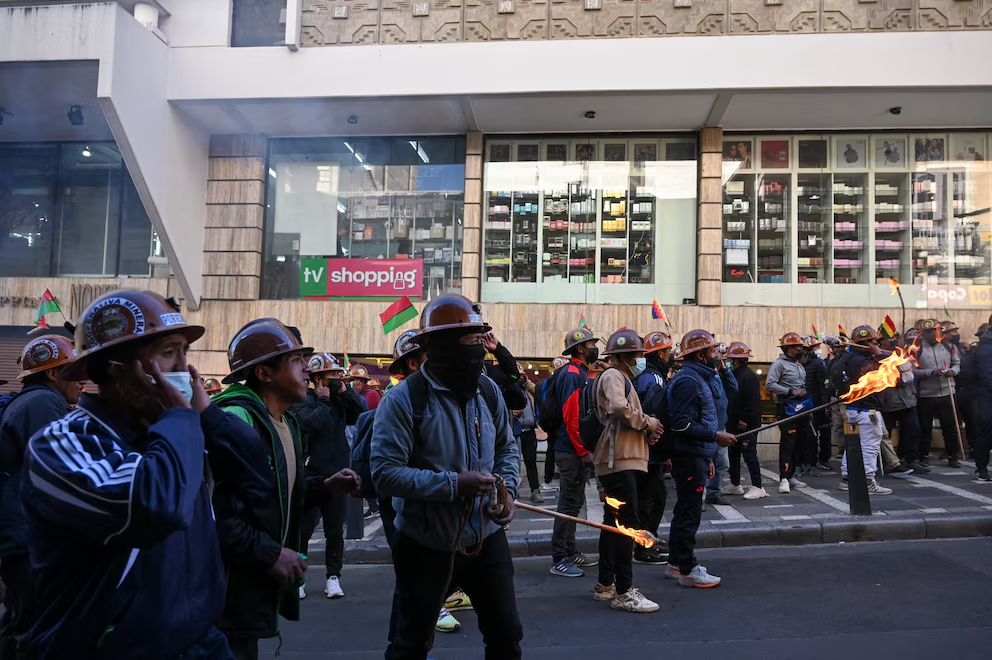
INSURGENCY DISGUISED AS PROTEST. Beyond organized crime, Bolivia exemplifies the extreme blurring of the lines between legitimate political and social protest and insurgency. The six federations of coca growers from the Tropic of Chapare, mentioned earlier, have played a fundamental role, along with the Bolivian Workers’ Committee (COB) and the Tupak Katari workers’ federation, in protests against right-wing Bolivian governments, defending governments or policies that affect their coca production and its de facto transformation into cocaine. The role of coca growers in the Bolivian protests of May 2026 is based, in part, on the arrest warrant issued by the government against Evo Morales for failing to appear in court to face charges of child sex trafficking, partly related to the daughter he had out of wedlock with Gabriela Zapata, who was then 14 years old. The enormous revenues generated by cocaine production in Chapare undoubtedly provide the resources used to transport protesters to specific locations, pay for their food, cash stipends, and other benefits. Notably, the use of dynamite in the mining economy has made explosives ubiquitous in protests in Bolivia, even at a level that poses a danger when thrown at armored police and military vehicles.
According to sources consulted for this work, over the years, the ideological allies of the leftist populist governments of Evo Morales have facilitated the recruitment of members of guerrilla groups such as the Revolutionary Armed Forces of Colombia (FARC), and reportedly also the National Liberation Army of Colombia (ELN), Shining Path of Peru, and Cuban groups, among others, to provide them with military and other training.
In the recent protests of May 2026, as in previous occasions, the combination of resources, lethal capacity, and military training available to coca growers and other protesters has led their actions to resemble a low-intensity insurgency. During the efforts in May 2026 to destabilize the government of Rodrigo Paz, for example, protesters deliberately blocked strategic routes controlling the access of food, gasoline, medical supplies, and other necessary materials to and from the capital, La Paz. They even blocked the few roads connecting the city to the International Airport and other areas of El Alto, the city located on the plateau connected to La Paz, and attempted to paralyze the cable cars that circumvented the roadblocks connecting both cities. When government forces attempted to advance in an armored convoy to unblock one of the routes and create a humanitarian corridor, protesters armed with dynamite and weapons ambushed the convoy, forcing it to retreat. In the process, the Minister of Public Works, Mauricio Zambrano, became separated from the convoy and, reportedly, his life was in danger as he was pursued by protesters seeking to kill him, just as years earlier they had ambushed a convoy and killed a government minister in the same area.
Elsewhere in the country, when the Bolivian police attempted to block a crucial road connecting Santa Cruz with Cochabamba with barricades, they were ambushed by protesters who threw dynamite from strategically elevated positions.
In the department of Santa Cruz, protesters blocked a strategic road in San Julián and mobilized thousands of reinforcements upon learning that members of the Santa Cruz Youth League planned to march to the site to lift the blockades. Reports indicate that the protesters in San Julián had stationed snipers along the road in anticipation of the arrival of the UJC, a situation that would have resulted in a massacre had the civic committee of Santa Cruz not canceled the planned march.
In traditional counterinsurgency analysis, the attempt by an organized and well-armed group to militarily deploy with the aim of isolating the capital and overthrowing the government would be considered an insurrection, subject to an armed response, albeit proportional, by the government, in accordance with the laws of war in Bolivia. However, the tradition of such protests, including the use of dynamite and some weapons, combined with the weakness and, at times, unreliability of security forces, has led the government to repeatedly treat these activities as criminal, not as combat.
Response of the Bolivian Government
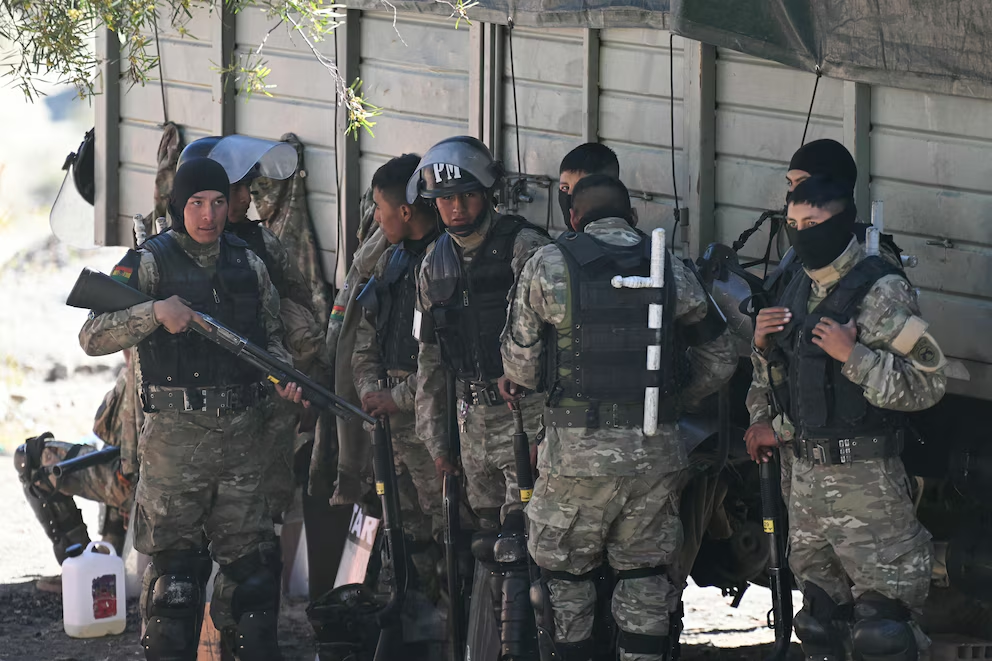
Within the Bolivian government, its armed forces and police, there are many competent professionals seeking to act honorably to fulfill their duties, protect the country’s security, and combat criminal organizations and other threats. However, severely affected by two decades of MAS government, closely linked to coca producers in Chapare and criminal interests in the informal mining sector, and with persistent insufficient funding, the Bolivian government and its security forces are severely impacted by corruption and degradation of their capabilities.
The Police and the FELCN. Within the Bolivian national police, especially after the expulsion of the DEA and the termination of U.S. training, transparency, and institutional strengthening programs, controls against corruption have been virtually nonexistent in a country flooded with illicit activity and money. According to those surveyed for this work, corruption within the Bolivian police is widespread. In fact, for example, in 2024, Maximiliano Dávila, the drug czar of the Evo Morales era in Bolivia, was charged in the United States with drug trafficking, as was the former director of the FELCN, Renée Sanabria, in 2011.
As a first step to address the situation, the Paz government reintroduced the DEA to the country in 2026, albeit with a limited number of members, operating as a representative in an office in La Paz.
In the police in general, in addition to corruption, there is a significant lack of necessary equipment both to combat crime and to handle protests. This includes a severe shortage of basic crowd control materials, such as tear gas, which in previous government responses, the government has even imported from Argentina. The Bolivian police have long been forced to purchase their own uniforms and much of their equipment. Amid a severe fiscal crisis, increasing police resources has not yet been an option for the Paz government.
THE BOLIVIAN ARMY. The capabilities of the Bolivian army, like those of the police, have been undermined by corruption and neglect. During the era of Evo Morales, the government sought to fundamentally restructure the armed forces and transform their orientation. Among its efforts was the incorporation of Cubans, primarily into the Bolivian military intelligence service G2, which not only supports the army but, in the absence of a civil intelligence service, also integrates civil, police, and military intelligence. The Morales government also used Cubans to help launch its “Anti-Imperialist School” for military indoctrination, which was later dismantled by the government of Jeanine Áñez.
The Morales government further promoted equality between troops and officers, both in the police and the armed forces, and opened the Bolivian officer corps to personnel who previously lacked the required university degree, and even, in some cases, basic literacy. Notably, a significant number of these new recruits, incorporated through the Equal Opportunities Program (PIO), came from Chapare, the main coca-producing region and stronghold of Evo Morales. Today, many of them reportedly hold leadership positions, with ranks ranging from major to colonel. As a result, President Paz’s government has been very reluctant to deploy the armed forces or police to confront protesters, not only due to the lack of adequate equipment and training but also because of the disparity of loyalties within the armed forces and the risk that they might choose to join the protesters, refuse to fight, or even engage in acts of sabotage that deliberately incite violence to destabilize the situation and accelerate the fall of the government. Of the limited new equipment acquired by the armed forces, almost all has been of low quality, purchased or donated by the People’s Republic of China (PRC). This includes 6 K-8 interceptor jets, 6 Z-9 helicopters, a limited number of Dong Feng military trucks, 31 armored vehicles, and a small number of patrol boats.
Of the six K-8s, two crashed, and reportedly only one remains operational, due to a combination of poor or deferred maintenance and difficulty obtaining spare parts. For similar reasons, of the six Z-9 helicopters, only one remains operational, but reportedly no one wants to fly it because it has not received adequate maintenance.
Although Bolivia attempted to maintain an aging fleet of U.S. UH-1H helicopters, the money that the U.S. State Department left for their maintenance was reportedly diverted for other purposes, and none remain in service. The situation is similar with the small number of Super Puma helicopters in Bolivia. Of the vehicles owned by the Bolivian Army, most were acquired from neighboring Brazil, including their main 2.5-ton transport trucks, manufactured by INGESSA. Some ground vehicles in the Bolivian fleet are nearly 70 years old. Of the amphibious URUTU vehicles, already obsolete and acquired from Brazil, only six remain operational. They also have a limited number of Cascavel vehicles, also obsolete and from Brazil, of which reportedly seven are operational. These vehicles that still function do so thanks to having been modernized and poorly maintained.
Bolivia has also acquired some Nissan “Condor” trucks manufactured in Argentina, but these are for civilian use, not military.
Of the small number of ground vehicles recently acquired from China, as mentioned earlier, the Bolivian Army generally does not use them due to their high operational costs, including a fuel efficiency of approximately one kilometer per liter at a time when gasoline is becoming increasingly expensive and resources are limited. To detect flights of drug traffickers, in 2016 the Morales government acquired nine radars from the French company Thales. However, during his term, these were never put into operation. The current government, on the other hand, has managed to get approximately half of them operational.
In light of these difficulties, the Paz government has resumed dialogue with the United States regarding military security cooperation. Reports indicate that it is again considering sending Bolivian students to U.S. military institutions such as the Western Hemisphere Institute for Security Cooperation (WHINSEC), although the number of students that may receive funding in the current fiscal situation is unknown.
Beyond cooperation with the United States, the path the Paz government will take with drug traffickers, illegal miners, and de facto insurgents seeking to overthrow it is uncertain. According to those interviewed for this work, the president has somewhat acknowledged the importance of addressing the issue of Evo Morales, currently a fugitive from Bolivian justice, and other coca leaders in Chapare, as key factors for the persistence, level of violence, and destabilization of the protests. However, it is unclear whether the president would risk a military or police action that could precipitate the fall of his government, as occurred in 2003 with the loss of life caused by the confrontation with the armed forces, as happened in 2019, or whether military and police elements would join the protests. On the other hand, if the president attempts to negotiate with the protesters, hoping to divide and bribe them, it would likely exacerbate Bolivia’s fiscal problems, ultimately making it more difficult to provide the necessary resources for the Armed Forces and the Police. Additionally, if President Paz incorporates some radical left groups into his cabinet as ministers, this could hinder his rapprochement with the United States and the resulting cooperation in security and anti-drug efforts.
Conclusion
Bolivia, a nation of strategic importance, is at a critical moment where the government of Rodrigo Paz is willing to rebuild relations with the United States in security and other areas, as evidenced by its participation in the American Coalition Against Cartels (A3C) and in Operation Shield of the Americas in March 2026.
While Bolivian cocaine, illicit gold, and refugees do not directly head to the United States, Bolivia’s previously noted role as a hub for significant international criminal organizations, including those like the PCC and CV, designated by the United States as terrorist organizations, underscores the importance for the United States of Bolivia’s success in its fight against drug trafficking, other transnational organized crime, and insurgency disguised as social protest.
Bolivia’s fiscal crisis and the deep corruption that permeates its institutions make it virtually impossible for the Paz government to succeed in this struggle alone. In fact, even the basic capacity to confront those participating in a military “siege” of La Paz is weakened by a lack of trust in the resources and loyalty of Bolivian security forces.
Reciprocally, the fall of a pro-U.S. Bolivian government, long awaited, committed to fighting organized crime and terrorist groups, and resisting cooperation with extra-hemispheric U.S. rivals, would be disastrous not only for Bolivia but also for its neighbors, already affected by the Bolivian criminal economy fueled by cocaine and gold, and by radicalized indigenous groups.
From the perspective of Washington D.C., Cuba’s role in supporting the previous government of Evo Morales, and the risk of their return to power with him, would directly contradict the progress that the current U.S. administration has made against the narco government of Nicolás Maduro in Venezuela, and seeks to achieve against the communist government in Cuba. Although Bolivia is geographically somewhat distant from the United States, it is crucial to the dynamics of the region, which the United States has prioritized in its National Security and National Defense strategies, considering it vital to the security of its territory. What happens in Bolivia has implications for the United States.