Observer or Full Member? Chile in the Coalition of the Americas Against the Cartels (A3C)
This article was translated automatically and may contain differences from the original. For reference, read the original.
EXECUTIVE SUMMARY
- On October 26 and 27, nineteen countries from the hemisphere gathered in the Dominican Republic to approve the governance framework and the campaign plan for 2026-2031 of the Coalition of the Americas Against the Cartels (A3C), a military and security component that supports the objectives of the Shield of the Americas.
- Although Chile participated in the meeting, it decided to postpone its full incorporation and maintain, for now, its status as an observer. This decision generated differences within the government and raised questions from some experts, who believe that greater participation in the U.S. initiative is necessary.
- This report examines four arguments in favor and four against full participation. However, it is argued that the opposing arguments are more convincing.
- The evaluation is based on four main arguments.
- First, the current composition of the A3C seems to respond more to political alignment with Washington than to the territorial distribution of the criminal threats it seeks to combat. The absence of key countries in the region’s criminal ecosystem, such as Brazil and Mexico (and, until two months ago, Colombia), raises doubts about its effective coverage and the continuity of its efforts beyond the current political cycle.
- Second, the military architecture of the coalition and its campaign plan tension the approach maintained by President José Antonio Kast’s government regarding internal security, which considers the fight against criminal gangs primarily a police responsibility. The differences between both approaches and their consequences suggest that this tension should be resolved before assuming full participation in the mechanism.
- Third, the similarities between the military approach of the A3C and that of other U.S. initiatives whose international legality has been questioned, such as Operation Southern Lance, pose potential reputational costs for Chile, considering the principles that have guided its foreign policy.
- Finally, full participation must be evaluated in light of Chile’s foreign policy tradition, which has prioritized United Nations mandates for its main international military deployments. Joining a military coalition also raises the importance of having internal political consensus to sustain that decision beyond the current government.
- It is concluded that maintaining the status of observer is a prudent decision consistent with Chile’s foreign policy tradition. Furthermore, it allows for the preservation of multilateral cooperation while evaluating the results of the A3C and strengthening regional initiatives promoted by Chile, particularly the Santiago Commitment Against Transnational Organized Crime.
WHAT HAPPENED
The Coalition of the Americas Against the Cartels (A3C) originated from the joint security declaration signed on March 5, 2026, in Miami, during a meeting convened by U.S. Secretary of War Pete Hegseth. Its creation preceded the launch of the Shield of the Americas by two days.[1], a broader diplomatic initiative whose security objectives the A3C supports from a military and operational standpoint.[2].
On August 11 and 12, the A3C held a new forum in Panama, where participating countries received a draft of the coalition’s governance framework.[3]. The document generated observations from various governments regarding its scope and operational mechanisms².
On October 26 and 27, nineteen countries met in the Dominican Republic to finalize the draft along with a campaign plan aimed at establishing the operational priorities and working methods of the military coalition. The meeting was led by the U.S. Southern Command (USSOUTHCOM)[4].
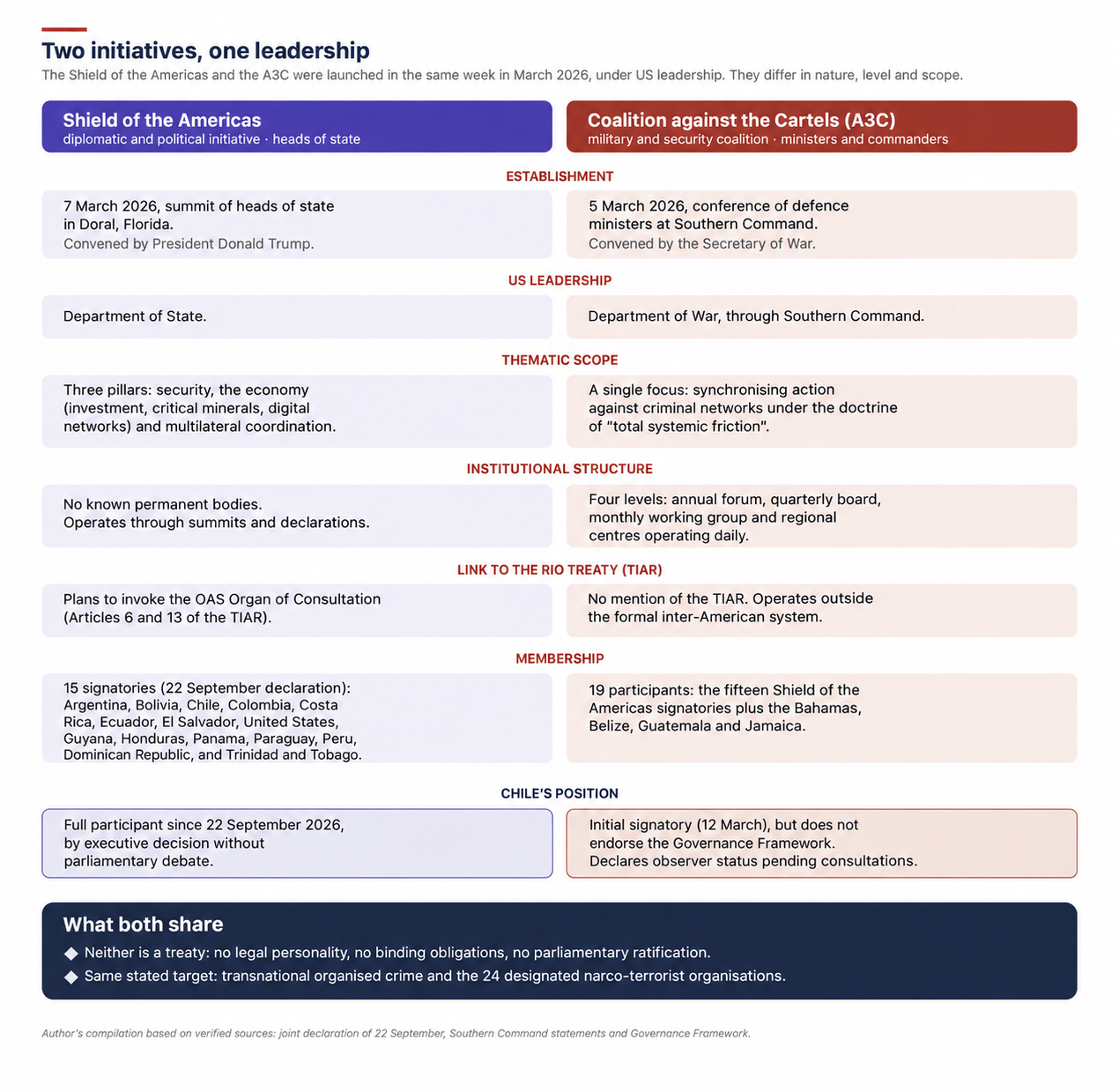
Figure 1. Comparison of the Shield of the Americas and A3C.
Source: Own elaboration.
The form of participation that Chile should adopt in the A3C generated debate within the Executive. According to press reports, differences arose between Defense Minister Fernando Barros, who favored a more cautious incorporation, and presidential chief advisor Alejandro Irarrázaval, who reportedly promoted a closer connection to the U.S. initiative[5]. The discrepancies focused on the scope of military participation and the sovereignty safeguards that the agreement should contemplate.
On October 25, President José Antonio Kast gathered his sectoral ministers to address the matter. The following day, the Undersecretary of the Interior, Máximo Pavez, traveled to Santo Domingo on behalf of the government. Ultimately, the Executive decided to postpone full participation and maintain, for now, the status of observer[6]. This option raised concerns among sectors of the ruling party and some expert voices in the field, who have called for reconsideration.
WHAT IS THE A3C AND HOW DOES IT WORK
The A3C is the military and security coalition that supports the Shield of the Americas. Although both initiatives are related, they have publicly declared themselves as distinct entities, with different foundational instruments, leadership, and memberships (see Figure 1).
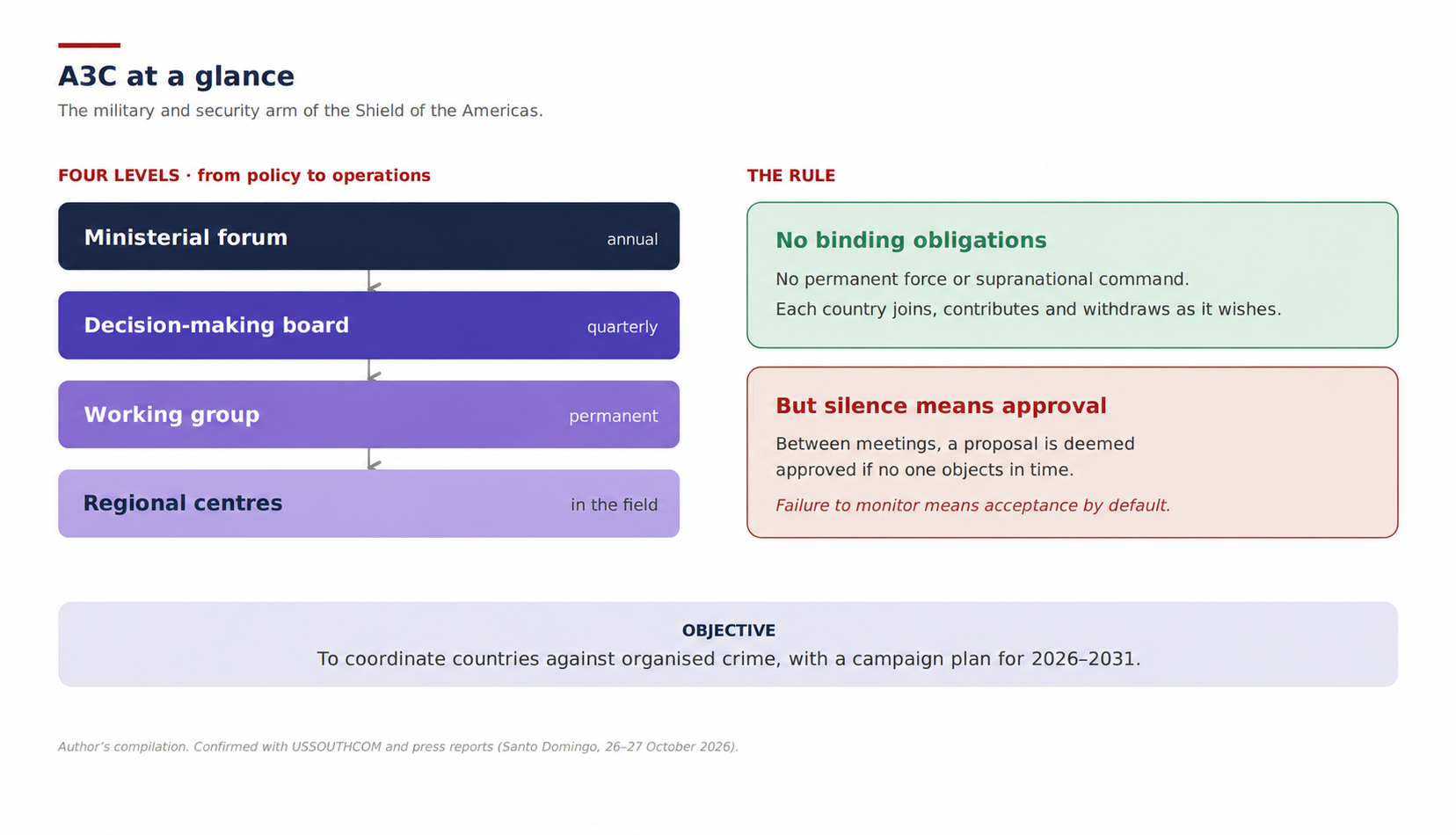
The objective of the A3C is to coordinate the national actions of participating countries against transnational criminal organizations through a campaign plan for the period 2026-2031. To this end, the governance framework establishes four institutional levels. The first is an annual ministerial forum, followed by a decision-making board that meets quarterly with the defense and security authorities of member countries and the commander of USSOUTHCOM. Additionally, there is a coordination working group and regional centers responsible for integrating information and facilitating the synchronization of operations.
The governance framework establishes that the coalition is non-binding and does not contemplate a supranational command or a permanent force. It also does not obligate states to provide personnel, funding, or information, and allows withdrawal at any time without justification.
Figure 2. Governance architecture of the A3C and position of the Southern Command.
Source: Own elaboration.
These provisions formally preserve the autonomy of the participants. However, the document also establishes expectations of cooperation. Each country must develop a national plan that contributes to the coalition’s objectives and must facilitate access to military facilities in accordance with its legislation. It may also invite other members to participate in combined operations within its territory.
The decision-making procedure deserves special attention. Between meetings, the board may consider proposals approved if no objections are raised within a specified timeframe. This mechanism preserves the right to dissent but requires active participation to prevent decisions from being made by silence.
ARGUMENTS IN FAVOR OF FULL PARTICIPATION
The public debate has featured voices both for and against Chile’s full incorporation into the A3C. Among its supporters, four arguments stand out[7].
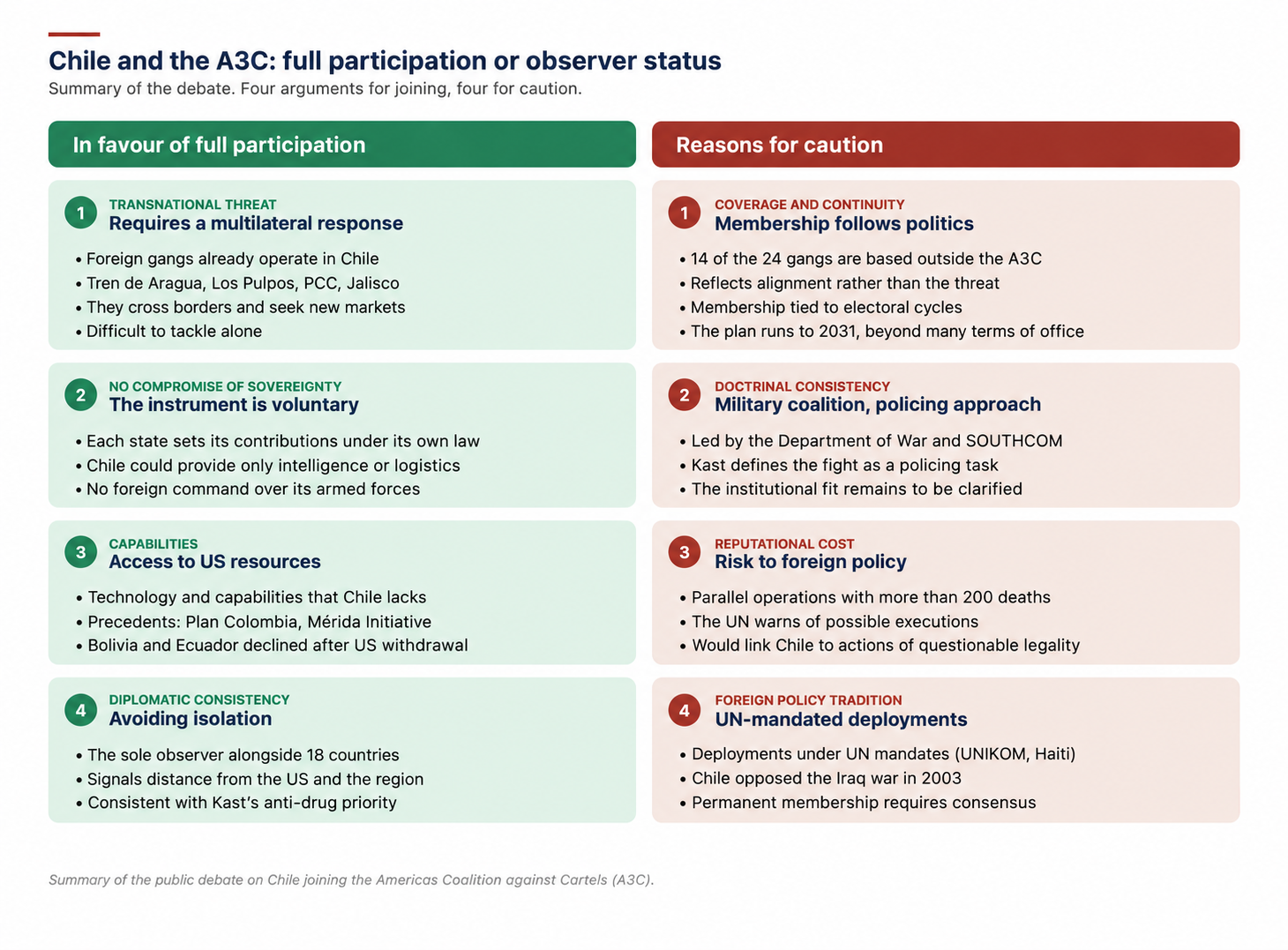
The first emphasizes the transnational nature of the threat and the need for multilateral mechanisms to address it. Recent criminal investigations have identified the presence of foreign criminal organizations in Chile with varying levels of penetration[8]. These include the Tren de Aragua (Venezuela) and Los Pulpos (Peru), as well as links to Primeiro Comando da Capital (Brazil) and the Jalisco New Generation Cartel (Mexico), among other groups. These networks operate beyond national borders and seek to expand into new illicit markets. From this perspective, an initiative like the A3C would allow for coordinated efforts among several countries to confront organizations whose prosecution is difficult through isolated national actions.
The second argument posits that full participation does not compromise national sovereignty nor require modifying Chile’s defense doctrine, which reserves routine internal security tasks for police institutions. Although the A3C has a military structure, the voluntary nature of the instrument allows each state to determine its contributions in accordance with its legislation. Thus, Chile could limit its participation to intelligence sharing or logistical support, without altering the responsibilities of civil authorities in public security or subjecting its military institutions to foreign command to combat organized crime.
The third argument highlights access to technological and operational capabilities from the United States that Chile lacks. According to some proponents of full participation, this type of cooperation has yielded favorable results in regional experiences, such as Plan Colombia (1999) and the Mérida Initiative in Mexico (2007). They also mention the cases of Bolivia and Ecuador, where the reduction of U.S. presence following the arrival of socialist governments since the mid-2000s preceded the deterioration of security conditions.
Finally, a diplomatic and political coherence argument is presented. Advocates of full participation argue that remaining the only country in observer status among a coalition of eighteen other countries could send a signal of distance from the United States, with potential consequences for Chile’s position among its regional partners. They also warn that criminal organizations might interpret this decision as a lesser willingness to engage in joint efforts. From this perspective, full participation would be consistent with the priority that the Kast government itself has assigned to combating organized crime.
ARGUMENTS AGAINST
The first argument questions the regional coverage and continuity of the A3C. Of the twenty-four criminal organizations designated by the United States on September 22, fourteen are based in countries that do not participate in the initiative: eight in Mexico, two in Brazil, two in Haiti, and two in Venezuela[9]. Thus, the composition of the new military coalition seems to respond more to certain political alignments with the United States than to the territorial distribution of regional threats. Mexico, Brazil, and Uruguay remain outside, while Colombia joined after the arrival of Abelardo de la Espriella. This potential dependence on political cycles raises doubts about the continuity of the mechanism, especially considering that its campaign plan extends until 2031, beyond the mandates of many of the governments currently participating.
The second argument questions the coherence between the military architecture of the A3C and the Chilean approach adopted locally towards organized crime. Although full participation would not obligate our country to militarize its response, the coalition is led by the U.S. Department of War, coordinated by USSOUTHCOM, and organized through a military campaign plan. This structure contrasts with the position maintained by President José Antonio Kast’s government, which has defined the fight against criminal organizations as primarily a police responsibility. This difference raises the need to clarify how Chile would participate in a military coalition without altering the competencies of its defense and public security institutions.
Figure 3. Chile and the A3C: full participation or observation
Source: Own elaboration.
The third argument relates to the potential reputational costs of Chile’s full participation in the A3C. The military coalition is developing in parallel to Operation Southern Lance, through which the United States has conducted attacks against vessels suspected of drug trafficking in the Caribbean and the Pacific, resulting in over 200 deaths according to various sources[10]. These actions have been questioned by the United Nations High Commissioner for Human Rights and several special rapporteurs, who have warned about possible extrajudicial executions[11]. Although both initiatives are distinct, closer participation in the A3C could politically associate Chile with operations whose international legality has been questioned, compromising the consistency of its foreign policy regarding international law and human rights.
The fourth argument questions the consistency of full participation with Chile’s foreign policy tradition. Although Chile has a long history of security cooperation with the United States, its main international military deployments have been under United Nations mandates, as occurred in UNIKOM (1991) and Haiti (2004). In contrast, it rejected participation in the Iraq intervention in 2003, during Ricardo Lagos’s government[12]. This tradition does not exclude operational cooperation outside that framework. In 2020, for example, the tanker Almirante Montt provided logistical support to a USSOUTHCOM interagency force tasked with detecting drug-related activities. However, that collaboration differs from permanent incorporation into a military coalition, a decision that also requires internal political consensus capable of sustaining it beyond the current government.
CONCLUSION
The evaluation of the arguments for and against Chile’s full participation in the A3C suggests that, for now, there are more convincing reasons to maintain the status of observer.
The favorable arguments identify real needs, especially international cooperation against organized crime. The transnational nature of this threat demands coordinated responses among states. However, proponents of full participation in the A3C do not sufficiently clarify what additional benefits Chile would gain from its incorporation compared to existing cooperation mechanisms. The objections examined, on the other hand, identify concrete limitations in the coalition’s regional coverage due to the absence of relevant countries for criminal networks, and in its capacity to sustain commitments beyond the current political cycles. Additionally, there are potential costs associated with aligning with a U.S. strategy whose practices have been questioned by international bodies. This dimension is particularly relevant for Chile, which has made respect for international law a principle of its foreign policy and a safeguard for its interests.
The decision of President Kast’s government is therefore prudent and consistent with Chile’s diplomatic tradition. The observer status allows for participation in the initiative while evaluating its results and clarifying the scope of its commitments. At the same time, it preserves negotiation margins with Washington in a context of increasing trade pressures[13], avoiding the assumption of additional political commitments without clear benefits for Chile. This position also favors the construction of internal political consensus before making a decision with potential long-term consequences.
This position, however, must be accompanied by efforts to strengthen existing regional mechanisms. The Santiago Commitment, promoted by Chile in May 2026, constitutes an opportunity in that direction. Its effectiveness will depend on its ability to implement its agreements and expand its coverage, particularly through the incorporation of Brazil[14]. The upcoming technical meeting in Argentina in November will allow for the evaluation of its progress and possibilities of consolidating as a space for regional cooperation.
Ultimately, Chile must prioritize mechanisms that effectively contribute to combating organized crime, with commitments proportional to their benefits and consistent with the principles that have guided its foreign policy.
DIEGO SAZO
Head of Research in International Relations
[1] Coalition composed of fifteen countries: Argentina, Bolivia, Chile, Colombia, Costa Rica, Ecuador, El Salvador, United States, Guyana, Honduras, Panama, Paraguay, Peru, Dominican Republic, and Trinidad and Tobago.
[2] U.S. Southern Command, “Dominican Republic hosts hemispheric forum on operations to counter cartels, narco-terrorists”, press release, October 27, 2026, https://www.southcom.mil/News/PressReleases/Article/4633800/dominican-republic-hosts-hemispheric-forum-on-operations-to-counter-cartels-nar/
[3] Countries that are part of the A3C: Argentina, Bahamas, Belize, Bolivia, Chile, Colombia, Costa Rica, Ecuador, El Salvador, United States, Guatemala, Guyana, Honduras, Jamaica, Panama, Paraguay, Peru, Dominican Republic, Trinidad and Tobago.
[4] The Southern Command is one of the unified combatant commands of the United States, headquartered in Doral, Florida. Its area of responsibility includes Central America, South America, and the Caribbean.
[5] El Mostrador, “Barros vs. Irarrázaval: the struggle in La Moneda for adherence to the coalition against Trump’s cartels”, October 28, 2026, https://www.elmostrador.cl/noticias/pais/2026/10/28/barros-vs-irarrazaval-la-pugna-en-la-moneda-por-adhesion-a-coalicion-contra-los-carteles-de-trump/
[6] The distinction between observer and full member corresponds to the Chilean public debate more than to the coalition’s categories. The governance framework contemplates the status of observer but requires prior agreement from the ministerial forum and a written agreement that sets scope and duration, without it being recorded that Chile has obtained this. At the same time, the coalition’s documents count Chile among its nineteen participants since March. The Chilean position corresponds, in fact, to that of a participant that has not signed the instruments approved in Santo Domingo.
[7] See Juan Pablo Toro, “A3C, the hour of truth”, in El Mercurio, October 24, 2026, and Richard Kouyoumdjian, “Reasons to adhere to the A3C”, in La Tercera, October 31, 2026, https://www.latercera.com/opinion/noticia/razones-para-adherirse-al-a3c/.
[8] National Prosecutor’s Office, Report on Organized Crime in Chile 2025, Specialized Unit on Organized Crime and Drugs (UCOD) and Division of Studies, Santiago, October 2025, https://www.fiscaliadechile.cl/sites/default/files/documentos/InformeCrimenOrganizado_V2.pdf
[9] Diego Sazo, “The Shield of the Americas and the limits of voluntary coordination”, Strategic Update, AthenaLab, September 24, 2026, https://www.athenalab.org/noticias/2026/09/24/el-escudo-de-las-americas-y-los-limites-de-la-coordinacion-voluntaria-claves-de-la-adhesion-plena-de-chile/
[10] CBS News, “U.S. military destroys alleged drug-smuggling boat in Pacific Ocean, killing 2 people”, August 24, 2026, https://www.cbsnews.com/news/us-military-destroys-alleged-drug-boat-pacific-deaths/
[11] UN News, “U.S. attacks on vessels in the Caribbean and Pacific are unjustifiable”, October 31, 2025, https://news.un.org/es/story/2025/10/1540664
[12] Cristóbal Bywaters C., “The ‘NO’ of Ricardo Lagos to the invasion of Iraq in 2003. The decision-making process of foreign policy in Chile”, International Studies 46, no. 177 (2014), 65-88,
[13] Chile is negotiating with the United States a Reciprocal Trade Agreement (ART) to expand the number of Chilean products exempt from the 12.5% tariff surcharge imposed by the U.S. administration.
[14] Emol, “Brazil would consider joining the Santiago Commitment promoted by Chile, as a counterpoint to the Shield of the Americas”, September 29, 2026, https://www.emol.com/noticias/Internacional/2026/09/29/1212707/brasil-por-compromiso-de-santiago.html.