ExpoNaval 2026 and the Necessary Renewal of the National Fleet
This article was translated automatically and may contain differences from the original. For reference, read the original.
From December 1 to 3, a new edition of ExpoNaval will take place, the international fair for the naval and maritime industry organized by FISA in conjunction with the Chilean Navy, which this year will be held in Santiago.
AthenaLab Team
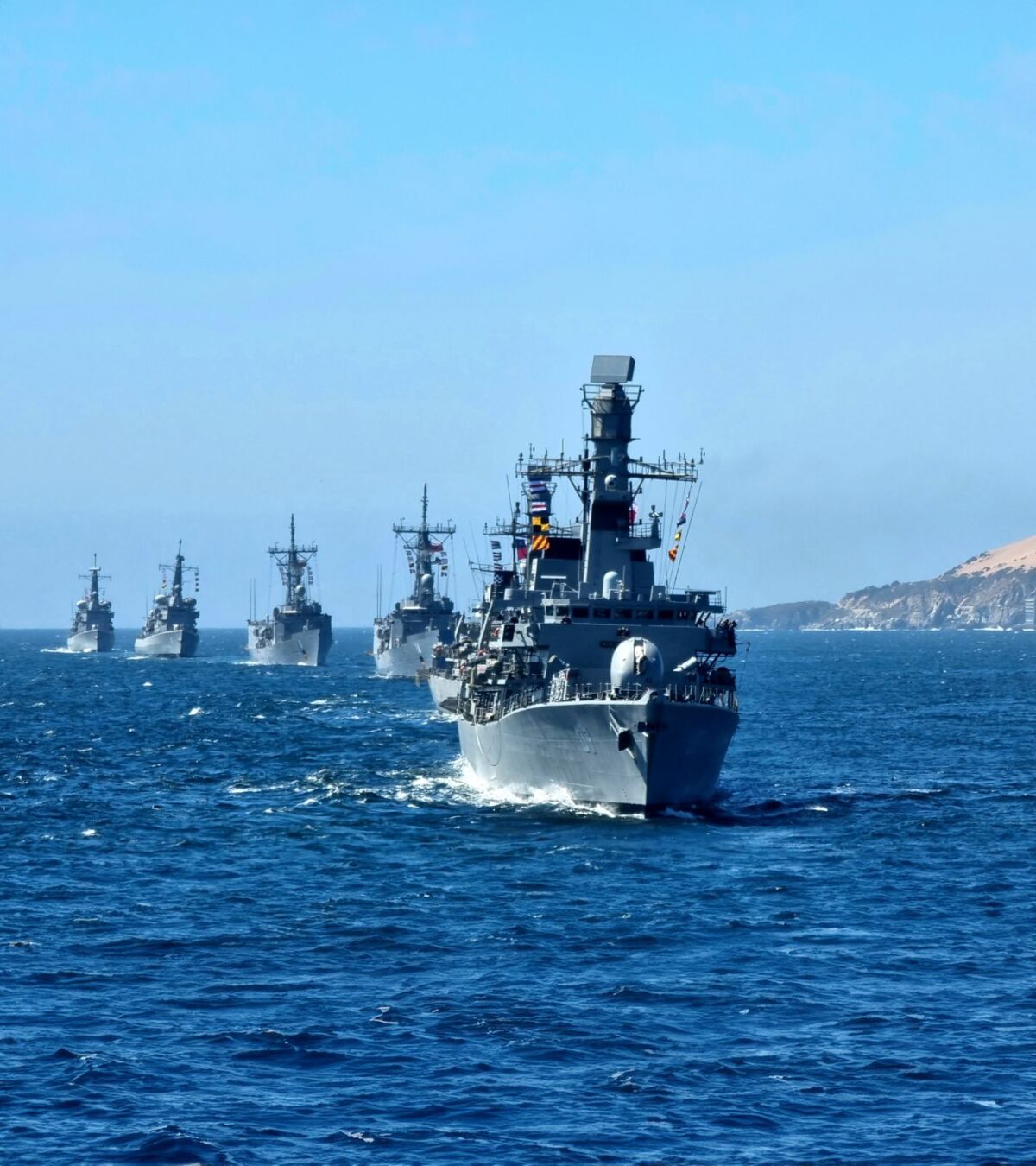
Chilean Fleet frigates arriving at their home port in Valparaíso.
Source: Chilean Navy.
From December 1st to 3rd, a new edition of ExpoNaval will take place —the international naval and maritime industry fair organized by FISA together with the Chilean Navy, held this year in Santiago. Over three days, shipyards, systems integrators, and suppliers from various countries will showcase platforms, technologies, and cooperation models. The event comes at a particularly relevant moment, as Chile must decide how it will renew the principal combat units of its National Fleet and ensure they remain available to carry out their missions over the coming decades.
AthenaLab has addressed this issue in previous publications and has warned that this decision cannot be postponed indefinitely. Current units have sustained a recognized naval capability, but they are aging while the timelines required to design, fund, build, equip, and commission their replacements continue to stretch. The concern, therefore, goes beyond hull age: it encompasses the continuity of combat capabilities, crew training, systems sustainment, and the cost of maintaining a heterogeneous fleet.
ExpoNaval offers a valuable opportunity to survey the global market, engage with potential partners, and compare local shipbuilding experiences. In general, however, companies arrive with solutions conceived around their own markets and industrial capacities, not necessarily around Chile’s operational priorities, constraints, and needs. The discussion should proceed in the opposite order: first determining what the naval force must do and at what level of availability, and only then examining which platform and which industrial partnership can deliver it, within the timelines and conditions the country can sustain.
What the Navy Needs, and Why
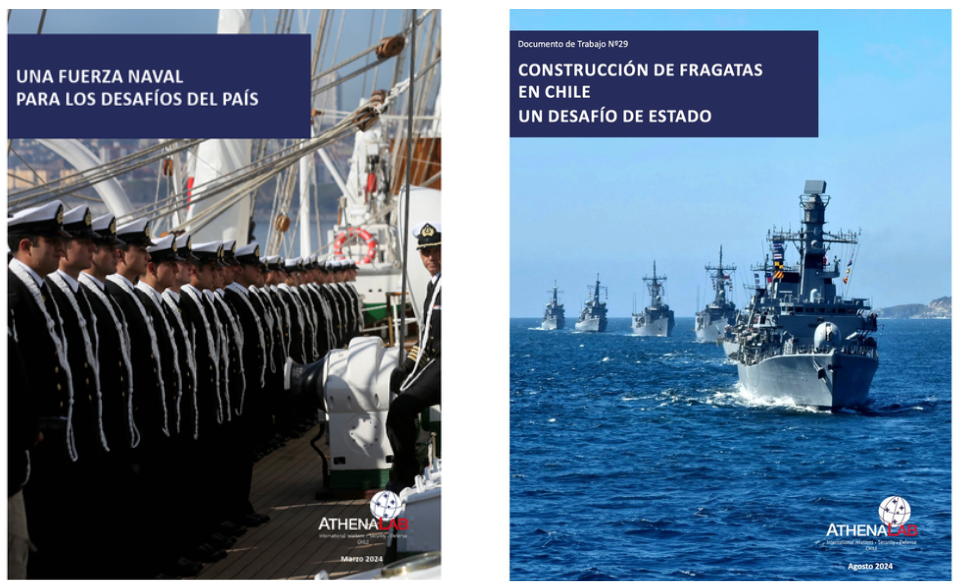
In two papers published in 2024, “Una fuerza naval para los desafíos del país”[1] and “Construcción de fragatas en Chile: un desafío de Estado”[2], AthenaLab laid out a set of arguments that remain fully valid. The answer begins with Chile’s maritime condition: more than 90% of our cargo moves by sea, and a decisive share of the fuels we consume arrives by that route. To this are added an extensive exclusive economic zone, distant insular territories, responsibilities in the far south, and a projection toward Antarctica, together with an economy whose principal trading partners lie on the other side of the ocean. The free use of maritime spaces and the security of sea lines of communication accordingly constitute vital national interests.
This reality determines the type of force required. According to Ken Booth, a navy’s military, diplomatic, and constabulary functions do not carry equal weight, with the military function serving as the foundation that enables the other two. The Navy, then, requires a balanced combat force built on warships. The most suitable platform is the frigate, a multirole vessel of between 3,000 and 6,000 tons that can operate from the waters of northern Chile to the Drake Passage and project itself across the Pacific. It also carries helicopters, integrates into multinational forces, and contributes to deterrence. Replacing frigates with offshore patrol vessels would undermine the country’s strategic posture, while replacing them with destroyers risks being disproportionate to Chile’s needs. Numbers also matter, given the variety of tasks required and the limited number of platforms available, not to mention the vast maritime expanse to cover. Submarines, for their part, should be replaced with similar conventional units, most likely acquired abroad.
Frigate Almirante Cochrane, modernized by ASMAR.
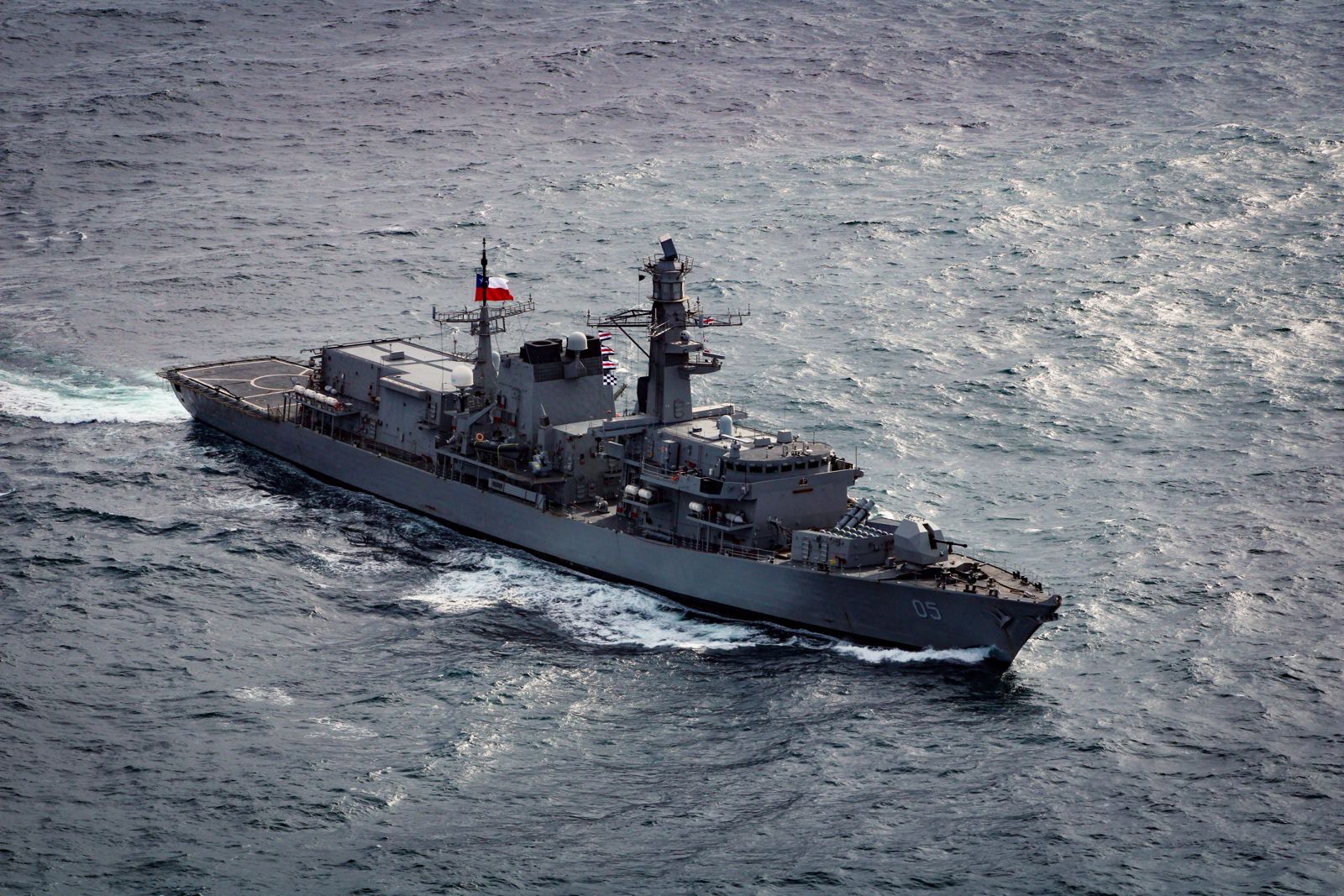
Source: Chilean Navy.
The Urgency of Renewing a Heterogeneous National Fleet
The National Fleet comprises eight frigates of four classes, all acquired second-hand from foreign navies. This approach provided efficient access to experienced, modern vessels, but its counterpart is the coexistence of different lines of spare parts, systems, training, and technical support. As several units approach the final stages of their service life, component availability becomes more demanding and the risk grows that a prolonged downtime could affect the force as a whole.
“Construcción de fragatas en Chile: un desafío de Estado” set out an illustrative exercise on ship availability between 2025 and 2044. Even assuming the periodic incorporation of new units, the study projected years in which the number of frigates in service could fall to four or five, without this meaning that all of them would be operational. This is not an official schedule of decommissioning and commissioning, but a methodological warning: decisions made too late produce gaps that cannot be closed from one year to the next.
Building a frigate can take between four and five years from the actual start of construction, to which must be added studies, engineering, authorizations, contracting, systems integration, testing, and training. Indeed, the process of bringing a ship into operational service does not end with its launch but continues until its crew and systems reach an acceptable level of readiness. Meanwhile, the traditional option of acquiring frontline frigates from other navies is becoming increasingly uncertain, as those navies extend the service lives of their ships or face growing requirements.
A possible purchase of second-hand vessels as a “bridge” measure merits consideration, but it should not be mistaken for the structural solution. It could help sustain capabilities during a transition period, provided that remaining service life, modernization costs, weapons systems, spare parts, crews, and availability timelines are carefully assessed. A unit that is relatively cheap to acquire can end up being costly to operate or arrive too late to close the gap it was meant to bridge.
To complete the picture, the situation of regional states, particularly neighboring countries, should also be considered. Argentina has emerged from a difficult situation marked by the loss of a significant portion of its surface combat capabilities and the absence of operational submarines. In this context, the Argentine government authorized US$3.5 billion in debt for the acquisition of two surface vessels and three submarines.
Peru, for its part, continues to maintain a sizable navy and, like Argentina, is carrying out several naval construction projects that will enhance its operational capabilities, favoring shared construction with a South Korean shipyard. As can be seen, both countries have already set in motion the recovery and development of naval capabilities. While the effect of these decisions is not immediate —it takes more than five years to bring the assets to operational condition— the fact remains that they have already begun the process and have a clear roadmap, which sets them apart from Chile.
Building Frigates in Chile: An Industrial and Defense Policy
The National Continuous Naval Construction Plan aims to move from isolated projects to a sustained sequence of design, construction, and maintenance of units within the country. The National Naval Construction Policy for the 2025-2040 period reinforces this orientation for surface vessels, mainly through ASMAR. Its justification goes beyond purely economic considerations: possessing domestic industrial capabilities increases sustainment autonomy and gives the State more options in the face of international market disruptions, supply crises, or technological restrictions.
Naval vessels built by ASMAR.
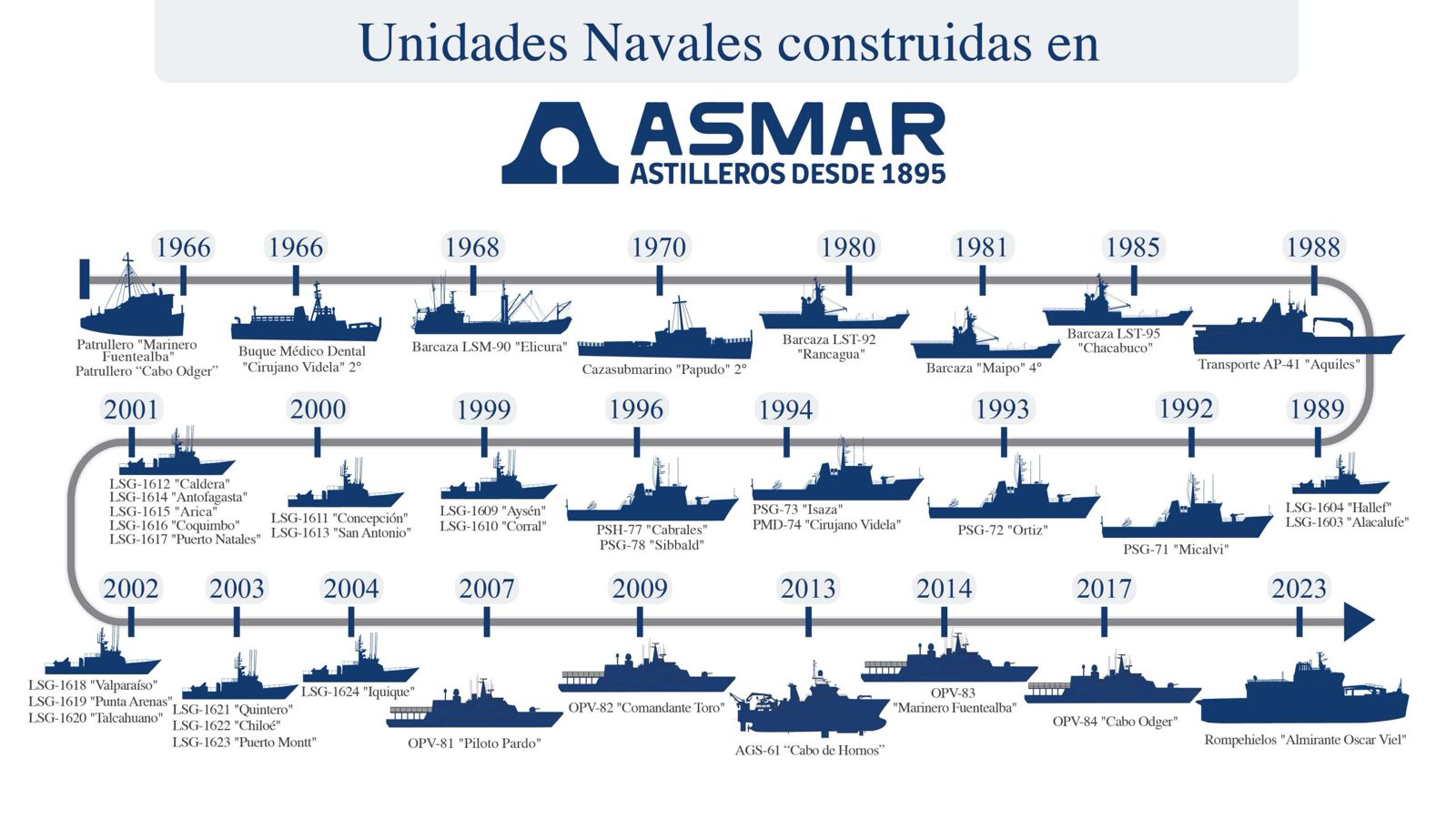
Source: ASMAR.
The challenge is to build a Maritime Industrial Base for Defense capable of sustaining a program over many years. ASMAR must be a central actor, but not an exclusive one: other shipyards, engineering firms, electronics suppliers, universities, and research centers can be incorporated according to their competencies. International experience shows the potential to generate specialized jobs, research and development, competitive suppliers, and knowledge transfer toward civilian activities. These benefits, however, do not arise automatically from the mere fact of assembling hulls on national territory.
A continuous construction policy requires a realistic order portfolio, clear financing rules, management capacity, workforce training, and an explicit division of responsibilities among the Navy, the State, ASMAR, and the technology partner. The risks are also real: cost overruns, delays, design obsolescence, dependence on imported inputs, and budgetary discontinuity. A decision limited to two or three units might not justify the initial industrial investment or secure the expected learning. Building in Chile must be a means of sustaining better naval capabilities, not an end disconnected from them.
Construction of the icebreaker Almirante Viel at ASMAR.
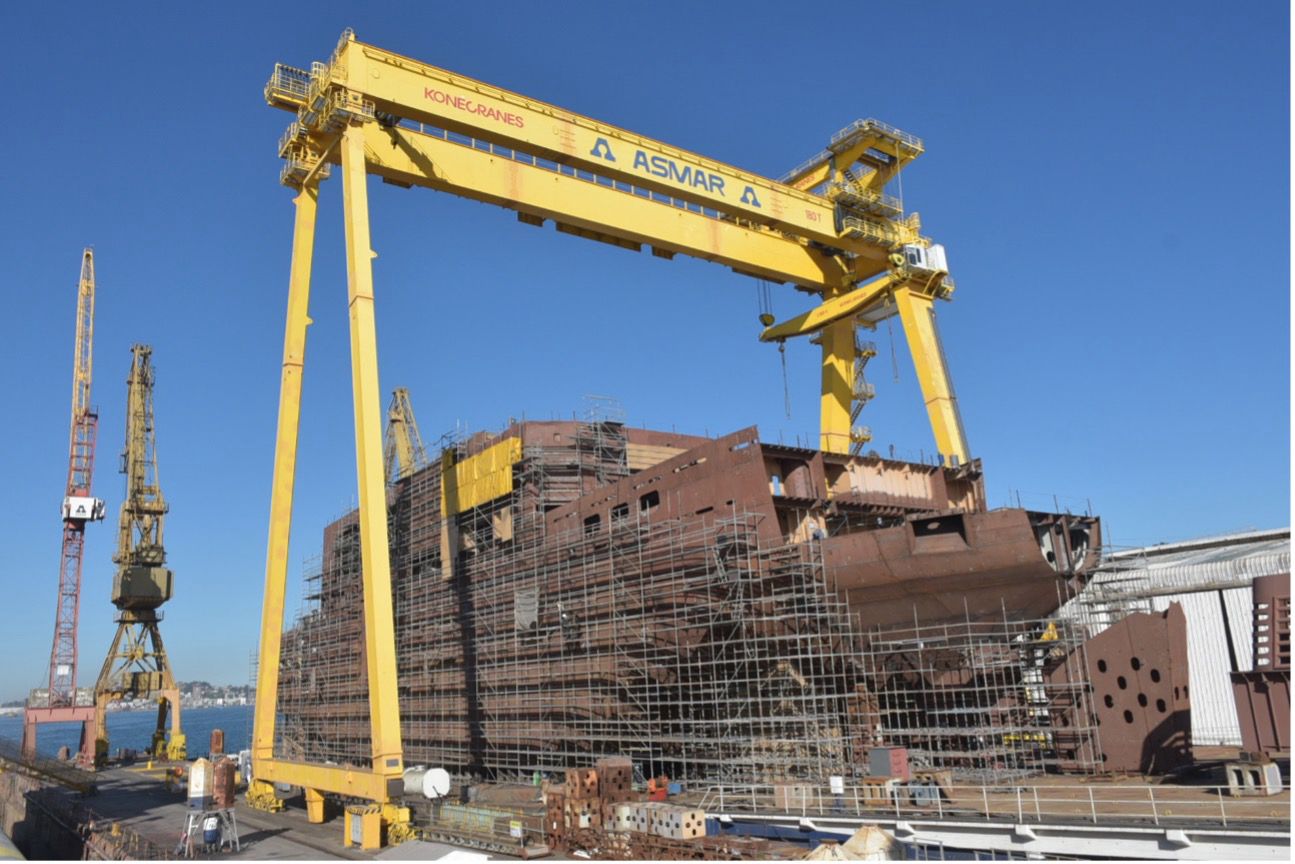
Source: Chilean Naval Shipyards (ASMAR).
More Than Acquiring a Ship: Choosing a Strategic Alliance
International experience shows that the true scope of a naval partnership is measured by what remains in the country after the first unit is delivered. The cases of Australia, Poland, and Indonesia demonstrate different ways of combining foreign designs, local shipyards, and industrial learning. They also serve as a reminder that large-scale programs can suffer delays, integration problems, and cost overruns. Chile should not pursue generic technology transfer, but rather identify specific capabilities it wishes to master: detailed engineering, block construction, platform integration, testing, major maintenance, software updates, and logistics management.
It is worth distinguishing between manufacturing parts, assembling a ship, and acquiring a national capacity to sustain and modernize it. A contract should define access to documentation, intellectual property rights over the adapted design, modification licenses, personnel training, the incorporation of national suppliers, and the foreign partner’s obligations in the event of faults and delays. It must also make explicit the export authorizations for systems and components from third countries, so that the intended strategic autonomy does not depend on uncertain permits.
The National Defense Problem
The discussion over the National Fleet reveals a problem that extends beyond the Navy and is not unique to Chile. In the region, the development of military capabilities tends to respond to the budget available at a given moment, to circumstantial offers, or to specific strategic demands, rather than to a technical and permanent process that views national defense as a whole and over the long term. This often leads to decisions that are reasonable in the short term but difficult to justify collectively and sustain over time.
What is missing is a methodology that links national interests to the tasks that derive from them and to the capabilities needed to fulfill them. With that connection established, it becomes possible to identify requirements, set priorities, and provide political authorities with more and better information when allocating significant resources to a basic function of the State.
This is precisely what AthenaLab is working on today. The first phase of this project aims to design, from civil society, an independent methodology for assessing the strategic capabilities of the Armed Forces, intended to serve as technical input for the Ministry of National Defense’s decisions on capability-building and short-, medium-, and long-term budgets. The tool will need to identify the demand for national defense capabilities and determine the existing gap. This is an external, apolitical, and traceable assessment, designed to diagnose whether the institutions have what they need to fulfill their tasks and to link each investment decision to the national interest it serves, with due regard for classified information. It also seeks to support Congress’s oversight function and contribute to an informed debate within academia and the defense community.
Final Considerations
ExpoNaval is a valuable event for Chile and its Navy, for the national industry, and for those of us who study these issues. It brings together, in a single venue, those who offer solutions and those who must decide. It also places the naval issue on the public agenda and at the heart of the Republic for several days. It is worth taking advantage of it.
What the fair does not resolve is the prior question that AthenaLab’s documents have already addressed, providing arguments on what naval force Chile requires and why. This exhibition offers a valuable opportunity to survey the global market, engage with potential partners, and compare local shipbuilding experiences, but the State still lacks the analytical tools to define what defense it needs and how to implement it, so that the renewal of the National Fleet is understood within a broader framework rather than as an isolated acquisition. To that end, AthenaLab will deliver its military capabilities assessment methodology in 2027.
The ships decided upon in these years will serve until the second half of the century, under governments we do not yet know. This fact demands that the country’s fundamental functions be approached with a strategic, long-term vision, as far removed as possible from partisan politics and short-term contingencies.
[1] Ignacio Mardones, “Documento especial: Una fuerza naval para los desafíos del país,” AthenaLab, marzo de 2024, https://www.athenalab.org/medios/noticias/2024/03/18/documento-una-fuerza-naval-para-los-desafios-del-pais/
[2] Ignacio Mardones, “Documento de Trabajo n.º 29: Construcción de fragatas en Chile: un desafío de Estado,” AthenaLab, agosto de 2024, https://www.athenalab.org/wp-content/uploads/2024/08/athenalab_doc_29.pdf