Bernardo O’Higgins Riquelme
This article was translated automatically and may contain differences from the original. For reference, read the original.
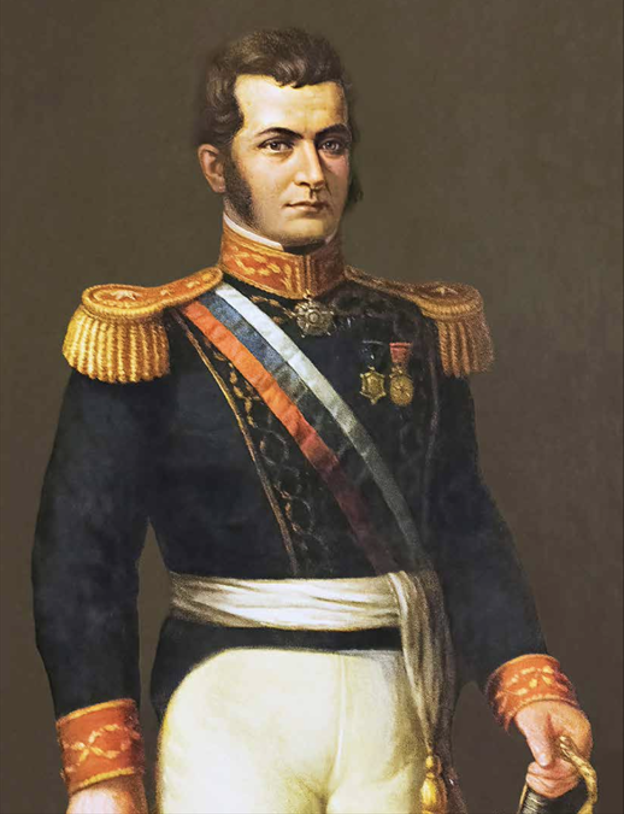
Father of the Fatherland
1778 – 1842
He was born on August 20, 1778, in Chillán Viejo. He studied in Lima and later in England, where he met Francisco Miranda, who introduced him to independence ideas.
In 1810, he was elected as a deputy of the newly formed Government Junta and appointed colonel of the army in 1811. In 1813, he faced the royalists for the first time at the Battle of El Roble. His rivalry with José Miguel Carrera, another leader of the Independence movement, led to their confrontation in the Battle of Tres Acequias (1814). Nevertheless, due to his patriotic spirit, he joined Carrera to confront the invasion of royalist forces led by Mariano Osorio.
During the Reconquista, he organized, along with José de San Martín, the Liberating Army of the Andes in Mendoza and led the Chilean offensive. After defeating the royalist forces, he assumed the role of Supreme Director and signed the Proclamation of Independence of Chile on February 12, 1818. Despite his well-known anti-monarchical stance, his desire to enhance the country’s economic development drove him to establish trade relations with the major European monarchies.
During his government, the construction of primary schools, the reopening of the National Institute and the National Library, and the creation of the Military School were particularly significant. In his tenure as Supreme Director, he took measures that earned him the dislike of the Creole aristocracy, such as the abolition of primogeniture and noble titles, the suppression of coats of arms, and the creation of the Legion of Merit. These provisions reflect the influence of the Lautarina Masonic lodge—of which O’Higgins was a member—which was characterized by its rejection of the noble order.
His glorious public life was assessed by himself in a manifesto addressed to his people. Paradoxically, his abdication from the position of Supreme Director of Chile on January 28, 1823, was the highest expression of his commitment to the country’s cause, as he voluntarily relinquished power to avoid a civil war, leaving behind an emotional farewell. He passed away in Lima on October 24, 1842.
Source: Chilean Memory