Update on the U.S. Military Intervention in Iran | March 2, 2026
ATHENALAB DOCUMENT No. 2 | MONITORING THE EVOLUTION OF THE CONFLICT
I. What has happened?
Over the past 48 hours, the conflict between the United States, Israel, and Iran has escalated following a joint offensive against Iranian strategic facilities, including nuclear program sites, command centers, military complexes linked to the Islamic Revolutionary Guard Corps (IRGC), naval bases, and vessels of the Iranian Navy.
Iran’s response has included missile and drone attacks against U.S. bases in the Persian Gulf, the indirect activation of fronts such as Lebanon through Hezbollah, and disruptive measures in the Strait of Hormuz. To date, Tehran’s reaction has resulted in three U.S. fatalities, in addition to the apparently accidental downing of three Western aircraft due to friendly fire over Kuwait.
These developments remain aligned with the objectives outlined in the weekend document: to pressure the regime to alter its nuclear ambitions, degrade Iran’s strategic capabilities, and ultimately create conditions that could enable regime change.
II. Changes in the strategic context
- Situation of the Iranian regime
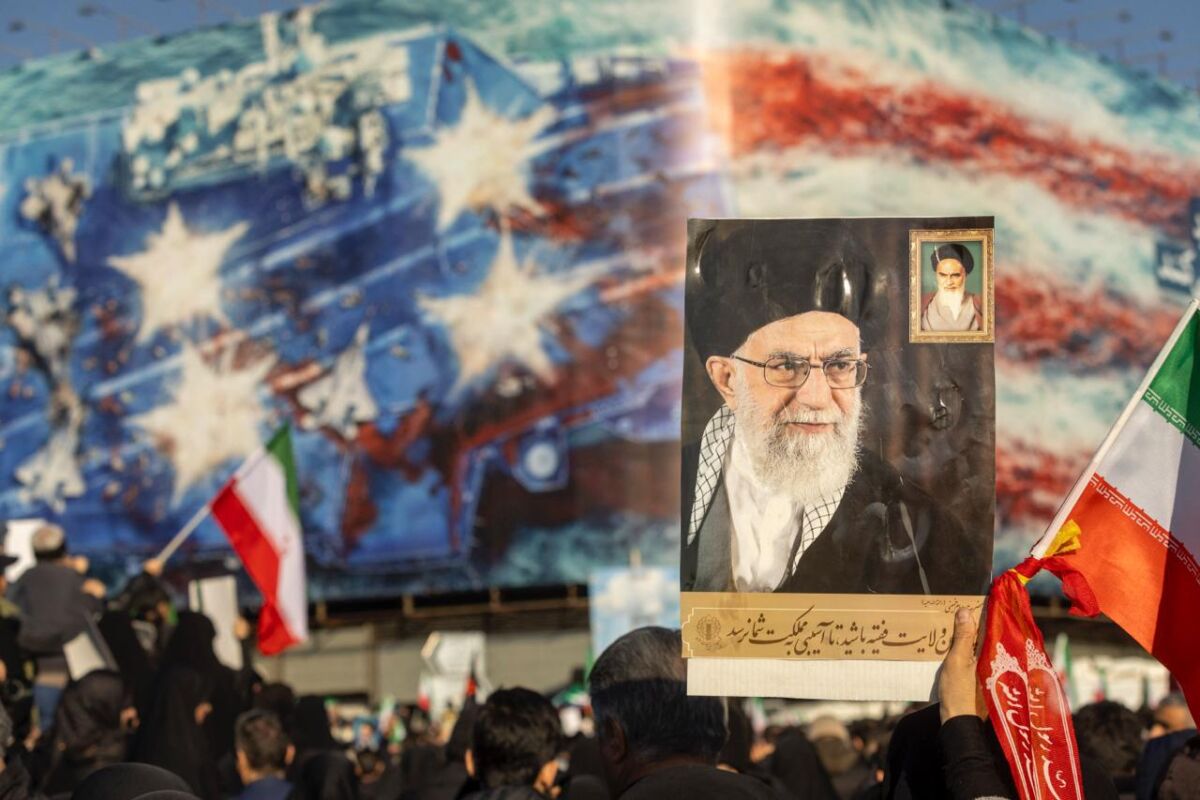
The confirmation of the death of Ayatollah Ali Khamenei, along with senior IRGC and Iranian General Staff commanders, constitutes the most significant development of the past 48 hours. The simultaneous decapitation of religious, political, and military leadership has altered Iran’s internal power architecture and activated formal succession mechanisms.
In the short term, state leadership has been assumed by a triumvirate composed of the President of the Republic, the Speaker of Parliament, and the Head of the Judiciary, in accordance with constitutional mechanisms предусмотрed for vacancies in supreme leadership.
At the same time, the IRGC has reinforced its central role in security and defense management. Thus far, no institutional collapse is evident: security forces maintain internal control and have increased their presence in key urban centers. While demonstrations have occurred both in nationalist support of the regime and in opposition to it, the coercive apparatus remains cohesive. Official narratives have framed the attacks as external aggression, favoring defensive consolidation rather than visible political fragmentation. Despite Iran’s severe political, economic, and military challenges, the change in leadership has not—at least for now—translated into regime change.
- Respuesta militar de Irán
As previously noted, Iran has carried out attacks against U.S. bases in Qatar, Bahrain, Kuwait, and the United Arab Emirates. The regime’s response has been more agile compared to the events of June 2025, demonstrating a higher level of military preparedness prior to the weekend’s attack. So far, the effects of these strikes have been contained in terms of strategic damage and regional escalation potential, but they confirm Iran’s willingness to expand the theater of operations.
At the same time, launches against Israeli targets have intensified, consolidating a direct exchange of fire between the two countries. The duration of Iran’s response is expected to depend on damage assessments and available weapons stockpiles.
Iran’s reaction also includes actions carried out—or potentially to be carried out—by affiliated groups. Hezbollah has been the first to act, launching attacks from southern Lebanon against Israeli positions. While a major offensive has not yet materialized, the Lebanese front has been activated and currently represents the primary axis for regional expansion of the conflict. Israel has responded with airstrikes against positions in southern Lebanon and in Beirut.
Another key factor to consider is that Israeli and U.S. air defense systems in the region are among the most advanced in the world, but they are not infallible. The high cost of interceptors and, above all, the potential saturation of attacks could increase costs for both countries and their regional partners. In addition, although Russia is not currently in a strong position to provide direct military support to Iran, it may supply satellite intelligence and transfer operational experience in the mass use of drones such as the Shahed-136—originally Iranian systems extensively employed by Moscow in Ukraine.
- Strait of Hormuz
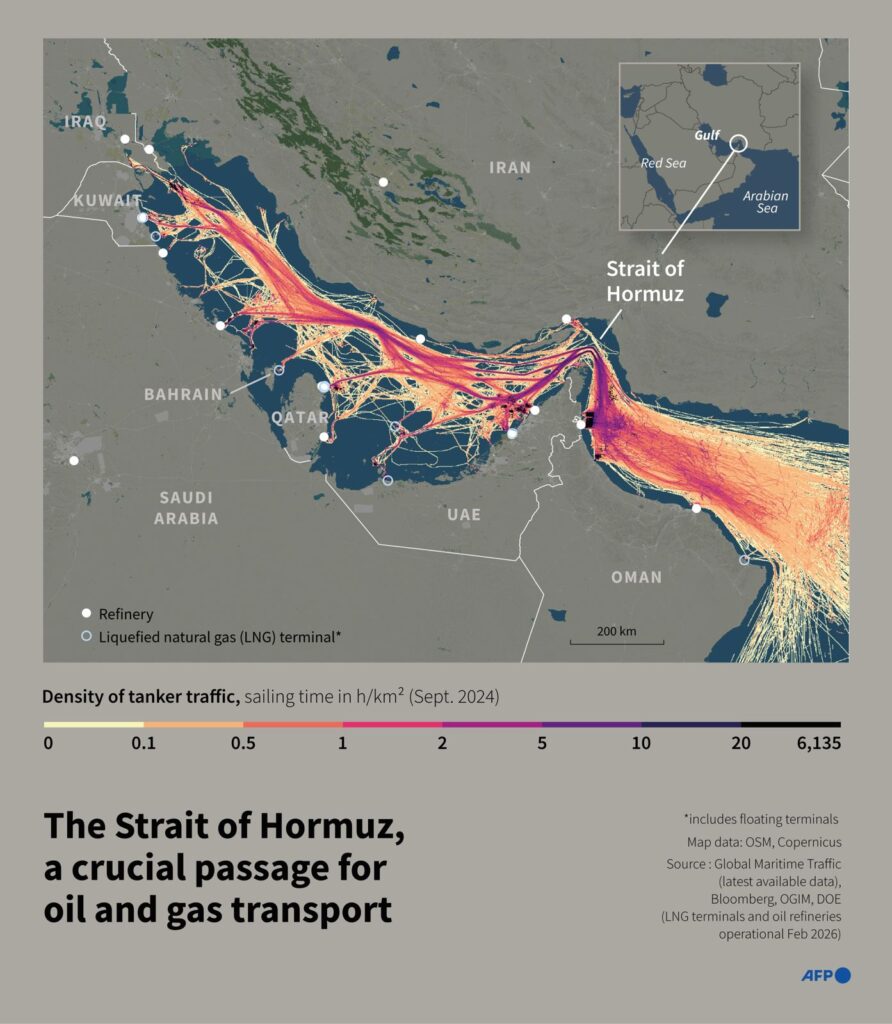
Iran has deployed naval units at strategic points in the Strait of Hormuz, generating operational disruptions to maritime traffic. Although no permanent formal closure has been declared—while only a few high-risk actions are sufficient to interfere with transit—commercial navigation has declined significantly due to security risks, impacting international energy markets.
The Iranian government is fully aware of the importance of this maritime route for global trade, particularly hydrocarbons. While Iran retains substantial mine-laying capabilities that could disrupt transit for a period of time, the regime’s decision on this matter and the reactions of other littoral states remain uncertain.
III. International reactions
- Regional actors hosting U.S. bases—Qatar, Bahrain, Kuwait, and the United Arab Emirates—have reaffirmed their cooperation with Washington. None have responded militarily to missile and drone attacks, nor have they announced restrictions on the use of those military facilities.
- International organizations: The UN Secretary-General has called for an immediate cessation of hostilities and warned of the risk of regional destabilization. The European Union has expressed concern over the escalation and urged a return to diplomatic channels, emphasizing the need to avoid a broader regional conflict.
- Extra-regional powers: China has condemned the initial operation as a violation of Iranian sovereignty and has promoted a negotiated solution. Russia has described the attacks as contrary to international law and has expressed political support for Iran. Meanwhile, the leaders of France, Germany, and the United Kingdom, while stating they are not part of the operation, have indicated their willingness to take action to defend their interests in the region.
IV. What can we expect?
- The attacks carried out on Saturday, February 28, should be understood as a new phase in a long-standing conflict that was reignited on October 7, 2023, when Hamas launched its assault on Israel. Since then, Israel and Iran have engaged in an increasingly intense strategic exchange, including Iran’s missile attacks against Israel in October 2024, Israel’s retaliation later that same month—destroying much of Iran’s air defense capacity—and, of course, the U.S. and Israeli strikes in June 2025 against Tehran’s nuclear and military facilities, as well as against its political, military, and scientific leadership.
- The continuation of the U.S. and Israeli offensive will depend on the achievement of the political objectives defined for the conflict, namely compelling the Iranian regime to accept terms related to its nuclear program and its destabilizing regional actions.
Unless Iran modifies its strategic posture, calibrated military pressure is likely to continue for several more days—possibly two to three additional weeks.
- Tehran is expected to demonstrate short-term institutional resilience, supported by IRGC cohesion and formal succession mechanisms. In this context, Iran may seek to expand the conflict regionally and even internationally to increase the costs imposed on the United States and Israel. Although its conventional capabilities are limited, it still possesses a significant missile arsenal and, notably, a network of affiliated groups capable of carrying out isolated attacks against U.S. and Israeli interests in other regions.
- The governing regime’s top priority will remain its survival. Therefore, its response and the continuation of the conflict must be assessed through that lens. Moreover, the nuclear ambition should be understood as a core strategic aspiration directly linked to regime survival and Iran’s broader geopolitical positioning.
- Conversely, the United States and Israel will seek to prevent direct involvement by additional states, avoiding broader regional escalation. Likewise, it is unlikely to serve U.S. interests for the conflict to become prolonged, whether due to the economic costs of sustained operations or domestic political considerations in Washington.
- Based on current information, it is not feasible to foresee regime collapse or replacement—whether due to existing power structures still in control, hypothetical fragmentation within the armed forces, or the limited organization and capacity of political and social opposition forces capable of challenging the regime.
- It should be expected that, sooner or later, negotiations could resume if Tehran assesses that sustained military pressure threatens internal stability. However, diplomacy would likely restart under more demanding terms than those that existed prior to the conflict.
V. Final considerations
- The conflict is expected to continue for at least the coming weeks, until Tehran decides to engage in negotiations with the United States that include limitations on its nuclear program. The timeline will depend on the level of pressure exerted by the attackers, the internal stability of the Iranian regime, and the resources available to sustain operations beyond its borders.
- The objectives defined by the United States and Israel remain unchanged, with regime change considered secondary to addressing Iran’s nuclear program and ballistic missile capabilities.
- There will be competing pressures between Iran’s interest in expanding and prolonging the conflict, and Washington’s and Tel Aviv’s objective of containing it geographically within Iran and bringing it to a close as quickly as possible, in order to resume negotiations under terms defined by the U.S. government.
- The most immediate impact of the conflict is economic. Reduced transit through the Strait of Hormuz has driven up oil prices, which may translate into higher energy costs and inflation for hydrocarbon-importing countries such as Chile.
- From a diplomatic standpoint, Chile should avoid importing the conflict into the domestic arena or expressing alignments that could compromise its future room for maneuver, particularly with less than two weeks remaining before the change of government.
- Finally, it cannot be ruled out that Iran may seek to expand confrontation toward U.S. or Israeli interests globally, increasing the overall level of strategic risk—one from which Chile is not exempt.
Marcelo Masalleras
Alejandro Amigo
John Griffiths
March 2, 2026