Who Adapts First, Prevails: Land Power and Urgent Transformation at the RUSI Land Warfare Conference 2026
Executive Summary
The RUSI Land Warfare Conference 2026 confirmed that land power has returned to the core of Western deterrence, as a concrete response to two questions that ran throughout the event: what kind of power is required to break an adversary’s will to fight and effectively compel submission, or produce regime change? From that, a second question followed: what would we be doing differently if we knew we had to fight tonight? These ideas, raised at the opening of the conference by the British Chief of the General Staff (CGS) and validated politically by the UK Secretary of State for Defense during his address, shaped the entire gathering and shifted the debate away from the declaratory principles of war towards the capabilities available and needed to confront threats in the land domain.
The strategic diagnosis that opened the conference describes a new era defined by Russian hybrid warfare as a deliberate precursor to kinetic conflict and by growing uncertainty over the sustainability of the United States’ commitment to Europe. On that basis, General Sir Roly Walker, CGS of the British Army, articulated a set of imperatives that prioritize interoperability with NATO, multi-domain operations across all levels of command, the army corps as the primary unit of effects generation and a force model combining high-protection systems with affordable and consumable means. The various sessions deepened that same logic from complementary angles, among them the impossibility of nations deterring independently, force design built around the task rather than the inherited inventory, the integration of new developments with existing systems under a model connecting humans, data and machines and, finally, lethality understood as a system property rather than the attribute of an isolated platform. The Ukrainian experience ran through the entire conference as empirical evidence of these ideas and as an explicit warning about the costs of failed deterrence.
This report closes with an assessment of the implications of this diagnosis for the Armed Forces, and for the Chilean Army, around the minimum viable scale of means, the integration between military force and industry, and the underlying question of what kind of army Chile needs.
1. Introduction
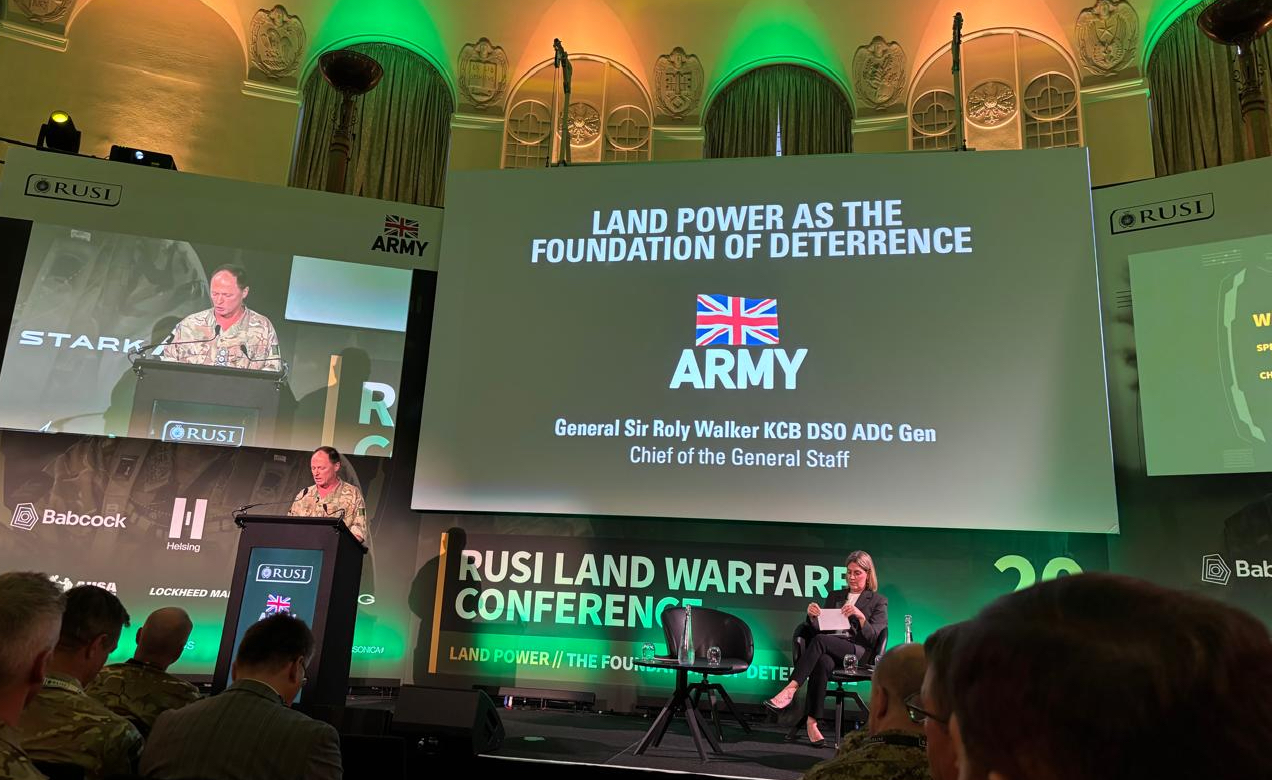
This report analyses the RUSI Land Warfare Conference 2026, held in London under the theme of land power as the foundation of deterrence. The conference’s agenda is established from the outset by its two welcome messages. General Sir Roly Walker, Chief of the General Staff of the British Army, argued that the value of land power is above all political: committing land forces signals that an outcome matters because it risks a state’s most vital asset, the blood of its soldiers, and that signal of resolve is demonstrated in the British Army’s permanent presence on NATO’s eastern flank. Dr Jack Watling of RUSI complemented that statement by framing the deterioration of the security environment in material terms, pointing to concrete episodes such as the closure of the Strait of Hormuz and Ukraine’s transition from positional warfare to new combined arms approaches, and asserting that the ability to hold ground is the foundation from which land forces impose costs on the aggressor.
Both messages converge on the same conclusion, though they justify it from different angles, one political and the other functional, and that convergence set the tone for the entire conference. Over two days and twelve sessions, heads of state, commanders of Western armies, defense industry representatives and academics examined what real capabilities sustain deterrence today and how urgent the gap is between the current military force and what the present threat demands. This report covers that content organized around a general overview of the conference, a thematic development of each session grouped by related subjects and an analysis of the implications these findings carry for the Armed Forces, and for the Chilean Army; closing with the report’s conclusions.
2. General overview of the conference
The RUSI Land Warfare Conference 2026 delivered a sustained message of consensus between the political and military levels about the urgency of transforming Western land power. That urgency was framed from the opening around a question that was present, explicitly or implicitly, in virtually every session: what would we be doing differently if we knew we had to fight tonight? The UK Secretary of State for Defense validated that urgency by acknowledging an accumulated neglect of defense matters resulting from years of underinvestment, while the Chief of the Defense Staff’s closing address brought it to a critical point by asking whether the army being designed is the one the state needs or the one the military institution itself prefers to build.
The conference moved consistently from strategic diagnosis towards concrete capability, focusing on the adequacy of current means and what developments were required to sustain the war effort. The opening sessions framed the problem in its strategic dimension, describing a Russia that uses hybrid warfare as a deliberate precursor to kinetic confrontation and a NATO facing uncertainty over the sustainability of the American commitment. The middle sessions translated that diagnosis into the realm of force generation, addressing how to achieve immediate readiness, what kind of force to design and how to integrate new capabilities with existing platforms. The subsequent sessions confirmed that this transformation ultimately depends on the industrial base, since no military capability, however well designed or integrated, can be sustained over time if the defense industry is unable to produce and resupply it at the pace demanded by large-scale conflict.
Ukraine served as a cross-cutting reference throughout the conference and not as an isolated topic within a single session. Its experience was cited as empirical evidence of accelerated adaptation in sessions on force design and lethality as a system property and was also used as an explicit warning in the closing address, where it was recalled that in that case deterrence had failed. That dual function of Ukraine as an innovation laboratory and as a warning of failure was a defining feature of the gathering and confirms that war as the most immediate example available for assessing and guiding Western preparedness to deter and, if necessary, to fight.
3.1 The strategic context: Russia, NATO and Ukraine
The conference opened its strategic diagnosis with a recognition of epochal change. The invasion of Ukraine closed an era of crisis management and opened a structurally distinct phase, faster in its pace and more focused on territory, in which Russia seeks to weaken the Euro-Atlantic security system by using war as an instrument. In that context, hybrid warfare is understood not as a separate category from conventional confrontation but as its deliberate precursor, since for Moscow destabilization is preparation for an eventual kinetic phase. NATO’s response to this scenario demands a strategy fulfilling two simultaneous functions: sustaining the current collective effort against Russia while simultaneously preparing for a potential larger-scale conflict. To achieve this, the Alliance is moving towards a multi-domain structure operating above the national level, precisely to reduce uncertainty about whether each member will be willing to contribute when necessary.
That uncertainty is compounded by questions over the sustainability of the United States’ commitment to Europe. The containment of Russia so far reflects both Ukrainian resistance and transatlantic deterrence, but that balance could erode as the conflict moves towards some form of resolution and Washington redirects capabilities to other theatres. The three scenarios proposed for a potential NATO 3.0 range from continuity of American commitment to a partial US withdrawal that Europe manages to absorb through strategic adjustment and, finally, an adverse scenario in which European countries must assume greater risks and prepare to escalate with nuclear deterrence underpinned by robust conventional deterrence. The assumption running through all three scenarios is that Russia is already building in parallel a force designed to confront NATO asymmetrically precisely in a context of reduced American presence, which turns European contingency planning into an exercise in urgency rather than prudence.
Russia’s own internal vulnerabilities nonetheless qualify that diagnosis of growing threat. The political and fiscal cost of mobilization falls increasingly on local governments rather than the central government, in a context where the pool of fighters willing to fight for economic incentives is beginning to dry up and the Kremlin has avoided general mobilization for fear of the political instability it would generate. To this is added a Russian society that is beginning to feel the war more closely without that yet constituting a breaking point. As a result, the outcome of the conflict would depend less on a military collapse than on Russia’s sustained economic decline in financing the war.
The address at the conference by Ukraine’s Minister of Defense, in office since mid-January 2026, confirms this diagnosis. His description of the importance of motivating the population while simultaneously maintaining the force’s operational readiness places the exhaustion of human capital as the most severe constraint facing Ukraine today, direct evidence of the mobilization cost described in the preceding paragraph but now from the Ukrainian side of the conflict. In the face of that constraint the response has been twofold: openness to international soldiers and private companies as a complement to the national force and a constant reorganization of the Army in line with the evolution of operations. The figure of a 91 per cent missile interception rate confirms that accelerated technological innovation produces measurable results on the ground and supports the Minister’s central doctrinal argument, according to which asymmetry is the only viable path to defeating Russia, sustained through constant innovation and initiative that keep the adversary permanently off balance and forced to react.
3.2 Land power, deterrence and the imperatives of transformation
The British CGS’s opening address responds directly to the preceding strategic diagnosis by arguing that the value of land power is above all political. For that military leader, the Army’s ultimate purpose is to fight and to generate the conditions that allow political leadership to secure favorable agreements and outcomes. He also noted that the development of land capabilities is justified both by its deterrent effect and by its economic contribution, since investment in defense reconnects the Army with the society it serves. This dual defense of land power, as a strategic instrument and as an economic and social asset, seeks to anchor military expenditure in a broader domestic consensus.
The core of the CGS’s address was a set of five imperatives that chart a roadmap of urgent adaptation rather than a program of gradual modernization. The first, NATO first, subordinates British investment decisions to a sequence of problem, pilot and platform that must align with Alliance priorities, which implies a deliberate concession of doctrinal autonomy in exchange for interoperability. The second, full commitment to the Allied Rapid Reaction Corps, positions the army corps level as the most relevant unit of effects generation, combining personnel and materiel under a NATO-led top-down capability development framework with artificial intelligence as a transversal enabler. The third, the 20:40:40 model, is perhaps the most doctrinally significant, because it formalizes the idea that future lethality rests on an ecosystem where low-cost, high-destructive-power systems coexist with higher-protection, more permanent platforms within a single combat system. The fourth, the warfare development system, conceptually equates readiness with transformation, suggesting it is no longer possible to keep them as sequential or separate processes. The fifth, centered on the soldier, translates into concrete gestures of commitment to the eastern flank such as the deployment of a reserve brigade to Germany, reinforcing the message that Britain’s commitment to NATO is not merely declaratory.

This architecture of imperatives is synthesized in a clear operational intent, strike deep, defend forward and build stronger, orchestrated through the ASGARD digital targeting system and oriented towards deterrence on the European eastern flank. The operational logic is to defend as far forward as possible as the priority and, if deterrence fails, to strike in depth to stop the adversary before it consolidates its advance. That logic rests, according to the CGS, on three fundamental attributes: the capacity to destroy forces, protection and sustainability, to which is added the need to increase tempo and reach of operations. This is grounded in the need to facilitate private capital access to defense, since resources and talent become, alongside people and materiel, strategic assets of the highest relevance in themselves.
3.3 Force generation: multinational integration, readiness and force design
Effective deterrence faces today a structural constraint shared by all Western armies: the impossibility of generating it independently, because no country on its own possesses sufficient mass to sustain it. That constraint shifts the problem from national force design towards a scheme of multinational integration that operates with increasing clarity at the army corps level rather than at brigade or battalion, the level where multi-domain operations with both offensive and defensive capability effectively take place today.
Transformation is understood in this context as an immediate priority rather than a background process and demands real interoperability between forces that would otherwise remain fragmented in the face of an adversary that does not face the same limitation. Readiness, for its part, is no longer conceived as a progressive aspiration but becomes a permanent condition, being ready to fight tonight, which inverts the traditional logic of capability generation. Force design can no longer start from the question of what is available but from what task must be accomplished today, and that shift in starting point demands a rethinking not only of equipment but of the cognitive processes of decision-making, in an environment where artificial intelligence accelerates the decision cycle without replacing human judgement. The experience of Ukraine adds a concrete warning to this urgency. Western armies’ current force structures are not substantially different from those that existed at the start of that war, which reveals that the pending renewal must be deep and will not be resolved by a declaratory reaffirmation of commitment to deterrence. The underlying lesson is that armies as currently configured will not be viable in a future high-intensity conflict.
The force design that responds to these demands is built around an architecture of integrated systems rather than a fixed proportion of platforms, where the advantage comes not only from adding more individual means but also from comprehensively connecting each system within a shorter decision-and-attack cycle. Mass, far from being a concept superseded by precision and technology, remains relevant, but now depends critically on resilient industrial supply chains and a sustained acceleration of resource procurement. The concrete priorities derived from this approach include protection, long-range and indirect fire, electronic warfare at the tactical level, integration of unmanned vehicles and command and control with embedded artificial intelligence, all subordinated to a single underlying demand: speed. Superiority is measured by the speed with which a force can be redesigned, resupplied and reconnected within the system before the adversary does so, confirming that force design and the updating of the acquisition model are, in practice, the same problem.
3.4 Integrating the new with the existing: command, control and lethality as a system
Necessary technological innovation does not replace existing combat systems but must be inserted into them, and that integration constitutes a doctrinal challenge as complex as the innovation itself. Given that much of the current mode of combat remains shaped by inherited operational frameworks, it is necessary to review which past tactics remain valid rather than assuming a total break with existing doctrine. From this emerges a deliberate combination of older, affordable means with new capabilities, on a battlefield defined by threats across 360 degrees and where readiness demands real sustainability backed by a resilient, distributed and dispersed industrial base.
Integrating new capabilities into existing systems also transforms the very nature of command decisions. The commander today has access to a near-total situational picture thanks to information shared in real time, which compresses the decision cycle and demands deep integration of means under unified command and control. That change is not resolved through technology alone but through an organizational effort centered on people, structure and training, where the challenge lies in adapting new materiel to one’s own culture and way of operating rather than copying external solutions without that translation work.
The framework organizing this integration conceives combat power as the result of three equally decisive components, humans, data and machines, where data multiplies lethality and network speed determines who retains the initiative. This logic already produces concrete effects on the ground, where battlefield transparency generates zones of high lethality near the line of contact and where the rapid adaptation of procedures, rather than the sophistication of an isolated platform, is what determines which force prevails.
Lethality, therefore, is no longer understood as a platform attribute but is conceived as a system property, the result of combined layers of survivability and effect sustainable across a prolonged conflict. Under that logic, smaller networked units can be more capable than traditional larger platforms, and there is also a manageable trade-off between close and deep combat, in that it is possible to shape the conditions of the former through strikes in the latter.
3.5 Industry as the material foundation of deterrence
The regeneration of combat power is above all a public policy problem rather than a technical one, because a force can transform itself conceptually, but that transformation would not withstand the demands of war if it cannot be produced and sustained at the pace required by a major conflict. Deterrence is thus reformulated as a direct function of industrial agility, understood as a complete ecosystem capable of supplying and sustaining a large-scale conflict, which includes talent formation as a critical and scarce input. This agility demands a cultural and procedural change that propagates to all levels of the organization and not only to pilot units testing new technologies, since speed of adaptation and not point-in-time sophistication will determine which force prevails.
The digital dimension reinforces this same logic by making cyber protection an operational condition rather than an optional complement, since any networked combat system is only as strong as the least protected link in its chain. This places an additional demand on industry to design resilience against cyber and kinetic threats from the outset rather than as a layer added afterwards, which confirms that the defense industry can no longer be understood as an external supplier but as a constitutive part of combat power.
However, the conference revealed a persistent and relevant tension between discourse and funding, since industry only invests when it perceives real and sustained demand rather than merely declaratory demand. This is compounded by the need to rebuild supply chains that do not depend on potentially adversarial suppliers and to move towards a model of genuine partnership between industry and armed forces, in contrast to centralized top-down control models that, while capable of scaling production through intensive reverse engineering, do not constitute a resilient or replicable ecosystem for the West. Sustained governmental consistency and the resolution of key vulnerabilities in one’s own supply chains are the minimum conditions for this material base to effectively support deterrence.
4. Implications for the Armed Forces, especially the Chilean Army
The diagnosis running through the entire conference poses a direct question for the Chilean Army: whether the current readiness standard corresponds to a permanent condition or is still a progressive aspiration. The idea of being ready to fight tonight demands a review of whether Chile’s model for generating and sustaining forces is designed to respond immediately to a contingency or whether it retains a sequential logic in which readiness is built in stages during a crisis. It is also necessary to examine whether Chile’s current force structure would be sufficient in a higher-intensity scenario or whether it requires genuine renewal rather than incremental adjustments. The mobilization dimension adds another layer to this reflection, in that the political and social cost of sustaining an expanded force over time, discussed at the conference from both the Russian and Ukrainian cases, raises for Chile the question of what force generation and reserve mechanisms exist today and how prepared they are to scale up in a prolonged crisis.
The 20:40:40 model and the human-data-machine framework offer a particularly relevant perspective for a medium-sized army like Chile’s, precisely because they do not depend on a massive force scale but on an intelligent system design. The logic of combining traditional platforms with affordable and consumable means allows forces with limited resources to generate relevant lethality without needing to match the volume of a larger adversary, provided they have the capacity to connect those systems within an agile decision cycle. Equally, the human-data-machine framework shifts the center of competitive advantage from the quantity of platforms towards the quality of integration between the trained soldier, the available data and the unmanned system, offering a path to modernization less dependent on expenditure on large platforms and more oriented towards iteration speed and the development of technical human capital.
The industrial and talent dimension is probably the most demanding structural gap for Chile. The conference made clear that no doctrinal transformation or force design can withstand the test of conflict if the industrial base is unable to produce and resupply at the required pace, and that this base must be understood as a constitutive part of combat power and not as an external provider. Chile does not possess a defense industrial complex of the scale of the European actors discussed at the conference, which raises the need to define clearly which critical capabilities the country must be able to sustain or produce autonomously and which it can assume through external partnerships, avoiding dependence on suppliers whose availability could be compromised in a crisis scenario. The formation and retention of technical talent, repeatedly identified at the conference as a critical and scarce input, also raises a question about the relationship between the Army and the national academic and industrial sectors, in line with the model of universities-DoD collaboration mentioned during the conference.
Finally, the question raised at the close of the conference about whether the army being designed is the one the nation needs or the one the institution itself prefers to build is directly applicable to the Chilean case. That question demands a distinction between modernization that responds to an updated reading of threats and force employment scenarios and modernization that simply reproduces institutional inertia or prioritizes inherited platforms out of tradition rather than operational necessity. Applying that same discipline of self-assessment to the Chilean Army means asking, with the same honesty the conference demanded of the British case, whether today’s decisions on force design, readiness and industrial investment respond to real threats and national interests or to the inclination to maintain a status quo that the conference, taken as a whole, identified as insufficient in the face of present challenges. It is evident that achieving this requires a permanent process of strategic reflection at the joint level and within each of the defense institutions.
5. Conclusions
The RUSI Land Warfare Conference 2026 confirmed that land power has returned to a central place in Western deterrence for reasons that go beyond technology or doctrine. It is land forces that seize and hold territory and in doing so make possible the achievement of the political objective of war, which makes them the irreplaceable component of any credible deterrent posture. That centrality is expressed today in the concrete demand to be prepared to fight tonight, a standard the conference set out from its opening and that organized the content of all its sessions. Meeting that demand requires simultaneous transformation across several dimensions, from the strategic diagnosis to force design, the integration of new capabilities with existing systems and the industrial base that underpins all the above.
The conference emphasized that advantage is no longer measured by the size of the inherited force or by the isolated sophistication of a single platform, but by the speed with which a force can redesign itself, integrate into systems and resupply before the adversary does. That logic is especially relevant for a medium-sized army like Chile’s, in that model such as the 20:40:40 or the human-data-machine framework offer a path to modernization that depends on intelligently designing the architecture of combat systems rather than matching volume.
The question that closed the conference, whether the army being built is the one the nation needs or the one the institution prefers, stands as the underlying challenge for any land force that aspires to credible deterrence. For the Chilean Army, that question demands the same exercise in strategic honesty that ran throughout the entire conference.