Managed Confrontation: The Indo-Pacific after Shangri-La 2026
This article is not yet available in English. The original Spanish version is shown instead.
- por John Griffiths & Diego Sazo
- Comments and Articles
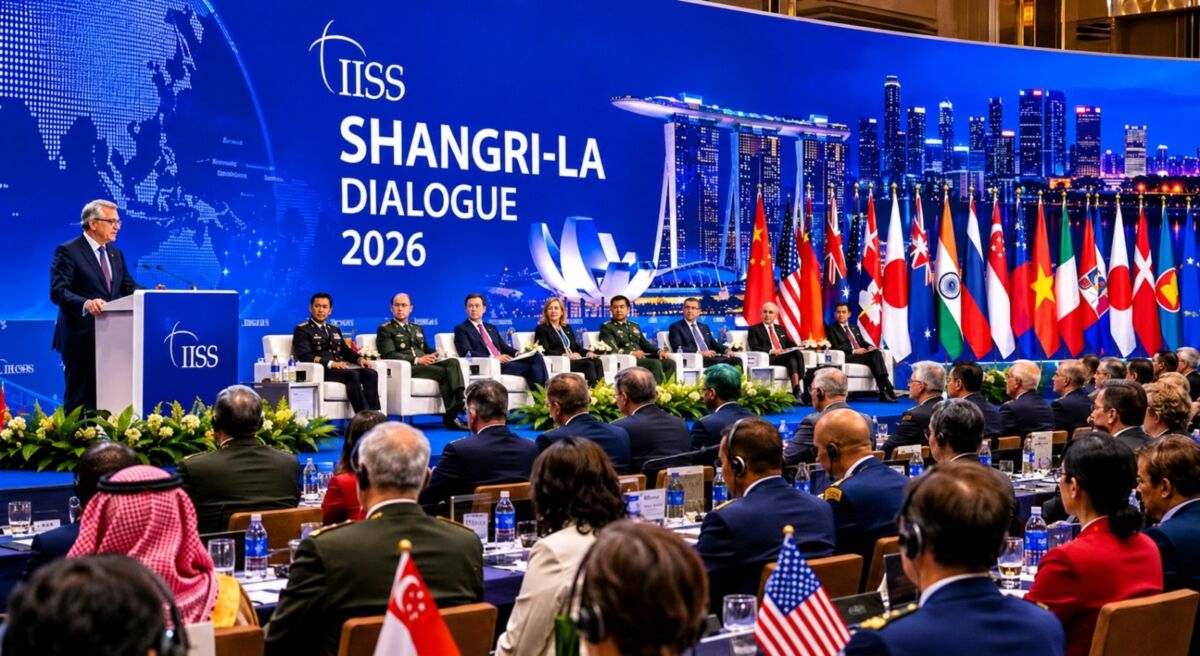
The 23rd Shangri-La Dialogue (SLD), held in Singapore from 29 to 31 May 2026, produced no major surprises. There were no declarations of rupture, no announcements of new alliance pacts, and no moments of open confrontation between the great powers. Yet the forum did reveal a security order that has crossed the threshold into confrontation: not armed confrontation, but managed confrontation.
By managed confrontation, this report refers to a condition in which the great powers actively compete for strategic position (accelerating military capabilities, securitising supply chains and contesting spheres of influence) while avoiding direct armed conflict and managing rivalry within escalation thresholds that no party wishes to cross.
The SLD is the most important defence and security forum in the Indo-Pacific. Organised annually by the International Institute for Strategic Studies (IISS) and held in Singapore since 2002, it brings together defence ministers, chiefs of defence, senior officials and specialist academics from more than forty countries. This year’s edition brought together 44 states, 54 ministerial-level delegates and more than 42 chiefs of defence, as well as representatives from the private sector and the defence industry. As such, the forum is the space in which Indo-Pacific actors take the real temperature of great-power competition and calibrate their position in relation to it.
The forum placed less emphasis on abstract declarations about the desired regional order and more on concrete capabilities: defence spending, munitions, underwater drones, critical infrastructure, intelligence, air defence, forward presence and logistical resilience. This shift in register (from principles to capabilities) was the central takeaway of the meeting.
The key question in the Indo-Pacific is no longer simply what architecture is needed to preserve peace, but what real capabilities exist to sustain it. This shift implies three things: that structural competition between the great powers is now consolidated; that deterrence has moved from the declaratory to the operational level; and that regional actors (from the United States to Vietnam, Australia and ASEAN) are adapting to a scenario in which open war is to be avoided, but material preparation is accelerating.
1. The Reordering of Great-Power Confrontation
The first axis examines the current stage of the strategic relationship between the United States and China. Four elements define this relationship: a more transactional American logic; China’s deliberate absence at the highest political and military levels; a rhetorical moderation that does not alter the underlying strategic picture; and the continued pressure generated by the Taiwan question.
1.1. The Indo-Pacific as the Centre of Gravity, under a New Logic
The forum confirmed that the Indo-Pacific remains the decisive theatre of great-power rivalry. The novelty in 2026 was not that recognition itself, but the changing form of the American presence. Washington reaffirmed its regional commitment, but under an openly transactional logic. It offers greater presence, but in exchange for allies assuming a larger financial and military burden. US Secretary of War Pete Hegseth explicitly called on Asian partners to increase defence spending (setting 3.5% of GDP as the new benchmark for contribution) and to strengthen their own capabilities in response to the rapid expansion of Chinese military power.
The most relevant element of Hegseth’s intervention was his definition of the United States’ strategy, characterised by a sharper geographical focus. This means a shift away from a global-scale presence towards a regional one, concentrating effort in the Indo-Pacific and, more specifically, along the First Island Chain. For Washington, controlling this belt is central to what Hegseth described as a “favourable balance of power” in the region: one capable of raising the cost-benefit calculation of any major confrontation and, in that way, deterring it. The urgency to close other fronts (in the Middle East and Ukraine) responds to the same logic: freeing resources in order to concentrate them in the priority theatre.
In Hegseth’s own formulation, one may have all the rules one wants, but if they are not backed by military power, they are worth little more than the paper on which they are written.
Image 1. The First Island Chain in the Indo-Pacific (reference map)

Source: Authors’ own elaboration.
In the room, this message translated into levels of commitment proportionate to each actor’s perception of threat. Japan, the Philippines and South Korea emerged as the partners most willing to increase capabilities and build new alignments. Of particular interest was the growing engagement of certain NATO members with the Asia-Pacific through the IP4 grouping (Australia, South Korea, Japan and New Zealand) without this amounting to formal mutual defence arrangements.
The difference from previous years is not one of position, but of model. The United States is not abandoning Asia; it is redefining the terms of its commitment towards a more distributed form of deterrence, less dependent on the strategic subsidy it sustained for decades. Those who invest in their own capabilities will remain relevant partners; those who do not will see their position erode.
1.2. China’s Absence and the Problem of Asymmetric Dialogue
The most significant political signal at the forum was an absence. For the second consecutive year, China’s Minister of National Defence, Dong Jun, did not attend. China instead sent a lower-ranking delegation, led by Major General Meng Xiangqing of the National Defence University of the People’s Liberation Army. Several delegates interpreted this as a deliberate downgrading of China’s participation. The absence also spared Beijing a direct confrontation over Taiwan and the South China Sea.
In the room and in the corridors, the absence of high-ranking Chinese figures was read as a message of “passive diplomatic confrontation”, directed less at domestic audiences than at the current United States administration. Singapore’s hosts, for their part, managed with notable balance their dual position as a commercial partner of China and a strategic partner of the United States.
The absence has structural consequences. Through this decision, Beijing privileges message control over exposure in arenas where it may face public pressure. As a result, the forum loses part of its value as a space for high-level dialogue between Washington and Beijing and becomes instead a stage on which the United States and its allies coordinate positions towards a China that listens without exposing itself. This asymmetry is not neutral: it reduces the Dialogue’s usefulness as a mechanism of interaction between the two powers.
1.3. Rhetorical Moderation, Structural Confrontation Intact
The American discourse was less confrontational than in previous years, partly because of the recent rapprochement between Donald Trump and Xi Jinping and the planned visit by Xi to the United States in September 2026. Yet the substance remained unchanged: the United States maintained its objective of preventing any form of Chinese regional hegemony, preserving the balance of power and strengthening its alliances with Japan, South Korea, Australia, the Philippines, Singapore and India.
This distinction matters because it defines the nature of the current moment. This is not genuine détente, but risk management in a diplomatically sensitive conjuncture. The search for stability with China is taking place within managed confrontation, not as a substitute for it. To confuse tone with substance would lead to an optimistic reading that the content of the forum does not support.
1.4. Taiwan: Present in the Background, Absent from the Podium
Although the American speech avoided overstating the issue (Hegseth, in fact, did not mention Taiwan in his intervention), tensions around the Strait remained in the background throughout the meeting. Regional concerns centred on maritime coercion, military manoeuvres, regulatory grey zones and the risk of miscalculation.
Image 2. Pete Hegseth, Secretary of War of the US, during his speech

Photo: John Griffiths / AthenaLab, 2026
Taiwan remains the principal flashpoint with high-intensity potential in East Asia, but the actors tacitly agreed not to make it the explicit axis of the forum. The careful treatment of the issue from the podium does not reflect a reduction in structural risk, but rather a deliberate management of the public narrative. No party wishes to precipitate a discursive escalation that might close the diplomatic space recently opened by the Trump–Xi summit in May 2026.
The underlying factor is the tension between what many actors regard as international waters and what China presents as falling under its sovereignty or security jurisdiction. This dispute will continue to shape the immediate future, not only among regional actors, but also with extra-regional powers that assert their right of passage.
2. Where Security and Trade Converge: The Material Environment
The second axis shifts the focus from the great powers to the domain in which confrontation takes material form. Three parallel processes define it: the expansion of maritime security into the underwater domain; the consolidation of a functional alliance architecture without full alignment; and the shift from declaratory deterrence to operational deterrence.
2.1. From the Surface Sea to the Seabed
One of the forum’s most important conceptual developments was the centrality of underwater security. Fibre-optic cables, underwater energy infrastructure, anti-submarine warfare, underwater drones and shadow fleets emerged not as marginal issues, but as structural ones. The event organiser, the International Institute for Strategic Studies (IISS), devoted a specific session to maritime security disorder in Asia, underlining how underwater threats, transnational crime, territorial disputes and the expansion of military capabilities are aggravating the regional environment.
The most concrete outcome of the forum in this domain was the launch of the GUIDE framework (Guiding Principles for Underwater Infrastructure Defence Exchanges), a Singapore-led initiative with co-signatory countries from multiple regions and the first interregional instrument specifically dedicated to the protection of critical underwater infrastructure.
Australia highlighted the increase in incidents affecting cables and critical infrastructure, referring to the disruptions recorded between Germany and Finland, and between Sweden and Lithuania, in 2024 and 2025. It linked these incidents to strategic vulnerabilities both in the Indo-Pacific and in the Baltic. This interregional connection is significant: the seabed is becoming a domain of competition with its own logic, where actions in one region generate lessons and vulnerabilities that travel to others.
Maritime competition is no longer limited to surface fleets or the control of sea routes. It is shifting towards the seabed, data, sensors and critical infrastructure, and it demands new technical, regulatory and operational capabilities that most regional actors still do not possess. In other words, the traditional dimensions of conflict (land, sea, air, cyber and space) are expanding to incorporate, with growing force, the underwater domain. This includes the fibre-optic networks, data flows, artificial intelligence systems and supply chains that operate through it.
2.2. Allies with Growing Autonomy, without Rupture
Australia, Japan, South Korea, the Philippines and Singapore are strengthening their own defence capabilities without breaking from the United States-led architecture. Hegseth praised those who have increased defence spending and operational cooperation, in explicit contrast with partners that have not followed that path.
The American pattern is consistent: greater self-investment, deeper operational cooperation and stronger participation in emerging technological domains, but all within the existing alliance framework. The region is moving towards a network of functional minilateralisms, including AUKUS, United States-Japan-South Korea cooperation, United States-Philippines cooperation, Australia-India links and reinforced ties with Singapore.
Image 3. Flexible Minilateral Architecture in the Indo-Pacific

Source: Authors’ own elaboration.
This is not an Asian NATO, but a flexible deterrence architecture without the rigidity of a collective defence treaty. That flexibility is both a strength and a limitation. It allows adaptation to each actor’s capabilities, avoids a rigid bloc logic and preserves diplomatic space with China. Yet, lacking a formal regional collective-defence mechanism, its deterrent power depends on repeated signals of capability and commitment. In parallel, ASEAN retains a highly valuable role by preserving a space for dialogue and encouraging communication that can contain risks and fragmentation.
2.3. From Declaratory Deterrence to Operational Deterrence
The forum placed less emphasis on abstract statements and more on concrete capabilities. Defence spending, munitions, underwater drones, critical infrastructure, air defence and logistical resilience dominated the substantive conversations. The American demand for higher allied defence spending and Australia’s focus on underwater cables are expressions of the same phenomenon: a shift towards the material preparation of confrontation.
This is probably the forum’s most significant long-term change. The debate over principles (the rules-based order, international law and multilateralism) remains present as a normative framework, but it is no longer the space in which the real fate of the regional order is decided. The question is no longer only what order is desired, but what capabilities exist to sustain it. That is a question of a different nature. It reveals the weakening of traditional instruments of multilateralism and places the analytical centre of gravity in the material domain.
3. Middle Powers’ Responses to Polarisation
The third axis examines how actors that are neither the United States nor China are navigating this order. Three elements structure the analysis: Vietnam as a strategic hinge actor; the spillover of the Middle East conflict into the Asian agenda; and ASEAN’s effort to avoid a binary logic of alignment.
3.1. Vietnam and the Doctrine of the Hinge Actor
The opening address by Vietnamese President Tô Lâm was significant. He identified three simultaneous crises converging in the Indo-Pacific: the erosion of international law, a development crisis and a crisis of trust among states. His emphasis was on preserving a rules-based order, avoiding coercion, and strengthening dialogue and transparency, with particular attention to the protection of cyberspace.
Vietnam is positioning itself as a hinge actor, advocating a regional order that limits great-power coercion, especially in the maritime domain. This position matters for two reasons. First, it offers an alternative to full alignment. Second, it is credible because of the actor advancing it. Vietnam retains simultaneous credibility with the United States, China, Russia and Southeast Asia, an uncommon form of regional weight.
In the room, its position was perceived as a form of realism suited to its sensitive geography. For Vietnam, privileging an open regional environment that reduces polarisation is the best way to protect its sovereignty and strategic autonomy.
3.2. The Middle East as a Reminder of Global Interdependence
The conflict involving the United States, Israel and Iran, together with the situation in the Strait of Hormuz, appeared as external factors with direct effects on Asia through three channels: energy, maritime trade and the availability of United States military capabilities. The Indo-Pacific cannot be analysed in isolation when energy and military interdependence connect Taiwan, Hormuz, Ukraine and the South China Sea within a single matrix of global risk.
For middle powers, acknowledging this reality is uncomfortable. Their security depends partly on events over which they have no influence, and on the ability of the United States to manage distant but connected theatres simultaneously. This explains Washington’s interest in closing the Middle Eastern front swiftly, precisely in order to release resources and concentrate on the Indo-Pacific. The autonomy claimed by middle powers is therefore exercised, paradoxically, within a system in which interdependence limits the real room for manoeuvre of any actor.
A consensus ran through the room during the days of the forum: in the current environment, no crisis in a strategic chokepoint can remain without immediate global effects. The countries most exposed through their dependence on imported energy (Japan, South Korea and India) are also those most motivated to strengthen their logistical and energy resilience.
3.3. ASEAN between Declared Autonomy and Structural Pressure
The states of Southeast Asia are seeking to preserve room for manoeuvre. They do not want automatic subordination to either Washington or Beijing. Their emphasis on international law, inclusive development, connectivity, trust and multilateral mechanisms reflects a clear preference for avoiding total polarisation. That preference is genuine, and the forum allowed it to be expressed clearly.
Yet there is a growing tension between declared autonomy and the conditions that make it possible. The space for not choosing is narrowing as decisions are imposed in practice. This pressure may arise through supply-chain dependencies, access to controlled technologies, exposure to financial systems, or specific demands for defence investment. The risk is not that middle powers will formally choose sides, but that de facto dependence will advance without being acknowledged in any political declaration. This gap between the rhetoric of autonomy and the reality of accumulated pressures is structural, and will probably deepen.
4. The Latin American and Chilean Perspective
The three axes do not end in Asia. The reconfiguration of great-power competition, the transformation of the material security environment and the pressure placed on middle powers also shape the space in which Chile trades, connects and projects its interests. The first thing a Chilean observer must note, however, is that the country barely registered the forum where these dynamics were discussed.
4.1. Absence as a Complete Phenomenon
Latin American presence was marginal, despite repeated statements by several states in the region about the importance of the Indo-Pacific to their national interest. Only Peru and Brazil had an official presence. From the Pacific side of the Americas, the only actors with real weight were the United States and Canada.
Unlike in 2025, Chile had no official presence. Nor was this absence exclusively a matter of the state: the Chilean private sector was also absent. It is fair to acknowledge that Chilean business leaders have read the Asian opportunity correctly. This year, SOFOFA reactivated its network of binational business councils with a focus on India, Asia and Latin America, including a Chile-India table in the context of negotiations for a Comprehensive Economic Partnership Agreement. Chilean business leaders interpreted commercial fragmentation and the dispute between the United States and China as an opportunity for diversification.
Although this reading is valuable, it remains partial because it approaches the Indo-Pacific as a market rather than as a strategic space. Markets do not float in a vacuum. Political and security decisions (where a red line is drawn, which underwater infrastructure is protected, which supply chain is securitised) determine the conditions under which trade is possible. Business associations, banks and economic think tanks would do well to complement their commercial view with a strategic reading of these spaces.
Against this backdrop, it is significant that the only Chilean presence came from specialised civil society. AthenaLab’s participation made it possible to observe first-hand the space in which decisions are being shaped that now determine Chile’s security and business environment in the Pacific.
4.2. Material Exposure: Underwater Infrastructure
The convergence between security and economics that ran through the forum has a concrete physical expression in Chile: the Humboldt Cable, the first direct submarine fibre-optic connection between South America and the Asia-Pacific, linking Valparaíso with Australia and New Zealand, with operations expected to begin around 2027. Chile is building precisely the kind of critical underwater infrastructure that the forum identified as a new domain of competition.
A second cable project, this time involving China, recently generated controversy and was suspended following a United States security alert. Great-power rivalry is therefore not a distant Indo-Pacific phenomenon for Chile. It already defines what infrastructure the country can build, and with whom. This is a fixed vulnerability: a localised asset, exposed to sabotage at a specific point. Responding to it requires physical protection and a legal regime that international law has not yet consolidated, as evidenced by the session on maritime disorder and the launch of the GUIDE framework.
4.3. Exposure of Flows: Trade Routes
Fixed infrastructure is not Chile’s only maritime exposure. The other side of this exposure lies in trade flows, where dependence is structural. Since 2010, China has been Chile’s main trading partner. In 2025, it accounted for 32.7% of Chile’s total trade and around 35% of its exports, while its share of Chilean shipments rose from 14% to almost 40% in less than two decades. Together with other Asian destinations (Japan, South Korea and India, the latter growing at annual rates above 40%) the Pacific is confirmed as the decisive commercial theatre for Chile’s national income.
Image 4. Chile and Indo-Pacific Flows (reference image)
Source: Authors’ own elaboration.
The copper, cathodes, cherries, lithium, salmon products and cellulose that sustain this income cross the Pacific towards the same Asian ports whose security of approach was discussed in Singapore. A disruption in the Taiwan Strait, the South China Sea or the maritime chokepoints along these routes are not an abstract geopolitical risk for Chile. It is the direct interruption of the route on which one third of its foreign trade depends. Unlike the cable, this is a flow vulnerability: its critical point is not located in Chilean territory, but thousands of kilometres away. Its response is therefore not physical protection, but diplomacy, logistical resilience and energy resilience.
Both dimensions (the cable that carries data and the route that carries cargo) belong to the same domain that the forum placed at the centre of strategic competition. In both, Chile is an exposed actor. For this reason, Chile’s analysis of the Indo-Pacific must adopt an integrated approach, incorporating foreign policy and economic policy into its strategic planning.
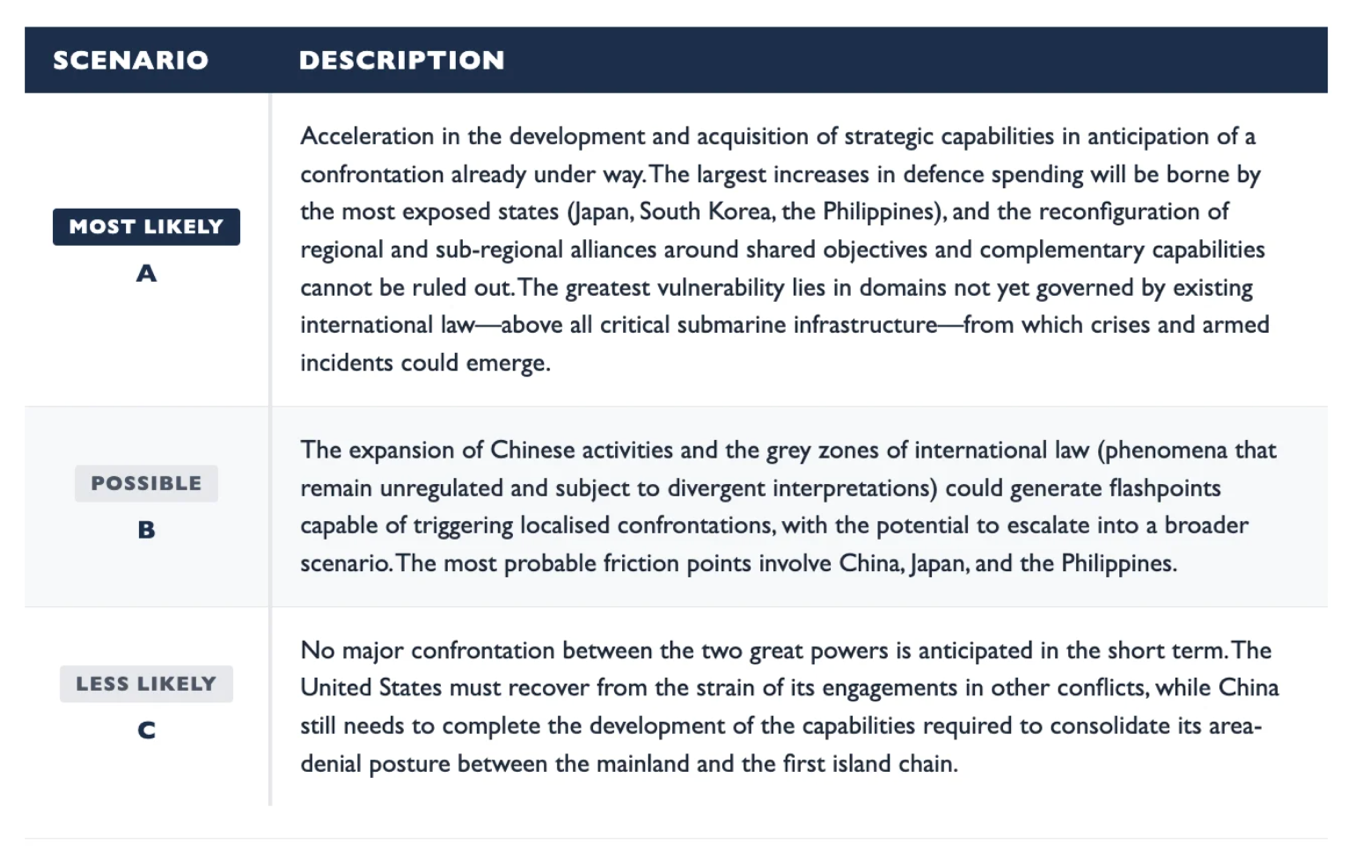
5. Three Projections to 2028
On the basis of what was observed and discussed at the forum (both on stage and in the corridors) three plausible trajectories can be projected for the Indo-Pacific over the 2026-2028 period.
Image 5. Prospective Scenarios: US-China Strategic Competition
Source: Authors’ own elaboration.
6. Conclusion: Managed Confrontation as the New Normal
The three axes converge on the same diagnosis. The Indo-Pacific is entering a phase of managed confrontation. Actors seek to avoid open war, but they are accelerating military, technological and logistical preparation for crisis scenarios. China’s absence reduces the space for direct dialogue between the two powers, even as it preserves the multilateral forum for the countries of the region.
The United States reaffirms its commitment, but demands greater material co-responsibility. Regional states insist on international law, strategic autonomy and maritime stability, without reversing the underlying logic. In theoretical terms, the forum reflects a transition from a relatively institutionalised liberal-regional order towards a competitive balance of power in which confrontation is managed.
The conclusion is neither alarmist nor complacent. The region is not on the brink of war, but nor is it building the institutions that would make war unlikely in the long term. Instead, it is establishing a condition of permanent and materially dense competition, in which stability depends less on shared agreements and more on each actor’s capacity to deter, withstand or prevail.
This is the new normal of the Indo-Pacific, and the 2026 Shangri-La Dialogue will be remembered as the forum where it became visible.
7. Implications for Latin America and Chile
For the region, the challenge raised by the conclusions of this forum is to bring together countries with shared interests and increase their collective influence in a context in which international law will, with increasing frequency, be subjected to expressions of power that override traditional legal foundations. Coordination among Latin American countries for the collective promotion of their interests is therefore an urgent task.
For Chile, the main lesson of the forum is the need to integrate and consolidate a process of strategic reflection on the Indo-Pacific that, guided by the national interest, identifies risks, threats and opportunities. The commercial dimension is not enough. It must be complemented by a strategic perspective on security and defence. Avoiding this approach increases Chile’s vulnerability, leaving the country exposed to dynamics over which it will have only limited capacity to influence outcomes or protect its own interests.
These forums are not merely declaratory arenas. They are barometers of the strategic climate: they allow actors to take the temperature of competition, anticipate trends and read signals that do not arrive through formal channels. In 2026, Chile’s presence at Shangri-La came solely from specialised civil society, and that first-hand observation informs our analysis and advice for decision-making processes on matters of national interest.
Sustaining and expanding that presence is an investment in strategic anticipation. Being present makes it possible to detect early what is already taking shape. AthenaLab will continue to cover these spaces and aspires to do so alongside sectoral representation from the state and the private sector, because the national interest is increasingly at stake in these arenas.
APPENDIX: SHANGRI-LA 2026 IN DETAIL
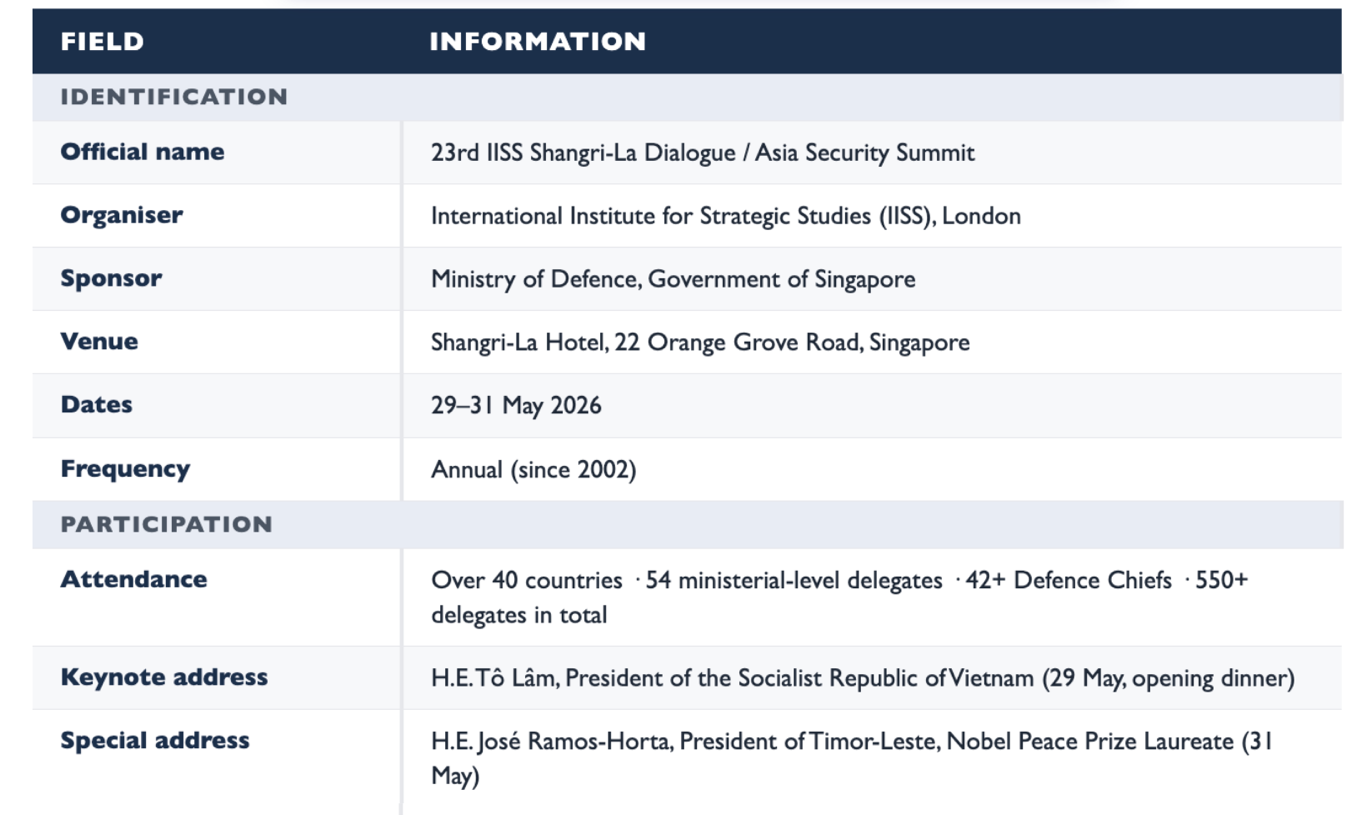
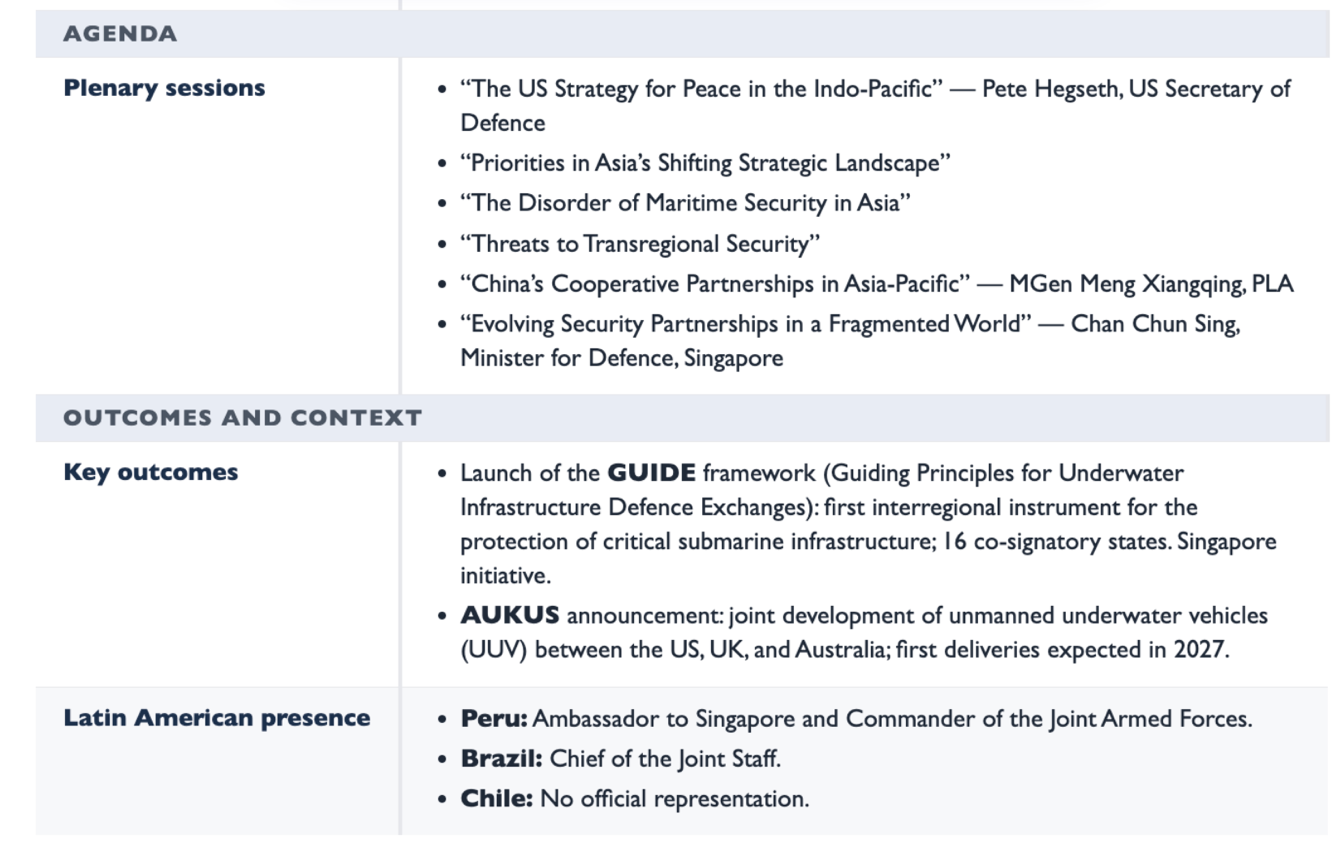
This report was prepared on the basis of AthenaLab’s direct participation in the sessions and activities of the 23rd Shangri-La Dialogue. The interpretations expressed here are AthenaLab’s own and do not represent the positions of the State of Chile.