The Issue of the Hito 1 Panels and Their Strategic Implications
This article was translated automatically and may contain differences from the original. For reference, read the original.
El Líbero, June 19, 2024
The Strait of Magellan is Chilean. This is established in the Boundary Treaty of 1881 and the Treaty of Peace and Friendship of 1984. These are not Argentine waters or waters under dual control as the Argentines continue to claim to this day.
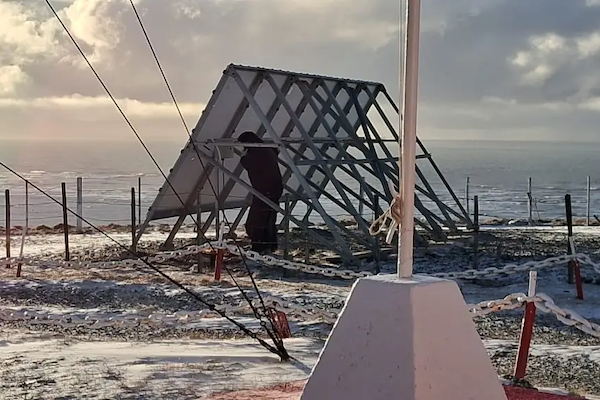
In recent days, a few poorly installed Argentine solar panels on foreign property stirred tensions in Chilean-Argentine relations, prompting a call to attention from the President of the Republic to the trans-Andean authorities, who immediately ordered their removal, which occurred on the morning of Tuesday, June 18, rather than in the summer as initially stated.
The crisis began when a local media outlet reported the issue in the middle of last week, leading to an unfortunate statement from the Foreign Minister Van Klaveren, as well as from the Ambassador Jorge Faurie, which further complicated matters and brought the issue to the forefront until the President Boric intervened on the morning of June 17.
We will have time to review whether there was a local failure in this mishap and whether our reaction was timely, and if not, where it went wrong or who did not fulfill their duties, something that is suspected may have occurred in some public agency located in the civic district of Santiago.
At first glance, it seems that someone or some people did not do their job, as on April 29, a military ceremony with great fanfare, which was reported in Argentine media, inaugurated improvements made to the facilities located at the border with Chile in the area of Cabo Espíritu Santo (Tierra del Fuego), known as the Maritime Traffic Control and Surveillance Post (PVYCTM) Hito 1 of the Argentine Navy, which now, due to the use of solar panel technology, extends several meters into national territory, something that is very clear in the event photos.
It is likely that some media and individuals will view this as an anecdotal incident in the complex relationship that has existed between our two countries for over 200 years, or as a dispute between two leaders with opposing ideological positions, failing to understand the underlying problem and why this occurrence is not a mere incident or something of no strategic importance, which I will proceed to explain below:
1) Cabo de Espíritu Santo (Hito 1) is the point of the Chilean-Argentine border located in Tierra del Fuego, which, along with the Ex-Buoy Dungeness (near the Punta Dungeness Lighthouse) on the opposite shore, establishes the line where the Strait of Magellan begins or where its eastern mouth is located.
2) The Argentine PVTCTM located near Hito 1 was installed in the late 1970s, initially located less than a kilometer from its current position adjacent to the border with Chile, which only occurred in the late 1990s, having been modernized several times, the last of which literally crosses the line.
3) Here we move from having nothing to having a surveillance and maritime traffic control post, which is excellent if its purpose were the waters of the South Atlantic, and not the Strait of Magellan, as is suspected to be their intention by placing it next to the Cabo de Espíritu Santo Lighthouse of the Chilean Navy, and something that is made clear in the aforementioned article from the Argentine Navy’s Gaceta Marinera, which states: “The two modules donated by the Mirgor Foundation are transportable and were specially designed to meet the housing and work needs of the Argentine Navy personnel who perform their tasks at the PVYCTM ‘Hito 1’ conducting satellite monitoring of the Strait of Magellan.”
4) The Strait of Magellan is Chilean. This is established in the Boundary Treaty of 1881 and the Treaty of Peace and Friendship of 1984 (TPA of 84). These are not Argentine waters or waters under dual control as the Argentines continue to claim to this day, as indicated by their latest Defense policy published in 2021, which has yet to be corrected despite Chilean diplomatic complaints, and which literally states: “One of the shared spaces that is fundamental to continue strengthening is that of joint exploration, study, and control over the Strait of Magellan and the Sea of Hoces, strategic spaces both for their role as natural waterways between the ATLANTIC OCEAN and the PACIFIC OCEAN and for being privileged access points to the Antarctic continent.”
5) The above, known as the thesis of Argentine Vice Admiral Segundo Storni, combined with the ongoing pursuit of placing the northern limit of the eastern mouth of the Strait at Cabo Vírgenes, transforming Argentina into a riparian state of the Strait of Magellan since we only reach Dungeness, thus making them riparians of the Strait, raises suspicion about anything Argentina does regarding boundaries in the area, which is why we must not tolerate any of it, demanding the utmost vigilance from our authorities regarding boundaries with Argentina.
6) Argentina already has a poor track record regarding free passage through the Strait. They do not allow the navigation of vessels coming from or heading to the Falklands/Malvinas through these waters, arguing that to reach the Strait, they must pass through their territorial waters, denying them the free passage to which they are entitled, something that was made very clear in the TPA of 84.
7) In Argentina, the political color of the President does not matter when it comes to boundary issues or state matters such as their southern and Antarctic ambitions, or the recovery of the islands in the South Atlantic that they claim as their own. This implies that situations like these must be treated as significant and not diminished. They always seek to move further south and further west, a principle they also apply to the Strait of Magellan, and for this, solar panels are also useful.
In the current geostrategic context of the world, it is not indifferent who holds sovereignty over the Strait of Magellan, which gains importance daily as other strategic passages fall victim to climate change or the new power realities governing relations between countries. This compels us to be diligent and demanding in all matters concerning these Chilean internal waters, leaving no room for errors, which we have opened to free navigation, but they remain ours, something I suspect may be revisable as we assess that our rights and sovereignty may be at risk.
In conclusion, in our relationship with Argentina, any poorly managed incident can end badly and require forceful solutions. Let us remember the case of Snipe Islet in 1958, which, along with the defense of Beagle in 1978, teaches us that with Argentina, action is taken with strength, and they only react to force. That strength we possess today, while they have little to none.
Richard Kouyoumdjian
Vice President of AthenaLab
Source: El Líbero