COLUMN | Military neutrality does not apply in times of competition
This article was translated automatically and may contain differences from the original. For reference, read the original.
- by Juan Pablo Toro
- Opinion
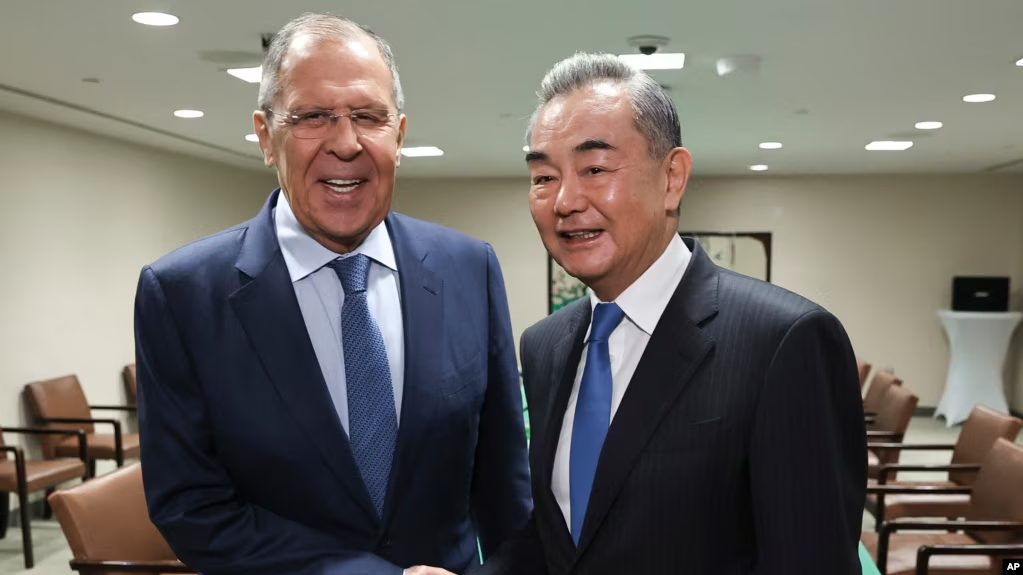
El ministro ruso de Exteriores, Serguei Lavrov, se reunió en la ONU con su par chino, Wang Yi
“The world faces a turning point,” warned President Joe Biden this week in his latest speech before the United Nations General Assembly. This veteran of U.S. foreign policy sought to alert about the high level of risk observed today, due to the open wars in the Middle East and Europe and the pending conflicts in East Asia.
Large and medium powers dissatisfied with the post-1945 rules-based global order are attempting to modify it by invading neighboring countries, sponsoring militias to attack their historical enemies, conducting ballistic tests every other day, or colliding their vessels in disputed seas. But, even more concerning, they are cooperating with each other against those perceived as common rivals.
In the current scenario, the axis formed by China, Russia, Iran, North Korea, and other minor allies has become increasingly evident. For some, it is an axis based on “discontent” with a world that has yet to become multipolar, while for others, it is a group seeking to create “upheaval” to achieve specific gains.
There are cases that speak for themselves, such as the war in Ukraine. Moscow receives attack drones and rockets from Tehran, and Pyongyang supplies artillery ammunition. Western authorities maintain that Beijing, under the framework of its “unlimited friendship,” provides political support and electronic components for the Kremlin’s war machinery. This has, of course, been denied by the Chinese.
Turning to Latin America, it should come as no surprise that among the first countries to congratulate Nicolás Maduro for maintaining power were Russia, China, and Iran, seemingly unconcerned that Venezuela has become an exporter of all kinds of insecurities for the region, including dangerous criminal groups and rampant immigration. This is about fostering “upheaval,” and what better place than the direct periphery of the United States.
“China and Venezuela are good friends and partners, and regardless of how international circumstances change, China will continue to support Venezuela in defending its sovereignty and national dignity, as well as in the country’s economic and social development,” stated Foreign Minister Wang Yi after meeting with his counterpart Yván Gil in New York during the UN Assembly, the same forum where President Gabriel Boric denounced the electoral “fraud” of Maduro’s “dictatorship.”
Given the above, the statements by Defense Minister Maya Fernández, who announced in Beijing that Chile seeks to “resume and deepen” relations “in the field of defense” with China, are surprising. This was just as Chilean forces were training with their U.S. counterparts and those from other countries in the region, alongside the government’s clear stance regarding Maduro and the illegal invasion of Ukraine.
It is possible that the minister, like some representatives of the previous administration of Sebastián Piñera, genuinely believes in those narratives of non-alignment and neutrality, which are so functional for the aforementioned axis, as they avoid the uncomfortable topic of common values and norms. However, what works in the realm of diplomacy and trade does not operate in the military field—where every relationship is strategic—and even less so in a context of intense geopolitical competition.
The armed forces of Chile are de facto integrated into Western defense structures, whether through common doctrines, officer exchanges, the origin of the equipment used, or adherence to international law regulating the deployment of forces abroad (always seeking the umbrella of the United Nations). Opening the sector to other actors could bring serious costs; how could Americans and Europeans feel secure if they see that the sophisticated material they are allowed to sell could be scrutinized by their rivals? At the very least, we should have a consistent strategic autonomy policy, which is nowhere to be seen.
Just look to Argentina to understand how quickly they obtained F-16 aircraft, only after discarding any intention of purchasing Chinese or Indian fighters. Even the British seem to have lifted their vetoes on the transfer of U.S.-origin material after that. Peru is another country that appears interested in moving away from Russian supply lines and is opting for South Korea as a preferred supplier.
It is clear that viewing the countries of the axis formed by China, Russia, Iran, and North Korea separately is becoming increasingly difficult. Their cross-support manifests in various regions of the world and generally in contexts of crisis and conflict. If there is no doubt that we are at a turning point, then the question is with whom will the threats and risks arising from it be confronted. With those who believe in respect for international norms, trade openness, and democratic values, or with those who do everything possible to undermine them. The answer should be obvious, but there are always those who unnecessarily entangle themselves.
Juan Pablo Toro
Executive Director of AthenaLab