COLUMN | Climate Emergencies, the Left, and King Felipe VI
This article was translated automatically and may contain differences from the original. For reference, read the original.
- por Richard Kouyoumdjian
- Columnas
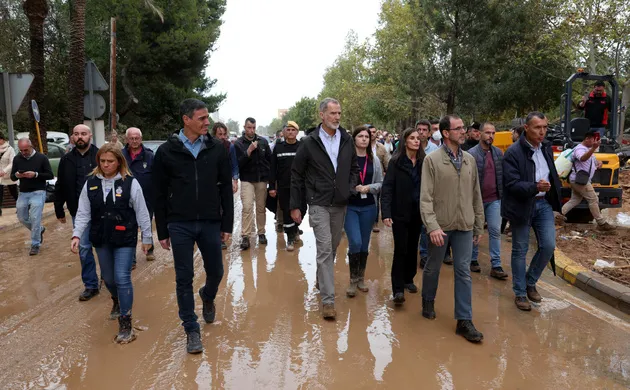
King Felipe VI and his stoic performance on Sunday during his visit to the town of Paiporta exemplify what is expected of a leader.
The management and prevention of emergencies or disasters is not a strong suit of the Chilean government, nor is it of the Spanish government. The climatic event known as isolated depression at high levels (DANA), which on October 29, 2024, caused over 200 deaths and significant material damage, primarily in Valencia, Spain, is an example of poor management by both the central government in Madrid and the regional authorities, similar to what occurred with the fires in Viña del Mar last summer, where both central and local authorities failed spectacularly, demonstrating very disappointing actions.
Both the Spanish DANA and the Viña del Mar fire, as well as the strong winds that affected Chile in early August, were not avoidable climatic events, but they were events where preventive action and prior organization could have reduced the impact. In the case of Valencia, disorganized and unauthorized construction in flood-prone areas, in Viña del Mar the lack of well-developed emergency plans at the municipal level, as well as the absence of training in emergency management, and in the case of the extreme winds that affected much of Chile in August, the electrical wiring affected by trees that caused both to fall together, leaving the capital and southern cities without electricity for several days.
The three events described above are also characterized by poor management of the emergency itself. Reactions are delayed and insufficient, with a lack of coordination between central and regional – local levels, and a strong emphasis on trying to find scapegoats to absolve themselves of the responsibilities and consequences of the poor management.
In Chile, the mayor of Viña del Mar was at odds with the regional emergency chief, in Santiago the mayors and central government assigned all blame to the electricity distribution company, and in Spain, there was infighting between the leftist government of Sánchez and the Popular Party that governs Valencia.
In Chile, it is the Armed Forces that end up solving the problems and inefficiencies of politicians, something that could also have happened in Spain if the Executive had utilized them with all their versatile capabilities from the beginning, but who knows where the PSOE and its partners got tangled up, as they did everything wrong, as wrong as our government when it comes to acting in emergencies or against crime.
Where the Spaniards do give us lessons is in the leadership of their Head of State. King Felipe VI and his stoic performance on Sunday during his visit to the town of Paiporta exemplify what is expected of a leader. Together with the queen, he went to the scene to show his face, support his subjects, and see how things were. The head of government joined the visit, but at the first boos, stones, and mud thrown, he fled the scene, leaving the monarchs alone, who had to deal with the frustration and anger of the affected people.
No matter how much Sánchez tries to rewrite history through official media, the image that remains, which is not the one represented by all Chilean media, is that of the kings standing with the people, something I am sure will be remembered by the Spaniards, even by those in favor of the republic and the anti-monarchists.
If the king had run away with Pedro Sánchez, it might have been the end of the Spanish monarchy, but he did not. His military training, his vocation of service to the people of whom he is king, and the fact that he is an upright man concerned for his people is something that, as long as it exists, ensures the survival of the monarchy in a Spain that, without it, I mean the monarchy, would disintegrate into a series of smaller kingdoms and autonomies, reverting to what it was approximately 600 years ago, before the arrival of Isabel of Castile and León, and Fernando of Aragon.
I hope Felipe VI continues to withstand the attacks from the left that want to reduce him to a mere ornamental figure. His existence is beneficial to Spain and is an example of what is expected of a Head of State, something for which the Princess of Asturias is being trained militarily, as state leadership and armed forces are two things that are closely linked.