Reflections on the 40th Anniversary of the TPA
This article was translated automatically and may contain differences from the original. For reference, read the original.
@Minrel_Chile
With Argentina, it works to respect treaties and to have well-equipped and trained Armed Forces to enforce them. If we do that and they behave well, we can be good neighbors and live in peace and friendship.
On November 29, 1984, the Treaty of Peace and Friendship (TPA) between Chile and Argentina was signed in the Vatican City in the presence of Pope John Paul II. For us, it was signed by the Foreign Minister Jaime del Valle, and for the Argentines, by the Minister of Foreign Affairs and Worship Dante Caputo.
The TPA was approved and enacted by the respective legislative and executive powers in the second quarter of 1985, thus remaining fully in force and execution. It is worth noting that, in the case of Argentina, prior to the signing on the 29th, a non-binding plebiscite was held days earlier in which 72% of the electoral roll voted, achieving an 81% approval rate. The right-wing, which supported the military during the so-called national reorganization process, opposed it, while a significant part of Peronism boycotted the consultation. For Alfonsín, it was important to have a political foundation before proceeding, and in that sense, he was able to sign without problems, confident that he would later receive legislative approval that would have to align with the will of the people. An anecdotal detail is that the approval received its lowest vote in the province of Tierra del Fuego.
I detail the above because, regardless of the fact that the defeat in the Falklands in ’82 clearly facilitated the acceptance of signing an agreement like the TPA, as it removed the hard elements from the negotiation, the Argentine people had been educated for generations under the ideas of Admiral Segundo Storni, believing that the Beagle was theirs, that Argentina was for the Atlantic and Chile for the Pacific, and therefore, that the Antarctic Peninsula belonged to them. They had to be sold the idea that they were ceding sovereignty in exchange for peace with Chile, something that in 1984 could be considered valuable, as this columnist estimates that sooner or later it would have been difficult to reach an agreement like the one that was signed because the national interest of that country is always and continues to be to push further south and west, something that has re-emerged with some strength in subsequent years, particularly regarding southern maritime spaces and in places like Southern Ice Fields.
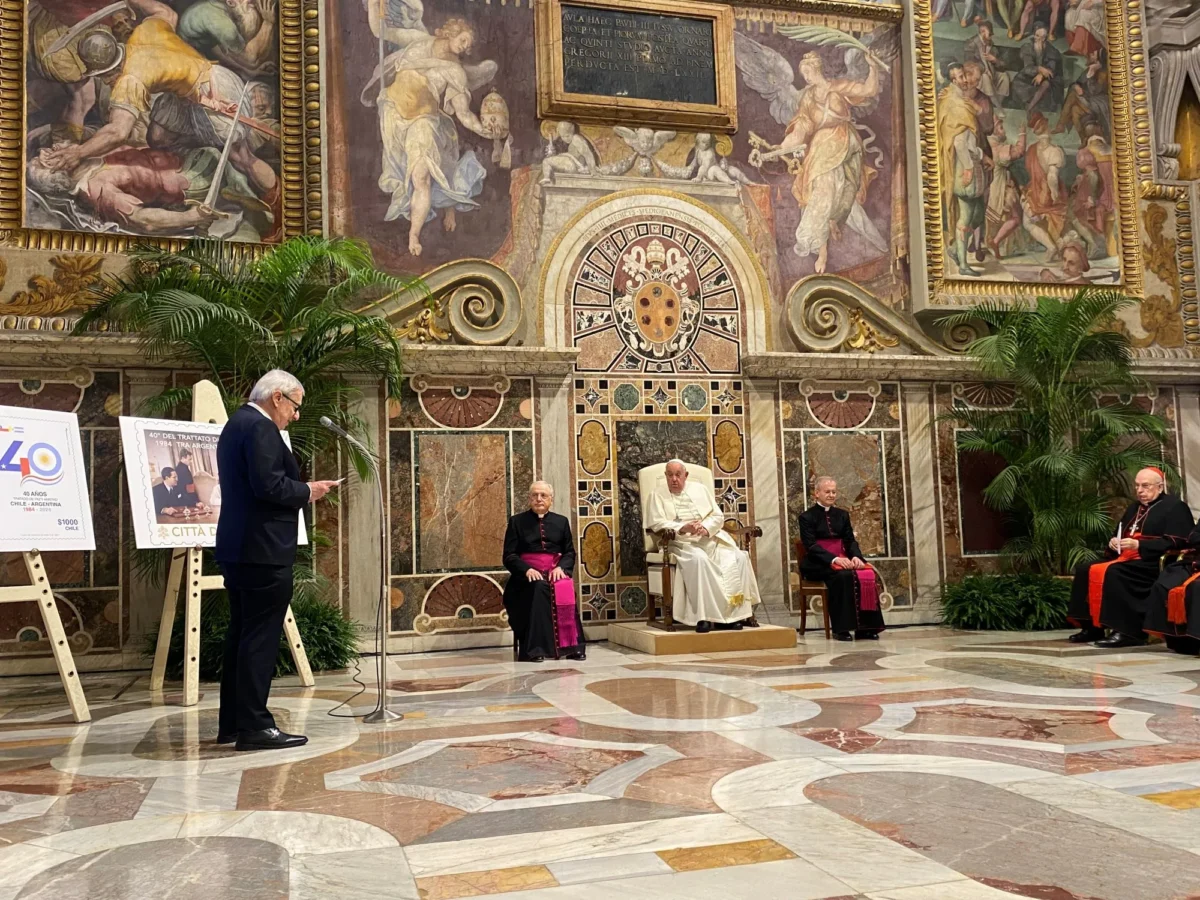
Regardless of the diplomatic efforts made by the foreign ministries of both countries to reach an agreement, I believe that the following concepts indicated by the Pope Francis during the ceremony on Monday, November 25, 2024 held in the Vatican reflect the spirit of the TPA of ’84:
- To seek an agreement that would be considered by the parties as satisfactory, fair, equitable, and honorable, and I emphasize the last concept, as it was key for the Argentines to accept,
- That it is a Treaty of Peace and Friendship, which is more than a ceasefire or a provisional agreement. The TPA seeks to definitively resolve the differences that existed regarding the Beagle issue and related aspects, and
- It aimed to develop a friendship between the countries, something that has proven to be somewhat more difficult to develop despite some moments of progress.
Clearly, the agreement was facilitated not only by the defeat suffered by the Argentines in ’82 but also by the increase in aerial and naval capabilities on the part of Chile, which came as compensation for the assistance we provided to the British in the recapture of the Falklands.
It was also helpful that the Chilean Armed Forces did not lower their guard after December ’78, when they showed their teeth to the Argentines, maintaining a high level of readiness, which was reinforced in 1982 when the Argentines invaded the Falklands, as we well knew that if that succeeded, there was a high probability they would attempt to exert pressure on Chile again or repeat what happened at the end of ’78.
The history with Argentina teaches us that it is effective to be firm and clear with them, avoiding the pitfalls of being overly accommodating or yielding. It works to respect treaties and to have well-equipped and trained Armed Forces to enforce them. If we do that and they behave well, we can be good neighbors and live in peace and friendship.
And to conclude, clearly,childish attitudes like those recently demonstrated by the leaders of both nations, leaving Pope Francis alone with Chancellor Van Klaveren, the Argentine ambassador, and present diplomats. The TPA of ’84 does not take care of itself; it requires support, otherwise, it becomes mere dead letter.
In memory of the diplomats and military personnel who managed to bring Argentina to the negotiating table, ensured that it did not leave, and, above all, that it accepted to sign the Treaty of Peace and Friendship on November 29, 1984.