INTERVIEW | Deportations in the Trump 2.0 Era: Experts Warn That Chile Must "Anticipate" and Prepare a Strategy Amid "Uncertainty"
This article was translated automatically and may contain differences from the original. For reference, read the original.
- por Pilar Lizana
- Entrevistas
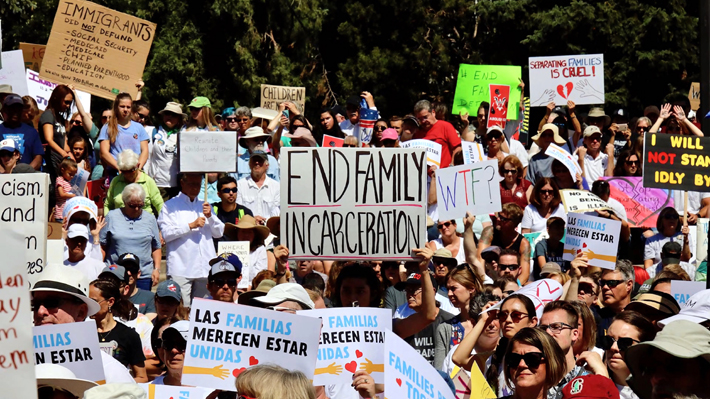
Manifestaciones contra las políticas migratorias de Donald Trump, en Estados Unidos.
The impasse that arose with Colombia revealed that the United States' immigration policy "does not allow for negotiations," and although Chile is not on the radar, experts urge preparation.
The President of the United States, Donald Trump, began to implement part of his immigration policy, which keeps several Latino communities in that country on edge, in light of the U.S. president’s promise to carry out mass expulsions of foreigners.
One of the initial focal points was Colombia, with the sending of two flights carrying Colombian nationals from the United States, which opened a diplomatic tension between the two countries. This was because Colombian President Gustavo Petro initially refused to accept the flights, arguing that “the U.S. cannot treat Colombian migrants as criminals,” and urged that country to provide them with “dignified treatment.”
However, Trump hardened his stance and imposed a 25% tariff on all Colombian products, announcing that in a week “it will rise to 50%.” This led Petro to backtrack and decide to accept the flights.
Meanwhile, in Peru, they have also faced Trump’s offensive. Yesterday, Peruvian Foreign Minister Elmer Shialer announced that the United States suspended aid to that country for programs managed by the U.S. Agency for International Development (USAID), which include governance, health, education, economic development, environment, and drug combat. In this regard, he explained that the country expected to receive $630 million in aid by 2030, but the disbursement of funds has been halted.
While the world and several governments in Latin America observe the measures imposed by Trump, a debate is also opening in Chile. This is because it is not ruled out that the reaction the U.S. president had with Colombia could be replicated in response to other deportations he attempts to carry out.
In the case of Chile, a concerning element is the multiple occasions when a U.S. sheriff has requested the cancellation of the Visa Waiver program due to a series of thefts committed by Chilean gangs, accusing that Chileans come to the United States to commit crimes. “We estimate that there are one hundred Chilean gangs of four to six people operating throughout the country, who enter and exit U.S. territory in cycles,” said Oakland County Sheriff Mike Bouchard in December.
Government Establishes Position: “There Is an Obligation to Receive Them”
The position of the Chilean Government regarding potential repatriations has been one of collaboration. Yesterday, Interior Minister Carolina Tohá stated in a conversation with Radio Infinita that “when we deport people to their country of origin, we expect cooperation from that country, and generally we receive it.”
“So if any country, whether the United States or another, expels Chileans for legal or immigration reasons and returns them to our country, we certainly collaborate in that, when it comes to coordination and the proper information. Chileans can always come back to Chile, and when they are expelled from another country, our obligation is to cooperate with that,” she added.
Regarding whether the conditions under which compatriots are treated matter for their reception back in the country, the minister pointed out that “when one is certain that the people coming are of our nationality, there is an obligation to receive them.”
“Anticipating Scenarios and Response Strategies”
Beyond the position established by President Gabriel Boric’s Government to receive potential compatriots who may be deported, experts point out that the country must be prepared for this in terms of resources, infrastructure, and the conditions in which these individuals may arrive. This is considering the existing levels of migration in Chile, which already strain capacities.
Pilar Lizana, a security expert and researcher at AthenaLab, tells Emol that what happened with President Gustavo Petro demonstrates “Trump’s conviction to carry out these mass deportations and that if they are not accepted, he is willing to take all kinds of actions.”
Although they are different countries, she comments that “both Colombia and Chile have ideologies that differ from the Trump administration, and it should be weighed how much that influences. But in any case, we must start thinking about the infrastructure and capacities we have to receive them; the backgrounds of these individuals, to know under what conditions they come, whether they are people who have committed crimes there, if they have records here in the country, we must prepare for all scenarios.”
The idea that Chile must prepare in any case is shared by Jorge Sahd, director of the UC Center for International Studies. He comments that what happened over the weekend with Colombia is not just a message to that country, “but to the rest of Latin America, that Trump’s immigration policy does not allow for negotiations and that the approach in this matter is all or nothing.”
“While Chile is not on the initial radar of the United States, the Government should form a multidisciplinary team to monitor the measures of the Trump administration and allow for anticipating scenarios and preparing response strategies. We are entering an era of high uncertainty, and countries will have to get used to navigating this new scenario,” he stated.
For his part, Diego Rojas, an international analyst at UC, adds that we must consider how this process will affect migration flows within Latin America. “Because primarily the displaced and the plan for mass deportations being executed by Trump will indeed have an impact on receiving countries within the Latin American region, and Chile is a fairly receptive country for migrants.”
“In that sense, the country should prepare in migration terms to see a new wave of intraregional migration, not just displaced individuals trying to look north this time, but displaced individuals also seeking other places to settle within Latin America. In that case, Chile remains somewhat attractive to migrants (…) and this migratory wave generated by mass deportations could also impact our country, potentially bringing new waves of migrants at levels we had seen in previous years,” he concluded.
Guillermo Holzmann, an international analyst at PUCV, comments that “regarding Latin America, Donald Trump acts and then talks. Regarding Russia, the European Union, China, he first states situations, makes assertions, establishes conditions, but does not act. For Trump, the situation with Latin America is ‘by the stick,’ particularly with socialist and progressive governments.”
“Considering all of this and keeping in mind that Chile has a progressive government, it is necessary to recognize that the Visa Waiver is actually one of our lesser problems, even if it is a measure that the Trump administration could impose quickly,” he adds.
In this regard, he argues that Chile should “worry a lot” about what has happened with Colombia, “and Chile should be able to anticipate, considering our geostrategic and geoeconomic position, despite being a small economy, in terms of the dependence we have on our exports to the United States, and considering that Trump’s first pragmatic reaction regarding a government decision for U.S. national interests and security is to increase tariffs.”
“Secondly, we have significant pressure regarding our dependence on the European Union, which is currently in confrontation or in a scenario of profound difference with the United States, not to mention our dependence on China,” he concluded.