COLUMN | Presidential Announcements on Israel: More Rhetoric than Substance
This article was translated automatically and may contain differences from the original. For reference, read the original.
- por Richard Kouyoumdjian
- Columnas
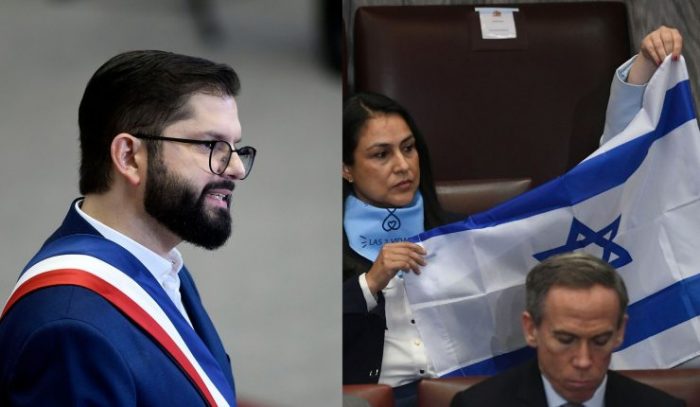
In the announcement of the Public Account, there is much rhetoric and phrases for the record—such as supporting the arms embargo proposed by Spain—but there are also statements that will be costly for Chile, very costly, when viewed from the perspective of Israel or the United States, its most loyal ally and protector.
While the President mentioned Ukraine, Venezuela, and Nicaragua, and also commented on El Salvador and the unorthodox way that government handles crime, he spoke about Israel only towards the end of his Public Account, something many had anticipated since the announcement last week of the withdrawal of the two military attachés that remained at our embassy in that country.
Much of what the President indicated yesterday was a confirmation of what has already been done, including the call for consultation of the Chilean ambassador in Tel Aviv, the prohibition of participation in the last Fidae, Chile’s support for the South African initiative before the International Criminal Court seeking to prosecute Israel’s top ministers for war crimes and crimes against humanity, and the aforementioned withdrawal of military attachés.
The good news is that he did not announce the closure of diplomatic relations, but the actions he indicated will bring the relationship to a very low point, not much different from merely having consular relations, which is the from in the relations between two countries.
In my view, the actions reported yesterday have little impact. The request not to import anything from occupied territories is inconsequential, as nothing we are interested in importing is produced in those areas, and, on the other hand, since this government took office, all new defense materials of Israeli origin are no longer approved. What was said yesterday only matters if someone wants to stop what is being purchased, consumed, or used under existing contracts, which are very costly to undo.
In the announcement of the Public Account, there is much rhetoric and phrases for the record—such as supporting the arms embargo proposed by Spain—but there are also statements that will be costly for Chile, very costly, when viewed from the perspective of Israel or the United States, its most loyal ally and protector.
The President of the Republic, who is responsible for Chile’s foreign relations, as enshrined in the Constitution, accused Israel of being a genocidal state and of applying ethnic cleansing in Gaza. This is as close to a declaration of war as one can get. Yes, he has said it before, but the circumstances in which he says it are different and will have serious repercussions both with the Israelis and with the Americans.
While it is true that he qualifies his statements by trying to separate the people of Israel from their government, indicating that the guilty party is the government led by Netanyahu, we must not forget that he was elected prime minister by that same people and that if that people disagreed with their prime minister, they could remove him very quickly through a vote of no confidence, as it is a parliamentary government.
Boric also condemns Hamas and demands the return of the hostages still in their hands, but he does not go beyond that when it comes to them.
An abrupt exit from the contracts and services we currently have with Israel would have significant impacts on the three defense institutions. Obviously, everything is replaceable, but not without incurring greater costs and immediate operational impacts. Indicating that he has asked the Ministry of National Defense to study the issue has more to do with communication than with real effects. In Defense, they are clear and know that it will not go beyond that: a phrase for the record and something that sounds good in the Public Account.
I had hoped that, after the announcement of the withdrawal of the military attachés—something that this medium and others pointed out before the Public Account, thus removing its novelty—the President would distance himself from the issue of Israel and leave it as it was, but unfortunately, he mentioned it again, a mention that came with serious accusations, which will not be without cost for Chile.
During the week, possible actions by the United States were mentioned as a reaction to the stance Chile was taking. After yesterday, I see it as more likely. Accusing Israel of being a genocidal state and of conducting ethnic cleansing is a strong accusation.
Everything Chile has done and announced regarding the conflict in Gaza will have no effect on the outcome or what happens there and, conversely, will have negative effects for Chile’s national interest, a risk that does not come so much from Israel, which will surely continue to respond to the commercial contracts and services we have with them, but will imply actions from the northern country.
I hope I am wrong, but this Sunday we increased the likelihood of having our Visa Waiver program revoked, of increased tariffs, and, most strategically, of having the delivery of weapons and systems used by our institutions, particularly the Navy and the Air Force, cut or restricted, as well as affecting the joint training we conduct and the studies that Chileans continue in that country.
The Navy primarily operates British and American material, so any potential restrictions would affect our strategic capabilities, but in the case of the Air Force, it would be catastrophic, as our deterrent and protective capacity of Chile’s skies mainly relies on the F-16s, material manufactured in the United States, and equipped with systems and armament of the same origin. The Chilean Army would also be affected, as would the Joint Chiefs of Staff, but to a lesser extent than the Navy and the Air Force.
I was left with the feeling that the screw was turned a bit more, particularly regarding the accusation. If we had stopped at reviewing alternative sources of supply, along with what had already been announced, perhaps we could have avoided this.
While it is true that politicians are accountable to their voters, we must not forget that the only two public policies that should always be considered as state policies are Foreign Relations and Defense. This is not just a saying; it is a reality supported by facts, history, and common sense. Both state policies converge on a fundamental and very delicate good, which is national security. The political management of both policies is built on history, trust, and how crises and tensions between countries are handled.