The concerning situation of National Defense
This article was translated automatically and may contain differences from the original. For reference, read the original.
- por Richard Kouyoumdjian
- Columnas
Last week we discussed Foreign Relations. This week we will address National Defense, the primary function of the modern state, one that citizens delegate to their governments, which is fundamental for national security and interest, the well-being and prosperity of Chileans, and the survival, sovereignty, and independence of Chile.
On March 11, a new government will take office, inheriting a somewhat concerning situation in National Defense, characterized by what are called continuity budgets that only allow for the minimum in operations, training, hours of navigation and flight, and the maintenance of strategic capabilities, which are certainly not solely determined by the investment made through the law on financing strategic capabilities, but by the ability to effectively utilize the various weapon systems and means available to National Defense for its primary purpose: the defense of territory, seas, airspace, and space, and the national interest of Chile wherever it may be located.
The year 2026 begins with a news item that raises concern: the need to once again adjust the budget by approximately US$800 million. Revenue fell short, and there was greater fiscal spending than estimated for 2025, which forces, just like the beginning of the previous year, a tightening of belts. For now, it is indicated that salaries will not be affected (subtitle 21), but adjustments will have to be made. The problem is that the Armed Forces are still affected by the adjustment of 2025, which has made the situation more critical given the very tight budgets of previous years.
The financial situation of the Armed Forces has been one of the reasons for the retirement of officers, non-commissioned officers, enlisted personnel, sailors, and aviators. They know that their salaries are not good, that to collect a pension they must serve at least 20 years, but it is another matter to serve in institutions where there is no money for anything, where it is difficult to perform as a military and professional. The truth is that every vocation has its limits.
Such is the financial situation of the Armed Forces that positions for defense attachés, military, naval, and air, have been reduced, including those designated for postgraduate studies in academies in neighboring countries, North America, the United Kingdom, and other European countries. This may be a short-term solution, but it affects national security in the medium and long term. When these types of positions are cut, countries apply reciprocity. Assigning attachés and students abroad helps build trust at the personal level, which is very useful when they reach higher ranks, beneficial for both National Defense and foreign relations, and certainly for national interest and security.
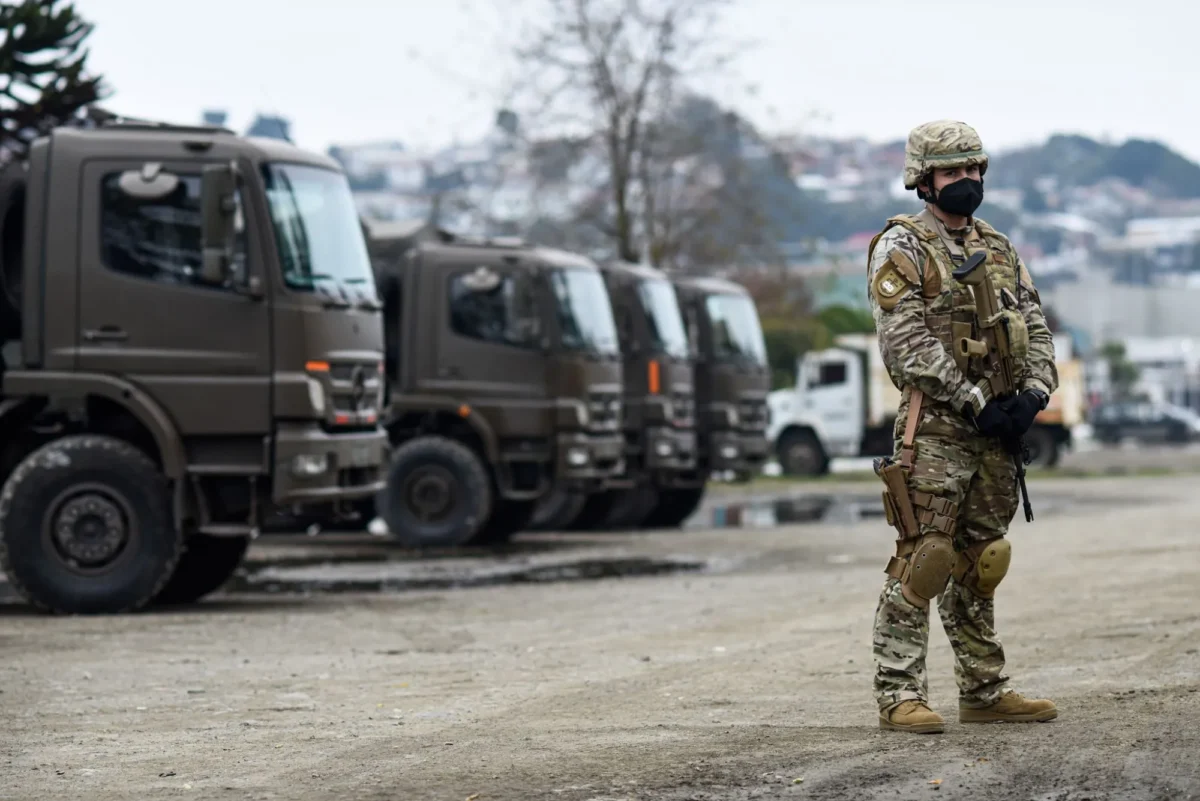
The Armed Forces are also short of soldiers and marines, which are necessary to sustain current efforts in the Southern Macrozone and the Northern and Northeastern borders. This is something known by the political world, but it is an issue that has not been acted upon as it primarily involves financing that has not been available. The professional troop numbers are around one thousand, and the conscripts do not exceed ten thousand between the two contingents. This greatly limits what can be done and forces the use of highly qualified military personnel in police-type tasks, which is demotivating, while also neglecting training in the main area: the operation of weapon systems, tanks, artillery, and other capabilities available to the Chilean Army.
On the other hand, the Chilean Navy’s Marine Corps, due to the fact that deployments to the Southern Macrozone have ceased to be exceptional, has been significantly losing personnel, who leave the institution for better job opportunities in the private sector. Being constantly assigned to the Southern Macrozone results in lower incomes for their families due to the minimal compensation they receive when sent to that area, prompting them to seek more lucrative options in the timber industry or jobs that allow them to spend more time with their families.
For a long time, efforts have been made to increase their salaries, especially at the lower ranks and particularly for the infantry, to make prolonged efforts like those they face more sustainable, but this is still pending authorization from Defense and Finance. If we want to have forces permanently deployed in the south, we must be willing to bear the associated costs.
We cannot continue with deployments both at the borders and in the provinces of Arauco, Biobío, Cautín, and Malleco without addressing the conditions in which our military personnel work, who, it should be noted, earn less than their police or gendarmerie counterparts. It may be time to finally resolve the situation in the Southern Macrozone, which could free up the human resources needed at the borders to implement the plans of the elected President, actions that, with technology alone but without soldiers, will not be very effective. It is time for politicians and those working in Defense to understand this.
The new authorities of National Defense should also pay attention to ensuring that the funds committed in the 2026 Budget are allocated to the accounts used for financing strategic capabilities, as well as the contingency fund considered by the law on financing strategic capabilities. Chile still has material in good condition, but the issue is maintaining those capabilities for the future. The Chilean Army must invest to ensure that its tanks, artillery, helicopters, transport aircraft, command and control capabilities, among others, along with all the necessary logistics, do not lose their relevance and are modernized in accordance with advances in military technology.
On the other hand, the Air Force needs to invest in its fleet of F-16s, which are well maintained and in good condition, but require investments to continue ensuring the air superiority they have provided us thus far. The new acquisitions in the region are of generation 4.5, while ours are 4.0. We are not talking about having F-22s or F-35s, but we do need our F-16s to be upgraded to generation 4.5.
The case of the Navy is somewhat more complex; we need to promptly resolve how we will renew the eight units of the Squadron, the four of the Submarine Force, and the maritime units, in addition to the naval aviation material and that of the Marine Corps. For now, there is a plan to build four logistical vessels, with the first two financed and under construction, but not the others.
Clearly, the law on financing strategic capabilities is insufficient to address the reality facing the Navy, something that the new Defense authorities will have to figure out how to resolve. We are a maritime country that requires a strong Navy. Our national interests extend beyond the exclusive economic zone, and for that, a naval force is required, which must obviously include submarines, as they, along with the F-16s, provide unique strategic capabilities to Chile and its defense.
Before concluding, something not to be overlooked: we gain nothing from having modern operational and trained material if the levels of ammunition are not adequate. I recommend that the new administration pay attention and review whether we are at the appropriate level. Purchases made now for more complex and sophisticated items (for example, missiles) can take up to four years to arrive in Chile. I suspect we have an issue to resolve here, and if we were to face an emergency tomorrow, we would not be at the recommended levels. It is like having a gun without bullets or only a few in the chamber.
In summary, the challenges of National Defense lie both in budgetary and logistical aspects, but above all, in its personnel, whose numbers are insufficient for all that is required of them, and clearly not well compensated. This goes beyond the assistance provided to public security, border protection, and the control of insurgency in the Southern Macrozone. We are talking about the primary and essential capacity for the defense of sovereignty, territory, seas, and air and space of Chile, and its national interests wherever they may be located.
“To the principal, the maximum, and to the rest, the necessary.”