Presidential Responsibility for National Defense
This article was translated automatically and may contain differences from the original. For reference, read the original.
- por Richard Kouyoumdjian
- Columnas
We hope that the emergency government, one that promises to be action-oriented, will take the bull by the horns and address the situation in which it receives the Armed Forces and the strategic capabilities of National Defense.
All recent governments, except the one currently ending, have made significant contributions to the maintenance or recovery of strategic capabilities for National Defense.
The government that concludes on March 11, 2026, literally did nothing of importance. It limited itself to so-called continuity budgets, which amounted to providing the minimum to the Armed Forces and partially fulfilling the requirements established by the law on financing strategic capabilities. There were no purchases of ships or submarines, or of aerial or military material, as there were in previous administrations.
While it is true that this government signed the naval construction policy and stated that the renewal of the Fleet should take place in national shipyards, this action did not manifest in the signing of decrees that would allow, among other things, the construction and financing of logistical ships 3 and 4 of the Escotillón IV project, or the replacement of the 209 submarines, or the replacement of the Williams frigate, and many other things in the maritime or aeronaval domain.
Regarding aerial material, the E-3 Sentry aircraft of the FACH were managed by Piñera’s second government and received during the first year of the current administration. I have serious doubts that funding was allocated for the modernization of the F-16 MLU and Block 50, and for the replacement of the older helicopters of the Air Force. In the case of the Army, aside from purchases of rolling stock, I have no records of the renewal of armored vehicles or materials such as drones and missiles that provide significant operational capabilities.
There were minor purchases of materials for border surveillance, and while the FACH space center was inaugurated during this government, it was authorized and financed in the second government of President Piñera, who, despite having to govern a country stressed by the pandemic and social-criminal upheavals, still purchased the Australian frigates that became known as Prat and Latorre, and signed the decree for the construction of the first two logistical ships intended to replace the Aldea, Aquiles, and the two barges.
The days when Presidents Frei and Lagos authorized and financed the purchases of submarines, frigates, F-16 aircraft, Leopard 1 and 2 tanks, Marder armored vehicles, 155mm self-propelled artillery pieces, command and control systems, and many other things, including the corresponding levels of ammunition, are long gone.
Bachelet, who had been Minister of Defense under Lagos and had studies in the field, participated in the aforementioned processes, and if I am not mistaken, had some involvement with the scientific vessel Cabo de Hornos and the icebreaker Viel.
It is true that in the late 1990s and early 2000s there were very interesting offers in the markets, but what is important is that they acted with a state vision and looking at the long term. They understood the importance of National Defense as a guarantor of our sovereignty, as protectors of Chile’s territory, seas, air, and space, as well as its national interests wherever they may be located.
In his first government, Sebastián Piñera did not hesitate to rebuild the Naval Base of Talcahuano and all that was damaged by the tsunami of February 27, 2010.He also ensured that naval power was in a position to effectively deter Peru during the time of the dispute in The Hague, as there was a possibility that they might become enthusiastic about the outcome and seek more.
We could continue indefinitely demonstrating all that was accomplished in previous governments and the little or nothing that this outgoing government did for the strategic capabilities of National Defense, which adds to the poor hunger budgets with which the Armed Forces have had to operate. The current government claimed that its priority was the sanitation of public finances, but that is only partially correct.
The social area did not experience impacts on its budgets, but on the other hand, the Armed Forces had no issues adjusting their operational budget,or not authorizing renewal or maintenance projects for capabilities despite the availability of funds from the law on financing strategic capabilities.
We literally lost four years. This is something that the elected President and his recently appointed Minister of National Defense will have to address. Of course, there are emergencies in the areas of security and the economy, but we are also on the brink of a situation regarding the strategic capabilities of Chile.
If nothing is done, very soon, and sooner than expected, we will have to begin decommissioning submarines and frigates, as well as material from the Army and the Air Force. It is no longer a matter of managing their replacement. We are talking about outright losing capabilities that have provided us with more than 20 years of peace and tranquility,and whose subsequent reacquisition will clearly be more expensive if not done now in an orderly and planned manner.
Continuity budgets coupled with disinvestment in defense are not a good idea, something we hope the new government will address and correct promptly. We do not have another four years, and we must take action immediately. We are not talking about completing the funds for strategic capabilities or contingency accounts. We are talking about taking action, signing decrees, and moving forward.
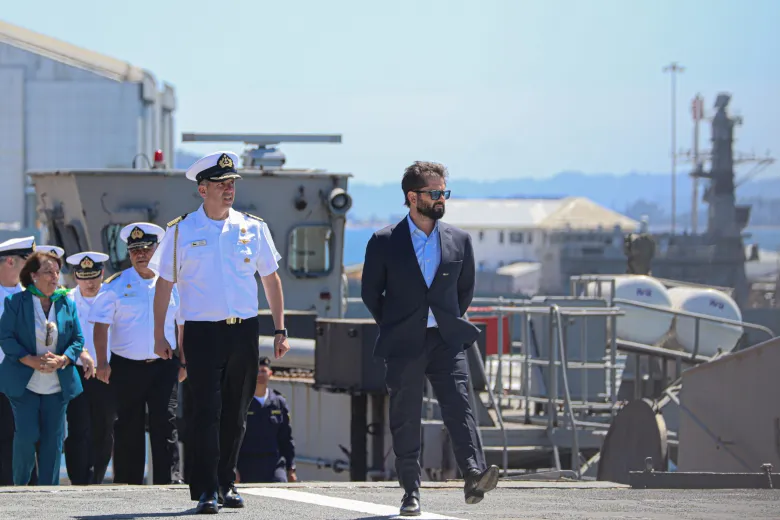
The outgoing president accused the new administration of wanting to take photos with inaugurations financed by his government, but he forgets that in terms of defense, he took photos at the reception of the Viel into naval service, or at the National Space Center, both authorized and financed by previous governments, giving the impression of doing many things, but having nothing of his own.
We hope that the emergency government, one that promises to be action-oriented, will take the bull by the horns and address the situation in which it receives the Armed Forces and the strategic capabilities of National Defense.