COLUMN | The Defeat of Iran and Checkmate to the Chinese
This article was translated automatically and may contain differences from the original. For reference, read the original.
- by Richard Kouyoumdjian
- Opinion
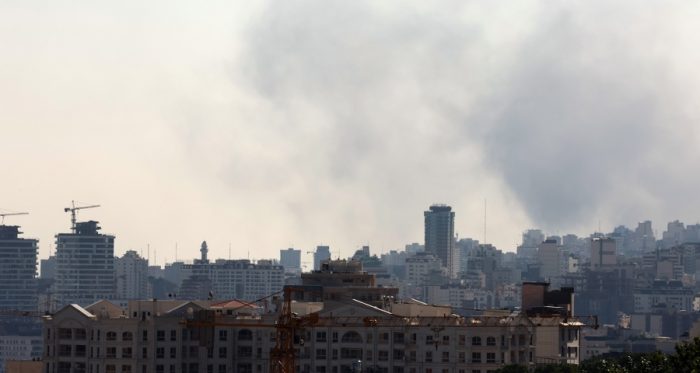
No one, not even the Chinese or the Russians, has come forward to lament Iran, a country that has not only managed to alienate two of the world's major military powers but also a significant portion of its neighbors. All indications suggest that the days of the clerics are numbered.
We had barely emerged from the Chinese Cablegate affair when we found that the United States and Israel had launched an attack on Iran in the early hours of Saturday, February 28. This was anticipated due to the concentration of naval and air forces in the Middle East and nearby seas, the coordination meetings between high-ranking officials of both countries, and the signals that Iran was not yielding in negotiations regarding its capabilities to produce nuclear weapons, as well as medium- and long-range ballistic missiles necessary to target Israeli interests or American interests in the Middle East, whether with nuclear or conventional warheads.
In short, Iran’s fundamental objective since the Shiite clerics’ revolution in 1979 has been the elimination of the nation-states of Americans and Jews. Since it has no borders with either country, achieving this requires ballistic missiles, preferably with nuclear warheads, as otherwise, their objective becomes more difficult to attain.
For all intents and purposes, an undeclared state of war has existed for the past 47 years between Iran on one side and Americans and Israelis on the other. However, in the last two years, triggered by the attack on October 7, 2023, which had the support and financing of Iran, the duo has entered active mode. First, in 2024, testing the capabilities of Iranian air defenses of Russian origin, and in 2025, seeking to eliminate nuclear weapons production capabilities, and more recently, to eliminate production, storage, and ballistic missile capabilities, along with whatever remains of nuclear capabilities.
To achieve the above, Operation ‘Epic Fury’ (the American version) or ‘Lion’s Roar’ (the Israeli version) has had to go beyond simply eliminating missile launchers or locations where nuclear issues have continued to be worked on. They have determined that it is necessary to neutralize or eliminate the leadership of the clerics that has led Iran down this path and will continue to do so until the ayatollahs surrender and cease to have political power or the capacity to return to their anti-American or anti-Israel activities.
If it were as simple as eliminating launch sites, storage, or missile manufacturing facilities, they would already be very close to achieving their objective. As of noon on March 5, it is observed that Iran is losing speed and capacity, nearing a knockout, completely dominated by the deployed capabilities and technologies, but not dead or without the possibility of revival. This is why allies will continue to apply pressure, killing their leaders or those who replace the fallen, eliminating clerics and anything that seems related to the Revolutionary Guard, armed forces, and militias.
It is said that the members of the warring duo differ in their objectives, but I do not share that opinion. Both seek to ensure that Iran never has the capacity to produce nuclear weapons and the possibility of attacking them with missiles armed with nuclear warheads, and eventually drones if they are developed. The issue is that for Israel, this is existential, while for the United States, it is important but not a matter of life or death. It is simply a matter of distances.
The elimination of Iranian warships operating outside the Persian Gulf or the Gulf of Oman, such as the frigate Dena, is a way to demonstrate that this is serious and that the ongoing operation aims to be definitive.
In any case, no one, not even the Chinese or the Russians, has come forward to lament Iran, a country that has not only managed to alienate two of the world’s major military powers but also a significant portion of its neighbors. All indications suggest that the days of the clerics are numbered, although it remains unclear who or what will replace them, a replacement that will not come with the capacity to manufacture nuclear weapons or the missiles necessary to threaten Israel or nearby countries.
While it is true that many applaud the actions of the United States and its Israeli allies, others observe with concern the military capabilities and technologies deployed, as well as what they have demonstrated regarding intelligence and special operations. The chasm that is opening between these two countries and the rest of the world is something I believe will last a long time. Both are champions of innovation, technological disruption, technology and engineering, digital advancements, and everything related to cyber. This goes beyond Trump or Netanyahu; it is the result of years of investment that are now paying off.
Chinese or Russian weapon systems have proven ineffective; middle powers have no way to oppose the will of the United States, which, despite all the capabilities it has demonstrated, does not intend to dominate the world but only seeks to ensure that its national security is not compromised, even granting a free hand to the Chinese and Russians in their respective spheres of influence as long as they do not affect its interests and security.
It remains to be seen whether the solution requires ground troops, something that does not appeal to Americans, who have already suffered six casualties at the time of writing. However, for the first time, I believe that the combination of air and naval assets, along with intelligence and special operations capabilities, can achieve the objective and allow for the desired final state without having to expose their ground armies, where most casualties occur. I do not blame alliance leadership when they do not precisely define the objectives they seek or when they are asked for clarity regarding timelines. We are facing a change in the character of war, a character that we have yet to fully understand, though its nature remains political, violent, and driven by will.
To conclude, something that is not so obvious. The big loser in this military action is China, which has already lost access to Venezuelan oil, oil that, along with Iranian oil, accounts for just under 18% of its imports, which it imported cheaply due to sanctions. If we add to this the fact that 50% of the oil it imports passes through the Strait of Hormuz, we could say that China has a serious problem because all indications suggest that the Persian Gulf, the Gulf of Oman, and the Strait of Hormuz will remain under the control of the United States. Checkmate from Trump to Xi.