COLUMN | Trump-Kim Summit: Denuclearization, Not for Now
This article was translated automatically and may contain differences from the original. For reference, read the original.
Juan Pablo Toro
El Mercurio, February 24, 2020
Trump, who now offers Kim a deal that Nicolás Maduro would envy, stated this week that he is in no rush, as North Korea has suspended its nuclear and missile tests.
A socialist dictatorship that keeps its population in a constant humanitarian crisis, supported by China, and thrives on threatening its immediate neighbor, which is an ally of the United States.
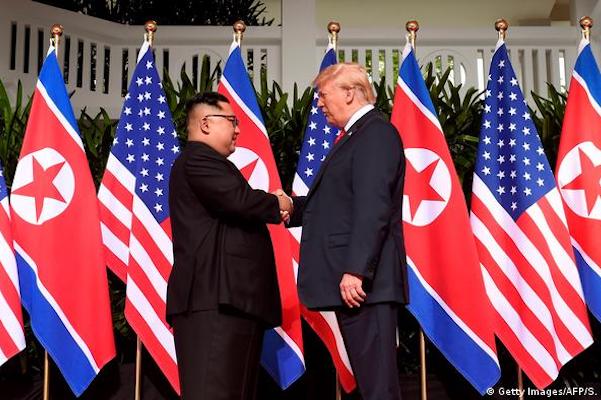
So far, the script is dangerously similar, but this is not about Venezuela; it is about North Korea. A country that possesses atomic bombs—therefore, a threat to global security that deserves to be taken seriously—and which will soon be back in the spotlight when its leader Kim Jong-un and U.S. President Donald Trump meet in symbolic Vietnam next Wednesday and Thursday. This summit should have as a condition for real success the taking of concrete steps toward the denuclearization of the Korean Peninsula.
As the meeting approaches, international media have begun circulating reports about the potential outcomes of the second Kim-Trump face-to-face: the opening of diplomatic representations in both countries—which would not have embassy status—and the decision to sign a peace treaty to end the war (1950-1953) in place of the current armistice.
The weight of Vietnam’s history should help; a communist country that fought an intense war against the United States and has now become a dynamic and proud exporting economy. Last year, it welcomed the aircraft carrier “USS Carl Vinson” in a message to China, with which it has territorial disputes.
Other concessions being discussed would include the destruction of a nuclear material factory in North Korea and the reopening of the Kaesong complex, an industrial park that is easily visible from observation posts along the 38th parallel, whose access has been blocked from South Korea in retaliation for its neighbor’s nuclear activities.
Trump, who now offers Kim a deal that Nicolás Maduro would envy—though the contradictions should no longer surprise in his administration—stated this week that he “is in no rush,” as North Korea has suspended its nuclear and missile tests. “If there is evidence, that is another deal,” he explained.
After criticizing those who doubted the outcome of the Singapore summit in June 2018 due to the ambiguity of the results (continuing to talk without a timeline), his own insinuations about the Nobel Peace Prize, and reports of undeclared North Korean missile bases, it is reasonable for the U.S. president to want to temper expectations.
Although the meeting itself is great news, the reality is that once the cameras are off, the evaluation of the outcome of the Hanoi meeting will be more demanding than that which followed Singapore.
It is realistic to think, then, that the goal of denuclearization will still be distant if North Korea does not receive greater relief from the economic sanctions against it—something that Seoul also desires to reconnect with its neighbor—and a package of humanitarian aid that it is formally requesting from the international community (another contrast).
New measures such as the peace treaty and the opening of diplomatic representations will undoubtedly be a step forward. However, it would be a partial achievement in deactivating one of the most contentious points in the Indo-Pacific, a region that is the dynamo of the global economy. Regardless of what happens in Hanoi, Kim will receive a new formal diplomatic recognition, which is already a net gain for his survival and that of his regime supported by its nuclear power.
Juan Pablo Toro V. is the executive director of AthenaLab.


