COLUMN | Reflections on this Contingency
This article was translated automatically and may contain differences from the original. For reference, read the original.
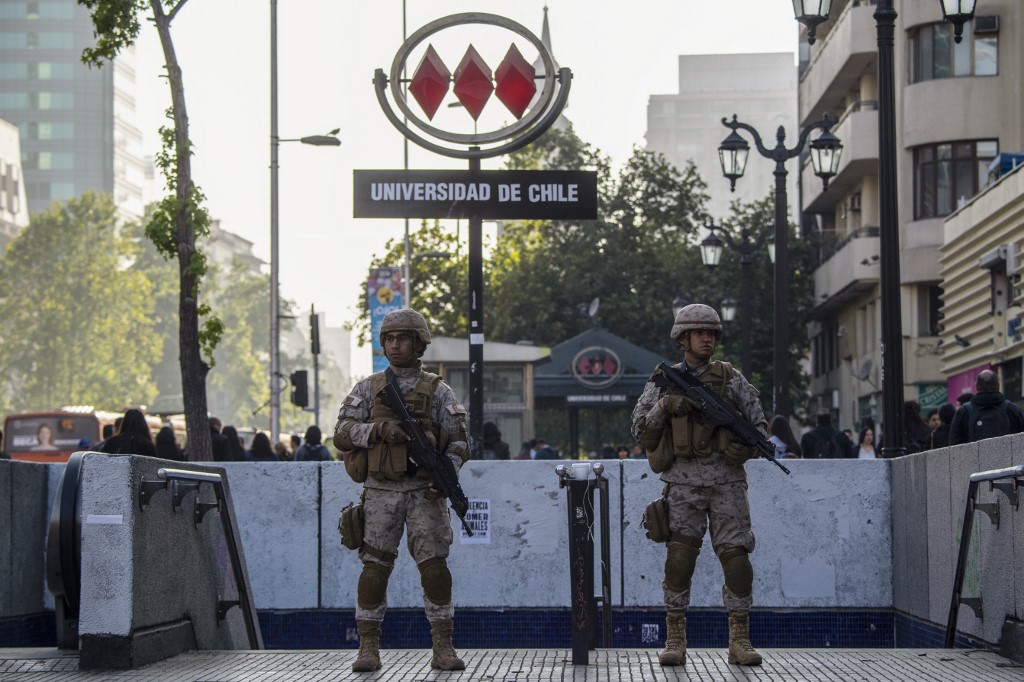
El Mostrador, October 23, 2019
RICHARD KOUYOUMDJIAN
This column was written on Tuesday, October 22, and it has only been 5 days since we entered contingency mode. I have the following reflections to share with you regarding the tragedy that affects us, which has resulted in deaths, injuries, destruction of public and private property, and a tremendous wound that I hope we can quickly repair:
1) The Role of the Armed Forces:
In the circumstances the country is experiencing, it is worth recalling the purpose of the armed forces, whose main function is the defense of the territory, the sea of Chile, and the protection of national interests wherever they may be located. Achieving this allows us to be sovereign, politically independent, enjoy democracy, and move towards inclusive sustainable development that includes all Chileans.
The constitution, in its article 101, states that the armed forces exist for the defense of the homeland and are essential for national security. Recent events indicate that national security can be at risk not only due to potential aggression from other countries but also from internal and external factors, or worse, the combination of both.
The armed forces are required when exceptional circumstances, ranging from war to natural disasters, demand their services, whether to defend us from external aggression, restore order when disorder exceeds the capabilities of law enforcement and security forces, or assist Chileans affected by the harshness of nature.
The armed forces report to the executive branch, which is a civil and political power. They act under the instructions of the President of the Republic and do not operate independently. When they intervene in exceptional circumstances, it is because the president has ordered it, and therefore we must allow the defense chiefs and their troops to perform their duties, which in this instance is to restore order and public safety, but we should not expect them to behave like politicians or hold them accountable for political decisions they did not make.
When the armed forces intervene, it is because clearly the other political solutions have proven ineffective, and the executive decides to resort to the power of arms.
2) The Need for Good and Timely Intelligence:
The incidents and civil disorder occurring remind us of the need for good and timely intelligence that allows us to anticipate rather than react. Perhaps it is time to advance with the modification and modernization of the intelligence law that the government, particularly Minister Alberto Espina, has been promoting, and perhaps we should also move forward with the reconstruction of national intelligence services, including the ability to accurately assess what is happening in Chile, as I do not believe anyone wants to repeat past mistakes. Lacking intelligence means navigating blind in terms of national security, and having intelligence services that operate in isolation or with limited capabilities in current times is highly risky and undesirable.
3) National Security:
I understand that few people like the concept of national security, but after all these days, I still do not understand why the National Security Council (COSENA) has not been convened, which is the constitutional body that should be functioning and advising the president in circumstances like the current ones.
In relation to the above, the current situation in Chile makes us think about the necessity for the president to have a national security advisor, who should be capable, with their team, of understanding the internal and external landscape from a security perspective as a whole, demanding good intelligence information, knowing how to use it, and thereby anticipating events that could put the Chilean nation at risk, advising the executive both on the effects of public policies on national security and on how to manage situations that are not entirely normal.
The world and the current reality are too complex to navigate without good intelligence and without a national security advisor.
4) The Responsibility for What Happens on the Streets:
How do I explain to a soldier, a sailor, a marine, or an aviator that they will be prosecuted and brought to justice for having unintentionally or fortuitously injured or killed a fellow citizen in a state of exception, a state they did not trigger or choose, and where the armed forces are called to restore order and public safety because the president of the republic ordered it, who, by the way, is obligated to do so due to their constitutional duties?
It is not easy to be a soldier and be on the streets trying to restore normalcy. The application of the rules of engagement (ROE) is not always clear and precise, especially when we are talking about human beings who tire, lose patience when provoked for too long, have to impose curfews at night, control the unruly, looters, and vandals, and everything that entails performing such a job.
Of all the constitutional states of exception, the state of emergency is the most difficult to manage. It is not the state of catastrophe where you go to help and control looting, but one where, in general, the vast majority are happy to receive you. In states of assembly (external war) and siege (internal war or serious internal unrest), the very gravity of the events helps make the rules of operation clearer and more precise, as well as the powers granted to the armed forces. The state of emergency is complex as it also involves complicated public disorder, but which does not qualify according to the authority for a state of siege, a state that also requires approval from the national congress, which in this instance is unrealistic. This leaves us having to manage the public emergency with limited tools that may not align with the circumstances, where arms can only be used in self-defense.
Having clarified the complexity of operating in a state of emergency, we must add that we are using the armed forces as the main component of the solution and the police as a complement. The armed forces are prepared for war, and their specialization is not in containing individuals participating in civil disorder. They have considerable experience in disaster response, but as previously indicated, that is not the same, and perhaps only those who participated in the peace mission in Haiti gained practical experience in managing and containing people in complex situations.
The questions one must ask are not very complex, but they are illustrative. What do I do if someone is violating the curfew, does not obey, and assaults the military force? How do I react and act to fulfill the legal mandate to impose order and security? How do I behave if I am faced with vandalism or theft in progress? What happens if people do not stop? How do I prevent the crime from continuing? It is the situation and those who are violating the law that create the problems. It is not the armed forces that are setting the prairie on fire; they are only trying to lower the temperature so that substantive solutions can be discussed and agreed upon. Those who are very wrong are those who take it out on the soldiers, sailors, marines, and aviators, as they are merely following orders, the order to restore order and public safety.
Gonzalo Vial wrote in the second section about similar uprisings that occurred in 1949 and 1957, known as the Battle of the Chaucha and the Battle of April 2, respectively, where unfortunately many were injured and killed, but which demonstrates that situations like those we are experiencing these days can end very badly if not managed well or if solutions are sought solely through the use of arms as was done in the past.
Having clarified that on the street, things are different, I only ask that we do not make life more complicated for those we ask to restore order and public safety, because if we do not, perhaps few or none of them will want to do it again in the future if the situation demands it.
Richard Kouyoumdjian
Vice President AthenaLab
Source: El Mostrador


