COLUMN | Models to Assemble
This article was translated automatically and may contain differences from the original. For reference, read the original.

El Mercurio, Saturday, December 28, 2019
One of the few certainties we have in these times is that given the turbulence affecting countries in Latin America, there is not much to copy from neighboring nations when it comes to seeking a new development model or, better yet, optimizing one’s own if it yields good results. Therefore, all eyes today are on Europe or the Asia-Pacific region. Thus, names like New Zealand, the Netherlands, and South Korea begin to emerge.
In a way, it is considered that all these liberal democracies have managed to reach a threshold of stability and quality of life for their societies thanks to policies that simultaneously combine criteria such as inclusivity, efficiency, and transparency.
However, having had the opportunity to visit the three countries, I would dare to say that another asset they all share is that when problems arise, social actors, rather than seeking blame, tend to focus their debates on finding solutions within a framework of respect for coexistence and the rule of law. The first-person plural tends to prevail over the ‘I,’ which has today transformed into ‘my opinion, my truth.’
Francis Fukuyama wondered a few years ago how we could reach Denmark, assuming that ‘Getting to Denmark’ is a kind of ideal that societies sharing democratic ideals aspire to. After reviewing various cases of modernization, he concluded that in Europe, social development preceded political development, so the institutions created sought to preserve individual rights and duties while allowing space for the state in those aspects deemed better addressed collectively, for both practical and egalitarian reasons (although the latter has been its effect).
It may even be that German Ursula von der Leyen has tried to crystallize this idea by establishing as one of the priorities of the European Commission, which she has presided over since early December, the ‘promotion of a European way of life,’ which centers on respect for the rule of law to defend values such as freedom, equality, justice, and human dignity. Undoubtedly, something less inspiring than the ‘American dream’ (individual progress based on equality of opportunity, which is highly questioned these days) or less ambitious than the ‘Chinese dream’ (a ‘modestly well-off’ society under strict political control), but much more practical, given that the issue of identity in the EU is very complex.
If we learned anything from the 20th century, it is that the failure of nation-building processes occurred due to attempts to transplant institutions without recognizing the uniqueness of societies. Likewise, it was a poor business to follow the dreams of others, especially if they were cloaked in totalitarian ideologies that lead to economic ruin.
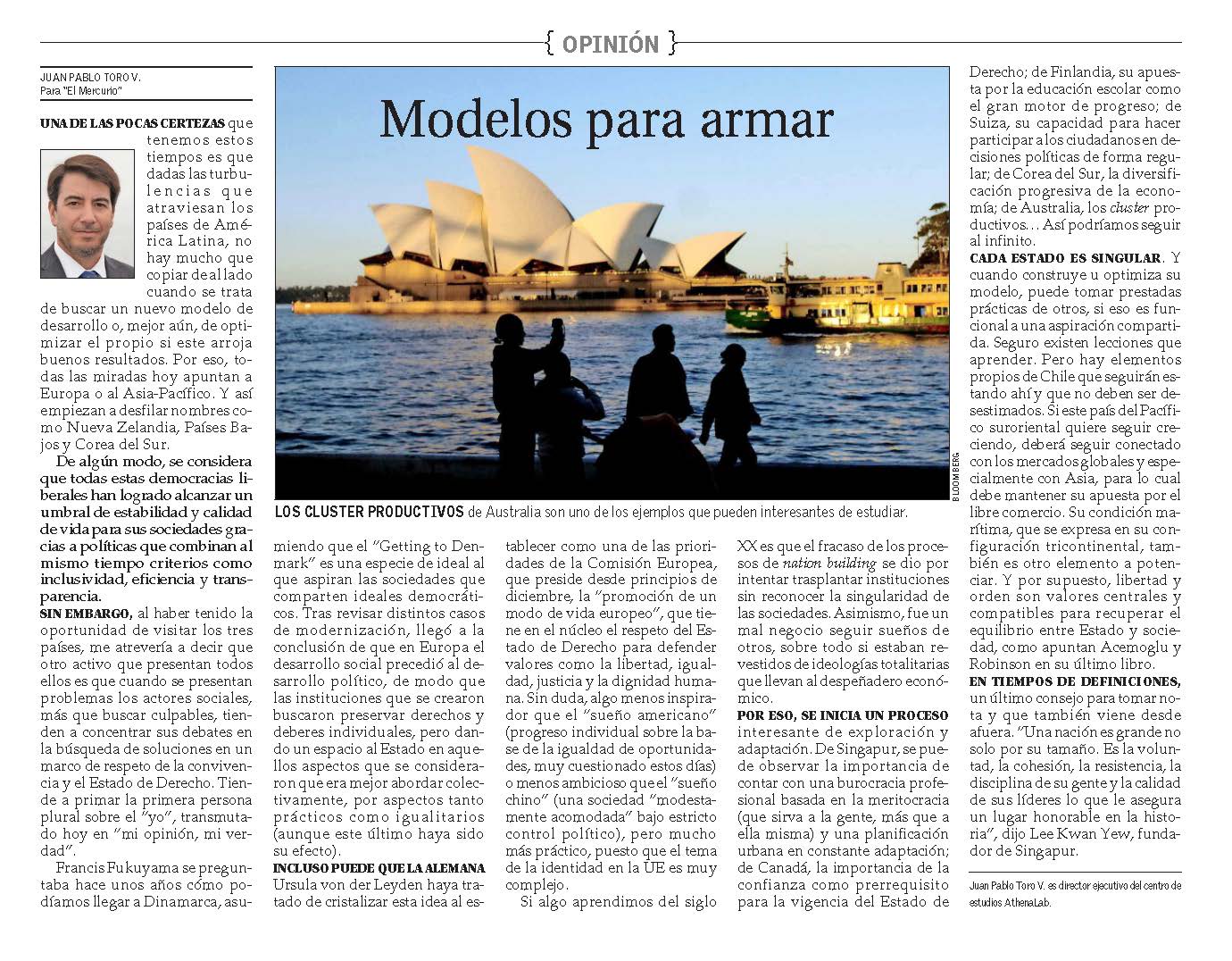
Therefore, an interesting process of exploration and adaptation begins. From Singapore, one can observe the importance of having a professional bureaucracy based on meritocracy (serving the people rather than itself) and urban planning that is constantly adapting; from Canada, the importance of trust as a prerequisite for the rule of law; from Finland, its commitment to school education as the great engine of progress; from Switzerland, its ability to regularly involve citizens in political decisions; from South Korea, the progressive diversification of the economy; from Australia, productive clusters… We could continue indefinitely.
Each state is unique. And when it builds or optimizes its model, it can borrow practices from others if they are functional to a shared aspiration. There are certainly lessons to be learned. But there are elements unique to Chile that will remain and should not be dismissed. If this country in the southeastern Pacific wants to continue growing, it must stay connected to global markets, especially with Asia, for which it must maintain its commitment to free trade. Its maritime condition, expressed in its tricontinental configuration, is also another element to enhance. And of course, freedom and order are central and compatible values to restore the balance between the state and society, as Acemoglu and Robinson point out in their latest book.
In times of definitions, one last piece of advice to take note of, which also comes from abroad. ‘A nation is great not only by its size. It is the will, the cohesion, the resilience, the discipline of its people, and the quality of its leaders that ensures it an honorable place in history,’ said Lee Kwan Yew, founder of Singapore.
Juan Pablo Toro V.
Executive Director of the AthenaLab think tank.