Effective Human Rights Policy: General Considerations on the Use of Military Force in La Araucanía
This article was translated automatically and may contain differences from the original. For reference, read the original.
El Mostrador, February 28, 2021
The emphasis on the existing violence problem in La Araucanía must be resolved primarily through strong political will to enforce law and order, without undermining the rule of law for all. This requires the full weight of the law from the judiciary and resolute political support for law enforcement and public security forces. Adequate effective intelligence is necessary to provide clear situational awareness and to supply evidence regarding the nature of the problem. What Admiral Vergara referred to as the consensus among politicians, prosecutors, and judges, along with an effective human rights policy, must apply to everyone.
Traditionally, there is a tendency to believe that the use of military force is an effective and quick tool to address multiple phenomena, without necessarily considering the nature and character of the problem we face.
As a hypothesis, we could suggest that if the problem we face has a military nature and character, the use of force will be the most appropriate, acting in conjunction with other means that the State possesses and are referred to as instruments of power. Political, diplomatic, economic, technological, and communicational tools will then be employed to support the emphasis on the military use of force.
However, if the phenomenon or problem to be resolved is not of a military nature and character, force may be used, but not with the emphasis on other more appropriate instruments of power for effective problem resolution. In other words, military force contributes its specific capabilities to “create the conditions for success” in a maneuver that is essentially political.
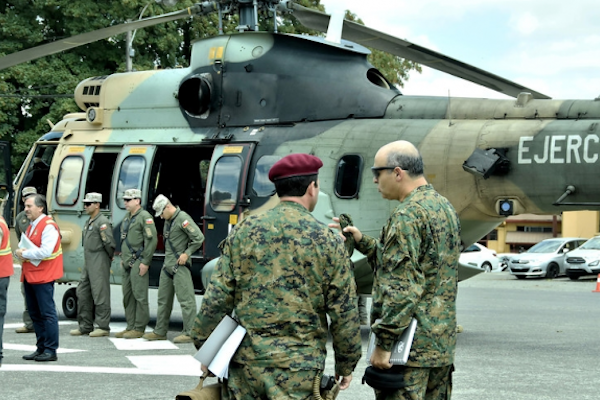
The previous preamble is necessary to state since military participation (Armed Forces) is currently being executed in La Araucanía alongside law enforcement and security forces (Carabineros and Investigations), among other actors.
A primary question to answer would be: What is the nature of the problem we face? Is it essentially military in nature, or is it fundamentally political with various facets: ethnic, criminal due to timber theft, violence from various groups that consider themselves outside the law, etc.? Is it subversion, terrorism, urban guerrilla warfare, or all of the above? If the clearest aspect is the violence of organized groups outside the law, the solution must involve the use of power instruments with an emphasis on law enforcement and public security forces, alongside the rule of law and adequate intelligence to detain and prosecute those responsible for such violence and for undermining the rule of law, harming innocent citizens. Additionally, a good level of intelligence is the most appropriate tool to determine not only the financing of violent groups outside the law but also to clarify the nature of the conflict. This requires the political will to want to solve and not merely manage the problem.
If, despite identifying and defining the problem as a phenomenon that is essentially not military, we still wish to use force, we should at least keep in mind, among many other considerations, the following precautions:
- How will we address the coherence between the military area of responsibility and the administrative and judicial area present throughout the territory where police and military actions will take place? Especially when, in the face of a potential “State of Constitutional Exception, of Siege,” it will operate for the first time in the context of a new judicial system, with various local administrative jurisdictions.
- Who will exercise total coordination of the employed means? The means of the Armed Forces and those of law enforcement and public security, along with all governmental actors and organizations in the area. There will be a General Headquarters with command, coordination, and control for the entire operation, with a clear and precise situational overview that enables all forces to be integrated into a common framework.
- What will be the command relationship among the forces? Who will exercise command throughout the entire chain of command of the deployed forces? For example, in a mixed patrol, who will be the commander to obey? Will police doctrine or military doctrine take precedence? And if one or the other prevails, is the entire force capable of employing it? Have they been trained for it? Are the means and procedures integrated, trained, and coordinated, along with the well-known rules of engagement? Is the logistical solution for supporting the entire force defined?
- We must not forget that the operation will take place in a territory where the center of gravity of operations will be more communicational and will demand winning the hearts and minds of the population that inhabits it. Legitimacy and local support are essential for the success of the operation, in which, if force is to be employed, it must be used surgically. Especially when the military deployment is in one’s own territory and with fellow citizens, this is vital.
- Who and how will information or intelligence be provided in the area of employment? Which organization will coordinate the various platforms, sources, and available means?
- Who will exercise or assume responsibility for the operation, given the potential collateral damage it entails? It cannot be assumed that the use of military force will be without consequences.
We could detail many other questions, but the purpose of the above is merely to reflect that the art of using force is to appropriately emphasize the combination of various elements or instruments of state power according to the phenomenon to be resolved. It is very simple and tempting to use military force, but even the most powerful armies have not been able to overcome phenomena such as terrorism, subversion, or guerrilla warfare, as these are essentially more political than military problems, more about mental struggle than traditional force, less kinetic and more communicational. The lesson was harshly learned in Iraq when the conflict shifted from a military nature to a civil war, with terrorism as the primary technique or weapon against military forces.
We dare to propose that the emphasis on the existing violence problem in La Araucanía must be resolved primarily through strong political will to enforce law and order, without undermining the rule of law for all. This requires the full weight of the law from the judiciary and resolute political support for law enforcement and public security forces. Adequate effective intelligence is necessary to provide clear situational awareness and to supply evidence regarding the nature of the problem. What Admiral Vergara referred to as the consensus among politicians, prosecutors, and judges, along with an effective human rights policy, must apply to everyone.
It is important to add that as crucial as having good specialists in diplomacy, technology, and economics, the 21st century, along with the particular challenges facing our nation, will demand specialists in security and defense to confront the threats we are already experiencing and their proper professional and academic training, which remains a goal on the horizon. If there were today a critical mass of such specialists, we would be in a better position to find more effective solutions.
Another significant aspect is to point out that if we indeed had a permanent Security Council, the monitoring, foresight, and solutions to the serious security problems we currently face as a country would have reasonable chances of greater success, benefiting not only the political decision-making process but also the security, development, and well-being of all Chileans.
John Griffiths
Head of Security and Defense Studies AthenaLab


