The Argentine Ambassador and the Principle of Non-Intervention
This article was translated automatically and may contain differences from the original. For reference, read the original.
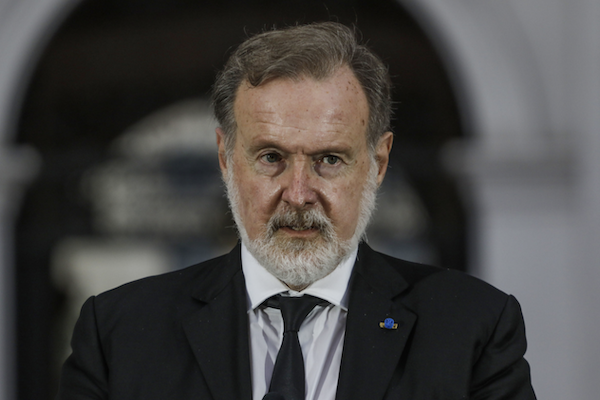
El Líbero, November 23, 2021
Bilateral relations between Chile and Argentina are too important to be left at the mercy of the outbursts of a single official.
As if he were in a private conversation with the “friends of the relationship with Argentina,” in an interview with a local media outlet, Ambassador Rafael Bielsa described presidential candidate José Antonio Kast as “rupturist,” “Pinochetist,” “anti-Argentine,” and “xenophobic,” allowing himself much more than an outburst: he has engaged in a direct (and unnecessary) intervention in Chilean internal affairs.
Mr. Bielsa ignores or pretends to ignore (or does not care) that, among the obligations of the diplomatic corps, the Vienna Convention on Diplomatic Relations expressly states that these agents are “obligated not to interfere in the affairs” of the country in which they are accredited. This obligation underpins not only the privileges and exemptions of diplomats but also—very importantly—their immunity.
The Argentine ambassador’s intervention in Chilean internal affairs has been so crude and unnecessary that it has forced an almost immediate statement from our Foreign Ministry, in which the government has found itself in the uncomfortable position of rejecting his attitude and statements. In context, this should be understood as a warning: the next step, in accordance with the same Vienna Convention, is to declare him “persona non grata.” The impact on the bilateral relationship would be very serious.
We all know that the principle of non-intervention in the internal affairs of another state is a pillar of the international system. Without respect for this principle, relations between states would not only be chaotic but also perpetually favorable to “the stronger.” For this reason, both the OAS (Art. 19 of its “Charter”) and the United Nations (UN Resolution 2131 (XX)) have recognized non-intervention as a requirement sine qua non for the functioning of international relations. None of this seems to matter to Mr. Bielsa.
Bilateral relations between Chile and Argentina are too important to be left at the mercy of the outbursts of a single official. While it is true that these relations are complex (and sometimes difficult and harsh), the fact is that both countries must strive to keep communication channels open to dialogue, solve problems, collaborate, and coordinate mutually beneficial actions. From this perspective, the condition to which Mr. Bielsa has subjected himself does not contribute to the healthy development of the Chilean-Argentine relationship. An issue so relevant to millions of citizens on both sides of the international border cannot be subjected to the sympathies or antipathies of a single official, whose obligation—moreover—is not to divide or separate, but to bring closer together.
In Argentina and Chile, there are all kinds of opinions regarding the type of relationship that suits us. Even the current Vice President of Argentina has allowed herself, for example, to state that her country “must have” a “sovereign outlet to the Pacific Ocean.” If Chile were to condition the bilateral relationship on obtaining a “clarification” on this matter, it is possible that we would enter a state of status quo that, among other collateral effects, would produce a line of tens of kilometers of cars and trucks stopped on both sides of the border. That is not the idea.
Whatever the outcome of the presidential runoff on December 19, the diplomatic officials who bear great responsibilities should remember that prudence is recognized as “the queen of virtues.” In the event that Mr. Kast is elected as the next President of Chile, the relationship between our country and Argentina must continue. Probably with new emphases, but, in any case, it must continue.
Jorge Guzmán
Associated Researcher, AthenaLab


