Tell me who you associate with, and I will tell you who you are: GADFA and its declaration of support for Boric
This article was translated automatically and may contain differences from the original. For reference, read the original.
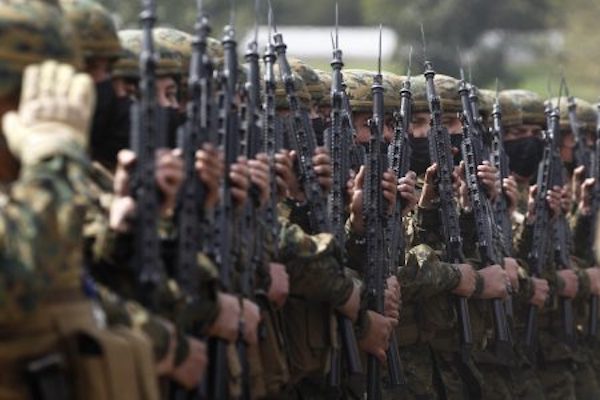
The GADFA declaration is of great importance for the defense debate. Public policies in the field of defense have been absent from the public sphere for too long. It is difficult to find defense specialists and challenging to find spaces and forums dedicated to discussing crucial issues for the future of the Republic. The challenges in defense that the future presents us are immense and very complex. It is urgent to generate synergy between Foreign Policy and Defense Policy. It is essential to clearly define the national interest and the positioning we want to achieve in the international environment. We need to discuss our presence in space, in cyberspace, in the world’s oceans, and in Antarctica. GADFA has done the opposite of what we believe is urgent and necessary for our future. With a Cold War perspective anchored in the past, it bases its support for one of the presidential candidates on an analysis of the other candidate’s program, claiming that the proposed approach is the “militarization of Chile.”
There is no popular saying more appropriate to the political circumstances we are experiencing, which, faced with two completely different political alternatives, forces us to decide which of the two options we align with, no longer having the possibility of remaining in the comfort provided by the candidates of the first round, or at the time, by the primaries of the various sectors seeking to have one of their own reach the presidency.
I say this because, in the Chilean tradition, the condition of non-deliberation of the Armed Forces, safeguarded in successive constitutional texts, has been largely accepted. It is true that this applies only to the National Defense institutions, which bear the weight of the monopoly on the use of force in our society, subordinated to the political power exercised by democratically elected civilians. It is noteworthy that the national public opinion has persistently conferred the highest levels of support and trust to the defense institutions as conceived.
In this presidential election, choosing one candidate over another is significant. If one leans towards the hard left, it must be clear that one of its main partners, or rather its main partner, is the Communist Party. This is a party that continues to defend its Marxist-Leninist doctrine, which does not respect human freedoms as many of us understand them in the Western world and subjugates the individual to the State. In communist doctrine, there is a very particular way of addressing the monopoly on the use of force that is very different from the Chilean tradition. Indeed, history is rife with examples indicating that where the Communist Party gains totalitarian power, one of its objectives is to subordinate the monopoly on the use of force to the party’s power structure. Thus, in Cuba and China, the Armed Forces depend on the General Secretary of the Communist Party and not on the Head of State. In fact, the world is filled with unfortunate examples that are worth considering if one leans towards that option. Do not forget the examples of Stalin and Lenin in the Soviet Union, Mao in China, the Castros in Cuba, Chávez and Maduro in Venezuela, Ortega in Nicaragua, Pol Pot in Cambodia, and the Kim dynasty in North Korea—all regimes that maintained or maintain power through the subordination of the Armed Forces to an ideology represented by the single party, which is the Communist Party. The euphemism used in these cases varies according to local culture, but the underlying theme remains the same. Liberation Army, Bolivarian Armed Forces, democratic Armed Forces, popular Armed Forces are names given by totalitarian leftist countries that cloak themselves in a process of “democratization” of the Armed Forces, which should be understood for what it truly is: the subordination of the institutions that hold the monopoly on the use of force to Marxist ideology.
In relation to the previous points, there is a group of Armed Forces and Defense analysts known as GADFA who recently published their public support for Gabriel Boric in this medium and others because they believe he will achieve the definitive subjugation of the Defense institutions to the interests of ideologies or extreme political parties that adhere to those ways of thinking. The other alternative is to nullify them, intervene them, or create alternative militias, with state resources, to remove the monopoly on the use of force from non-deliberative institutions, leaving a clear path for the assault on total power. For more information on the GADFA declaration and those who sign that document, see here.
There is no problem with civilian citizens, in a free and democratic country, declaring their support for a legally registered presidential candidate in general elections. What is concerning is that they do so from the perspective of the Armed Forces and National Defense, a territory that good practices and the republican tradition of Chile have sought to keep free from partisan politics. The most dangerous aspect is the arguments put forth to justify their support, as they are fallacious, partial, or outright incorrect arguments, attempting to sustain a position that has no other logic than that of totalitarian ideologies.
If we are going to discuss the Armed Forces, and particularly their roles and purposes, let us do so from the standpoint of the national interest, of what the geopolitical reality in which we are embedded demands. The most important thing is to maintain the Armed Forces in institutional roles and functions, obedient to the democratically elected civil political authority and regulating the scope of the legitimate monopoly on the use of force within the constitutional framework and the rule of law. The dynamics of supporters of ideologies and political parties tend to generate personal loyalties with their leaders and express support for a particular person to gain power. The Armed Forces, in contrast, obedient and non-deliberative, are loyal and obey the institutionality, that is, the President of the Republic, regardless of which political party they come from or what ideology they represent, as long as they comply with the Constitution and the laws of the Republic. That is the profound sense of the role of the Armed Forces and the stability provided by the monopoly on the use of force in the hands of non-deliberative entities solely concerned with the national interest that affects all Chileans.
The GADFA declaration is of great importance for the defense debate. Public policies in the field of defense have been absent from the public sphere for too long. It is difficult to find defense specialists and challenging to find spaces and forums dedicated to discussing crucial issues for the future of the Republic. The challenges in defense that the future presents us are immense and very complex. It is urgent to generate synergy between Foreign Policy and Defense Policy. It is essential to clearly define the national interest and the positioning we want to achieve in the international environment. We need to discuss our presence in space, in cyberspace, in the world’s oceans, and in Antarctica. It is urgent to consolidate integrative visions of how we will direct the country’s capabilities in the best way to safeguard our interests, deter our threats, and produce public good in security and defense. GADFA has done the opposite of what we believe is urgent and necessary for our future. With a Cold War perspective anchored in the past, it bases its support for one of the presidential candidates on an analysis of the other candidate’s program, claiming that the proposed approach is the “militarization of Chile,” which is incorrect and any reader can verify it (see), and confirm that it does not mention anything that GADFA states in its latest declaration and previous documents.
In summary, GADFA can and has the freedom to hold whatever opinion it wishes, but if they are going to have it, they should acknowledge that they are a militant group, ideologically close to Marxism, and that in the justification of their support, they do not employ academic rigor or a vision of the national interest, but rather a perspective of events that has been distorted by ideology.
Richard Kouyoumdjian
Vice President AthenaLab