The Magellanic-Antarctic continental shelf
This article was translated automatically and may contain differences from the original. For reference, read the original.
El Mostrador, Saturday, December 18, 2021
Considering that the President of the Republic has reminded us that in August his Government updated the official cartography of the continental shelf to the south and southeast of “Point F,” it is possible to understand that our country has set the task of clarifying the outer limits of the Magellanic-Antarctic continental shelf beyond the 200 nautical miles projected from the Diego Ramírez archipelagos, Cape Horn, and certain “submarine elevations.” This should allow us to link those territories with the land and seabed of the Weddell Sea and the Bellingshausen Sea. The impact on the bilateral relationship with Argentina is already evident. A fascinating challenge for the next Government.
In keeping with the commitment made in 2020, the Government has just announced the general guidelines for a “first presentation” on the extended continental shelf in the American Antarctic (for these purposes, Chilean Antarctica). This sector is part of our Magallanes and Chilean Antarctic Region.
This is a highly anticipated fact that, in itself, not only encapsulates the State’s will to reiterate—consistent with International Law—our status as an “Antarctic power,” but also demonstrates both an updated and geopolitically refreshing approach as well as a showcase of the country’s advanced geoscientific capabilities.
Extraordinary and congratulations! A measurable contribution to the ongoing interest of the Republic! (in the etymological sense).
Thus, the Government of Chile intends to ‘submit’ for analysis by the competent scientific-technical body (the Continental Shelf Limits Commission) the data and cartography that demonstrate—so far—the extension of our sovereignty beyond 200 nautical miles over the natural resources of the seabed and subsoil of the Bellingshausen Sea, which bathes the western sector of the Chilean Antarctic Territory.
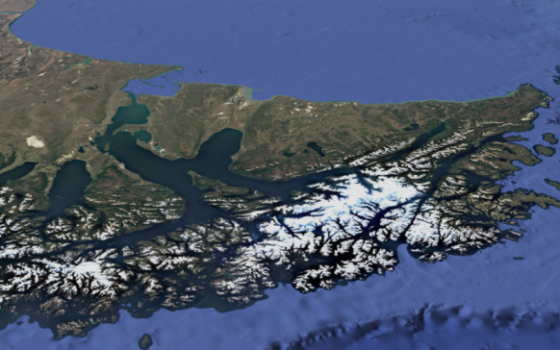
Additionally, this presentation includes a sort of “statement” of the link between the studied areas and sectors of the Magellanic-Antarctic continental shelf located north of the 60º south parallel (the limit of the application area of the Antarctic Treaty). The observer may understand that, in the future, this should allow for the connection of that sector of the seabed of the (misnamed) Drake Passage with the extension of the continental shelf of our islands located south of Tierra del Fuego, as was legally established last August with the update of the projection of the continental shelf of the Diego Ramírez and Barnevelt Islands.
Consistent with our nearly 500-year southern and Antarctic tradition, this sovereign act of the State can, justly, be understood as a legacy of the Piñera 2 administration, especially of its last chancellors, Teodoro Ribera and Andrés Allamand. Nobility obliges.
The next Government (whichever it may be) will face a task and challenge of great complexity and magnitude that, viewed from the increasing complexity of the geopolitical and geostrategic scenario in Antarctica, will compel it to prioritize this matter of profound material significance for the interest of all Chileans, without exception.
It happens that, in no way, is it guaranteed that by the end of the 2040s the Antarctic Treaty (which since 1959-61 has guaranteed Pax Antarctica) can be renewed. Along with the emergence of disruptive powers (China, Russia, etc.) in the Antarctic decision-making system, countries such as Australia, Argentina, Norway, France, and South Africa (all founders of polar cooperation) have preempted Chile in claiming rights over submarine territories within the application area of Antarctic regulations. In this regard, two cases deserve comment.
The first refers to Norway, a country that, in addition to annually awarding the Nobel Peace Prize, is the only one that, so far, claims continental shelf spaces beyond 200 nautical miles in the Arctic and Antarctic. The rights that Norway claims in Antarctica are based on activities of its whaling companies, which, it should be noted, are “less ancient” than Chilean Antarctic sealing activities and, at best, as old as the Magellanic whaling activities in Antarctica and the circumpolar Southern Ocean. Despite Norway being “a champion of international cooperation,” its claim to continental shelf in the ‘African sector’ of Antarctica (dating from 2009) is still being “reviewed” in New York by the aforementioned Continental Shelf Limits Commission.
The second is the case of Argentina, a country that in 2009 formalized a presentation that included not only an ambitious Antarctic claim (overlapping with the Chilean Antarctic Territory) but also added a “crescent” of thousands of square kilometers located south of the so-called “Point F” of the Treaty of Peace and Friendship of 1984. This aspect of the Argentine claim unilaterally extended the binational limit plus ultra that Point F (which the same treaty of 1984 defined as the “unchanging boundary” between Chile and Argentina).
Considering that the President of the Republic has reminded us that in August his Government updated the official cartography of the continental shelf to the south and southeast of “Point F,” it is possible to understand that our country has set the task of clarifying the outer limits of the Magellanic-Antarctic continental shelf beyond the 200 nautical miles projected from the Diego Ramírez archipelagos, Cape Horn, and certain “submarine elevations.” This should allow us to link those territories with the land and seabed of the Weddell Sea and the Bellingshausen Sea.
The impact on the bilateral relationship with Argentina is already evident.
A fascinating challenge for the next Government.
Jorge G. Guzmán
Associate Researcher, AthenaLab