Chile and the Crisis of Western Paradigms
This article was translated automatically and may contain differences from the original. For reference, read the original.
El Líbero, Sunday, December 19, 2021
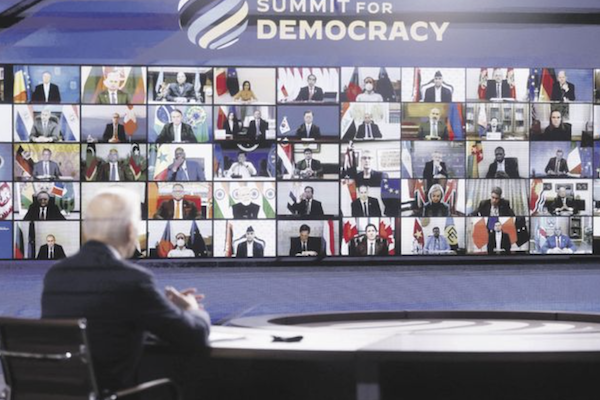
The Summit for Democracy organized by the Biden administration has passed with little fanfare, in which, it is understood, the Chilean government also participated. Everything indicates that, similar to our country, the impact of this global event has been moderate at best in Ibero-America.
This is not only related to the almost ideological division that currently prevails in our region but also to the erosion of the relative moral authority that American democracy exercised until Donald Trump’s assumption of office. Beyond its economic reforms and attempts at global realignment, the erratic behavior of the President himself and many of his close associates (investigated and documented in detail by the American press) as well as the dirty war between conservatives and Democrats (staged for television in Congress) ultimately caused structural damage to the prestige of the United States. The corollary was the Hollywood-style assault on the Capitol by a mob of Mr. Trump’s supporters during the certification ceremony of Mr. Biden’s electoral victory. An episode featuring characters from Comedy Central.
For the external observer, everything indicates that this is the new American democracy, the result of a country deeply divided between conservatives and liberal Democrats, between people from the North and the South, between the lifestyles of the East Coast versus the West Coast, between Caucasians and minorities (African Americans, Latinos, Asians, etc.), between the rich (those who realized the American dream) and the poor (those abandoned by the Grace of God), between people with university education and those without complete education (some television programs include segments to illustrate how ignorant their citizens are).
In Europe, the Summit for Democracy also failed to generate enthusiasm. For Europeans—who lack both a common foreign policy and a common defense policy—the American hesitations regarding geopolitics with Russia and that country’s interventions in Syria and Ukraine seem to be interpreted as symptoms of a crisis of identity in U.S. leadership. The unfulfilled ‘red line’ of Barack Obama in Syria (and the subsequent tsunami of refugees into Greece and other European countries), and the isolationism practiced during the Trump administration (staged at the end of 2019 during a tragicomic NATO meeting), are, among others, inescapable signs of political confusion.
The Biden administration has not managed to heal the wounds in the transatlantic relationship left by its predecessor, which, in the view of its European allies, constituted an ‘unforgivable oversight’ of the sacrifices made by many of them in the widely unpopular wars in Iraq and Afghanistan that followed the attacks on New York in 2001. The covert Republican support for the Brexit process and the recent impasse caused by Australia’s withdrawal from a contract signed with France to build a fleet of submarines (replaced by American-British submarines) has only reinforced the impression that the United States is no longer the ally it once was. Additionally, there is a certain underlying cultural disdain among Western European citizens regarding the notion that American democracy is essentially corrupt. The American press and academia have contributed to solidifying this perception.
All of this occurs while the conflict on the Ukraine-Russia border continues to escalate, the war in Syria has entered a phase of low intensity, and China—illustrated by its enormous fishing fleets that continue to cross our Strait of Magellan—continues to empower itself in global geography.
While China is now recognized as the main adversary of the United States and justifies the announcement that Washington will not attend the opening ceremony of the Winter Olympics in Beijing, the invitation to boycott that event has received comments such as those from the President of France, who has called it ‘insignificant.’ Meanwhile, Europe has long been immersed in its own identity crisis (partly generated by its expansion into Eastern Europe).
As for many other countries—and especially during the second half of the 20th century—for Chile, the American political-economic paradigm represented the aspiration, the model to follow. This was even a priority in foreign policy and trade for the ‘progressive’ governments of the former Concertación. Not only has the emergence of China as our main trading partner (after the United States endorsed its entry into the WTO) altered this perception, but the melting away of American political prestige has also moderated it.
While the above has, of course, global ideological and political consequences (one can still wonder if we are witnessing the twilight of the announced end of the American century), it also represents an opportunity to stop looking beyond our borders to find, in the most evident way, our own ‘aspiration,’ our own paradigm. At this point, Chile is a mature democracy that, with its flaws, virtues, contradictions, and complexities, is self-sufficient and capable of becoming a model in its own right.
In many respects, Chileans have repeatedly tried to define ourselves in relation to some external model: the French, the British, the German, the American, and even the Nordic. None of them find roots in our diverse and unique idiosyncrasy, which is the result of centuries of specific and special mestizaje. The Cuban and/or Bolivarian model (with its literally thousands of political prisoners and millions of economic migrants) are not alternatives either. Those who insist on these models do so more out of a profession of faith than through an analysis of the harsh reality.
The persistent search for an imported paradigm has facilitated both our ongoing identity crisis and/or growth crisis, as well as the emergence of impractical models that, when imitated (usually with great voluntarism), result in behaviors that, like the spectacle of our children dressed as ghosts asking for candy on Halloween, provoke the mockery of any visitor from the Northern Hemisphere.
The media and social networks have made evident the crisis of global leaderships and paradigms. For this reason, between the autocratic and oligarchic Russian model, or that of the Chinese one-party system, or the example of a country where Congress itself is stormed (after the outgoing President refuses to acknowledge the election results), or the case of a former world empire whose Prime Minister has normalized error and excess (and specializes in apologizing), perhaps the best option is the most
evident: the Chilean model that we should all finish defining.
Jorge Guzmán
Associated Researcher, AthenaLab


