Violence settles in the collective imagination
This article was translated automatically and may contain differences from the original. For reference, read the original.
El Líbero, January 8, 2022
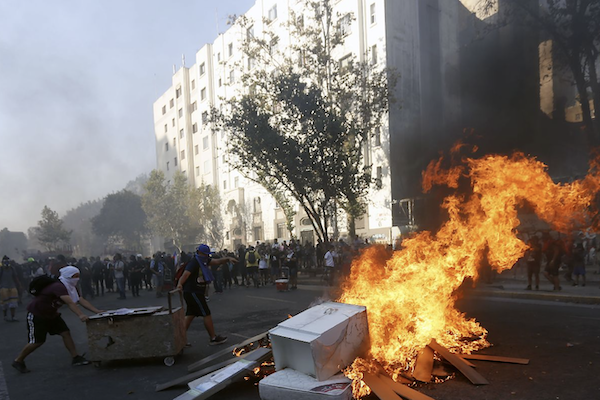
Since October 2019, violence has been established as a means to achieve objectives. The pandemic provided a respite for many, but there remained the question of whether it had been validated as a method of political action or not. The consensus among the population is clear: there is a high concern for security. The recent Bicentennial Survey confirms this: 64% of the sample in the Metropolitan region believes that violence exists in the country and that it must be taken very seriously because it threatens to destroy institutional order. So far, so good. But what happens when we look at the details of the data?
The perception of insecurity among the population is widely shared. Moreover, scenes such as the looting of MercadoLibre warehouses do not help. The constant coverage of murders, clashes between criminal gangs, drug trafficking, etc., also does not help. We are bombarded with criminal information that would leave anyone paranoid. But in reality, how much do we justify the use of violence? Do we trust those who are supposed to provide us with security?
The State is responsible for providing security to the population so that it can achieve development and well-being. In this sense, the data presented by UC is not very optimistic: expectations regarding achieving development have decreased, while the validation of the use of violence has increased.
Between one-fifth and one-quarter of the population justifies its use to achieve salary improvements, enhance living conditions, and defend the environment, while only 30% validate the use of force by the State in the event of looting, 21% for roadblocks and barricades, and 16% during protests. On one hand, we demand security and recognize that violence threatens institutions, but on the other hand, we reject that those who legitimately hold the monopoly on force use it to restore the rule of law that ensures peace and stability for citizens.
The trust that citizens have in the State is a relevant aspect. The percentage of the population that trusts the three branches of government is less than 10%. The lowest indicator belongs to Congress with 4%. The most validated institutions are the Armed Forces with 20%, far from the 49% they had in 2011, and Carabineros with 17%. Here lies the dilemma! We identify violence as a threat to institutional order, justify it for causes related to quality of life, and do not trust the institutions that should provide security. It seems that it has settled in the collective imagination, transforming into a method of political action to demand well-being and development.
Attacks in the south for “ancestral demands,” looting in cities, protests to demand better pensions, and an increase in murders in the northern macrozone are some manifestations of violence in the country, which, according to the data presented by the survey, appears to be here to stay, at least for a while.
The challenges in this area are many. Trust in institutions is urgent. Validating the State as responsible for social peace is fundamental to advance toward those balances that are so important for development. The Social Contract is being tested, the eyes of the world are watching the constitutional process and the new government’s ability to reach consensus that leaves behind conflict, the cornerstone of the future Chile.
Crises in ancient Greece were seen as a turning point for the creation of something better. An opportunity to build. Let us not lose sight of this and, from constructive criticism and the lessons learned, pave the best path to development.


