Antarctica after 2048
This article was translated automatically and may contain differences from the original. For reference, read the original.
El Mostrador, January 20, 2022
In effect since 1961, the Antarctic Treaty was initially conceived to last 30 years. After this period, the countries that make up its system approved an Environmental Protocol (Madrid Protocol) to extend the “Pax Antarctica” for another 50 years (in effect after 1998). Thus, in 2048, a period will begin during which the Antarctic Treaty (along with its entire regulatory system) could be subject to review at the request of any of its Consultative Parties.
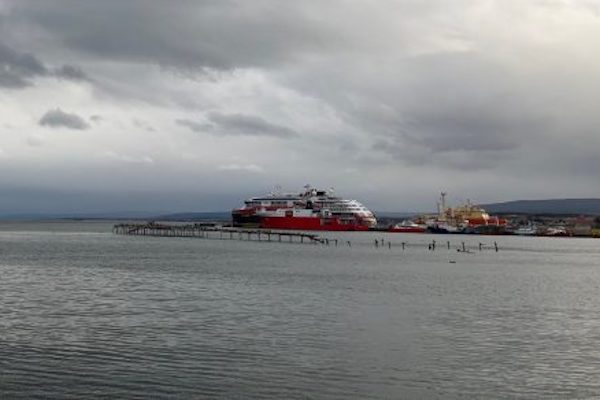
As the austral summer progresses, the bay of Punta Arenas once again welcomes a group of polar vessels engaged in supplying bases and scientific projects, all instrumental in strengthening the “presence” of those countries operating in Antarctica. Among the vessels that frequently use the Strait of Magellan as a logistical point are an icebreaker and a support oceanographic ship from the Brazilian navy, and a newly constructed icebreaker from the Peruvian navy.
From a strictly political perspective, the presence of these vessels in Chilean southern waters should be understood as a manifestation of the willingness of both countries to be part of the “group of States that governs Antarctica” and, in a catastrophic scenario for polar cooperation, a “precedent” for participating in the distribution of the Southern Polar Region. It’s that simple.
In the case of Brazil (and later also Peru and Ecuador), the inspiring principle of such ambitions lies in the so-called “theory of defrontation,” a Brazilian geopolitical invention from the 1950s, conceived in the context of the rivalry generated by the “Antarctic claims” of the United Kingdom, Argentina, and Chile—which even prompted a British “invitation” to submit the matter to the jurisdiction of the International Court of Justice (1947-1956). As is known, this circumstance was later overcome by the political and scientific cooperation of the International Geophysical Year (1957-1958) and subsequently by the negotiation and implementation of the Antarctic Treaty (in which neither Brazil, Peru, nor Ecuador participated).
Only in 1975, 1981, and 1987, respectively, did these South American countries adhere to the Antarctic Treaty (and its regulatory “System”), in which—again respectively—only since 1983, 1989, and 1990 do they have the status of “Consultative Party” (voice and vote in the decision-making system).
It is noteworthy that in 1987, six years after acquiring Consultative status, with a Decree establishing its Antarctic Policy, the Government of Brazil formalized its intention to “protect its direct and substantial rights in Antarctica,” hinting that such “rights” could be “exercised” if the Antarctic Treaty were not in force. Equally interesting is that Brazil’s current National Defense Policy stipulates that, while one of its objectives is to access all decision-making mechanisms of the international system, Brazilian interests in Antarctica have a special character, as it is a region with “significant reserves” of natural resources, along with the South Atlantic.
A somewhat different approach occurs in the case of Peru, a “southern hemisphere” country that, due to “ecological and historical” factors, considers itself projected towards Antarctica. For now, the Peruvian approach seems focused on polar cooperation, at least while the Antarctic Treaty remains in effect.
In addition to Brazil, Peru, and Ecuador, at different times and with varying “intensity,” Uruguay and even Colombia have “hovered” over the utility of the “theory of defrontation,” a sort of extrapolation of the so-called “sector principle.”
Originally conceived in the early 20th century to resolve the issue of Canada’s borders in the Arctic, between 1908-1933 the “sector principle” was employed by the British government to set the limits of its “territories” in West Antarctica and in the Australian and New Zealand sectors of the Southern Polar Region. Invoking various titles and also applying the so-called “hinterland” principle (used by European powers in the 19th century to set the limits of their African colonies), the British “claims” referenced certain longitudes along the circumpolar coast, within which land areas extend into the “hinterland,” hence, towards the South Pole. With that precedent, already in 1926 the Soviet Union established the limits of its Arctic territories between the Kola Peninsula and the Barents Sea, and the northeastern tip of Siberia over the Bering Strait. Adding what Soviet geopolitics termed the “principle of gravitation of land spaces” (continental shelf included) and the concept of “area of attraction,” since then the Soviet territorial claim extended to the North Pole itself. It is with this precedent that, in December 2001, Russia became the first country to use the regulations of the United Nations Convention on the Law of the Sea to “claim” millions of square kilometers of underwater territories, including the Arctic Pole.In Antarctica, the sector principle has been used not only by the United Kingdom and its former colonies Australia, New Zealand, and South Africa, but also by Norway, France, and Argentina. Likewise, and as mentioned, through an extrapolation of this concept (the “theory of defrontation”), Brazil and other South American countries seek to “reserve” rights in Antarctica.
The Chilean case is different and, especially in languages other than Spanish, almost unknown. Particularly, Anglo-Saxon literature tends to reduce the Chilean argument to the stereotype of the Alexandrian Bulls (1493), the Treaty of Tordesillas (1494), and the principle of “uti possidetis” (1810). A gross error. While the Antarctic Decree of 1940 bears some similarity to the Soviet Decree of 1926, in practice, this act of the Chilean state established—only—the outer limits of a polar territory geographically and environmentally linked to the rest of the country, in which, moreover, the permanent presence of its nationals and their enterprises predates the first scientists and the oldest of the “Antarctic claims.”
From a general perspective, the essentially geopolitical approach that Brazil applies to the Antarctic situation (with an emphasis on post-2048 scenarios) is useful to verify—once again—that while political and scientific polar cooperation continues each year, various States have begun to prepare for a circumstance in which the Antarctic Treaty is no longer in effect.
In effect since 1961, the Antarctic Treaty was initially conceived to last 30 years. After this period, the countries that make up its system approved an Environmental Protocol (Madrid Protocol) to extend the “Pax Antarctica” for another 50 years (in effect after 1998). Thus, in 2048, a period will begin during which the Antarctic Treaty (along with its entire regulatory system) could be subject to review at the request of any of its Consultative Parties. After that date, any revision must be approved by a simple majority of the Parties, among which, however, must include ¾ of the Consultative Parties of the Treaty at the time of the approval of the Protocol (28 countries). If this quorum
is not reached, after three years without the amended Treaty being ratified by at least 22 of the countries that had consultative status in 1998, any country may withdraw from the Protocol (and ultimately from the Antarctic Treaty System). In such a scenario—and provided that the prohibition on mining activities must then be included in a “legally binding regime”—after another two years, that country could, at least hypothetically, initiate mining activities in Antarctica (2053). In other words, starting in 2048, it will be sufficient for one country’s initiative and a minority of 7 governments for, following a theoretically failed revision of the Treaty, the “Pax Antarctica”—as we have known it since 1959-61—cease to be in effect. A catastrophic scenario.
Moreover, it is known that Russia, China, and India (and probably other Consultative Parties) continue to show interest in the exploitation of Antarctic natural resources (in addition to the well-known fishing wealth of the Southern Ocean, certain studies claim that south of latitude 60° south there are no less than 203 billion barrels of hydrocarbons), the inclusion of Antarctica in the arena of the “new Cold War” and the reaffirmation of territorial claims through the implementation of international law regarding the continental shelf beyond 200 miles, make the concern for the future of polar cooperation after 2048 an issue of growing importance for national interest.
In the final part of the current Government, Chile has managed to respond to this developing scenario by specifying the limits of its continental shelf in some areas south of Cape Horn. So that in a catastrophic (and undesirable) scenario our country is not only in a position to assert its sovereign rights but also has the management capacity to deter other countries that are less committed or have a double discourse, it is essential that Chilean rights continue to be reinforced through the implementation of the Antarctic Statute and the geoscientific work that must demonstrate that, in accordance with international law, Chile is effectively a continuation from and towards Antarctica. Not doing so (and informing it urbi et orbi
) would constitute a renunciation of the initiative that has always characterized the Chilean contribution to Antarctic governance. No principle, concept, or geopolitical or economic ambition, old or new, should prevent decades invested in building and strengthening Antarctic cooperation from giving way to a period of uncertainty and instability with consequences that are difficult to imagine.
The same apprehension should be valid for initiatives that—drawing on the regimes for seabed resources, the moon, or outer space—wish to turn the Southern Polar Region into a “common heritage of humanity,” replacing the current governance system with one that—unlike this one—is unproven and, for that reason, cannot be assumed to have the experience or capabilities of the one that has ensured for seven decades that Antarctica is not only a demilitarized and denuclearized region but also “a new southern world” open to research and political cooperation.
It is already necessary and convenient to think about what could happen in Antarctica starting in 2048. Jorge GuzmánAssociated Researcher, AthenaLab
Investigador asociado AthenaLab
Investigador asociado AthenaLab
Investigador asociado AthenaLab
Investigador asociado AthenaLab


